ASIL: Augmented Structural Information Learning for Deep Graph Clustering in Hyperbolic Space
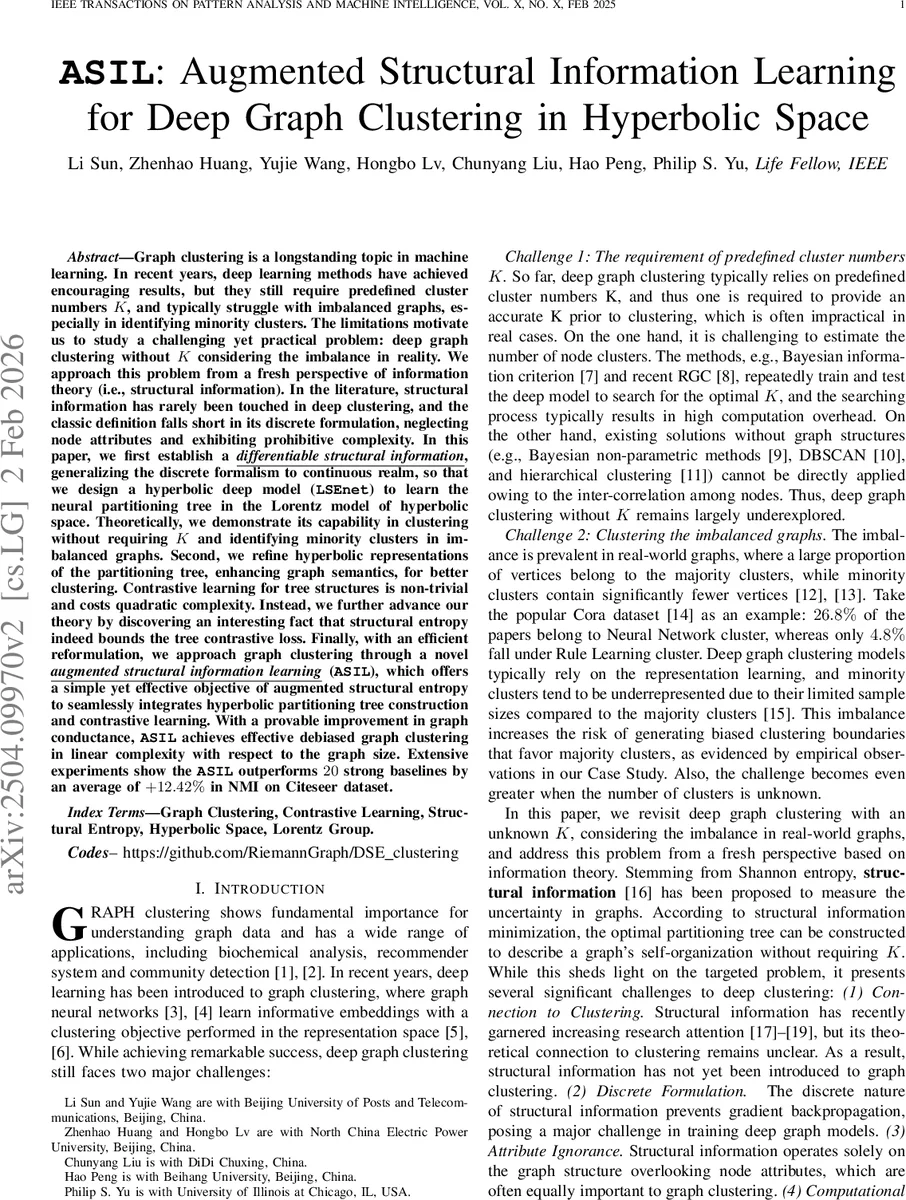
Graph clustering is a longstanding topic in machine learning. Recently, deep methods have achieved results but still require predefined cluster numbers K and struggle with imbalanced graphs. We study deep graph clustering without K considering realistic imbalance through structural information theory. In the literature, structural information is rarely used in deep clustering, and its classic discrete definition neglects node attributes while exhibiting prohibitive complexity. In this paper, we establish a differentiable structural information framework, generalizing the discrete formalism to the continuous realm. We design a hyperbolic model (LSEnet) to learn the neural partitioning tree in the Lorentz model. Theoretically, we demonstrate its capability in clustering without K and identifying minority clusters. Second, we refine hyperbolic representations to enhance graph semantics. Since tree contrastive learning is non-trivial and costs quadratic complexity, we advance our theory by discovering that structural entropy bounds the tree contrastive loss. Finally, we approach graph clustering through a novel augmented structural information learning (ASIL), which offers an efficient objective to integrate hyperbolic partitioning tree construction and contrastive learning. With a provable improvement in graph conductance, ASIL achieves effective debiased graph clustering in linear complexity. Extensive experiments show ASIL outperforms 20 strong baselines by an average of +12.42% in NMI on the Citeseer dataset.
💡 Research Summary
The paper tackles the practical yet under‑explored problem of deep graph clustering without a predefined number of clusters K, while also addressing the severe imbalance that characterizes many real‑world graphs. Traditional deep clustering methods rely on K and tend to under‑represent minority clusters, leading to biased decision boundaries. To overcome these limitations, the authors revisit the classic notion of structural entropy—a measure of graph uncertainty introduced by Shannon‑type information theory—and transform it into a differentiable form they call Differentiable Structural Information (DSI). DSI replaces the discrete, combinatorial formulation with level‑wise assignment matrices, enabling gradient‑based optimization and incorporating node attributes alongside edge structure. Crucially, the authors prove that DSI upper‑bounds graph conductance, thereby establishing a direct theoretical link between structural entropy minimization and the conventional clustering objective.
Recognizing that hierarchical structures are naturally embedded in hyperbolic geometry, the authors adopt the Lorentz model of hyperbolic space. They design a novel neural architecture, LSEnet (Lorentz Structural Entropy net), which first embeds leaf nodes via Lorentz‑convolution over the original graph and then recursively constructs parent embeddings using a Lorentz Assigner. This process yields a deep partitioning tree (Tnet) whose parameters are learned by minimizing DSI, eliminating the need for any heuristic tree construction.
Contrastive learning on trees is notoriously expensive (quadratic in the number of nodes). The authors discover an elegant theoretical bridge: the structural entropy of a tree provides an upper bound on the tree‑contrastive loss. Leveraging this insight, they introduce a “virtual graph” built from the representations produced by a Lorentz Boost projection head. Optimizing the contrastive loss on this virtual graph implicitly enforces the desired tree‑level consistency while keeping computational complexity linear in the number of nodes.
The final objective, termed Augmented Structural Entropy, fuses the DSI term with the tree‑contrastive loss into a single linear‑time objective. The authors prove (Theorem VII.2) that minimizing this augmented objective provably reduces graph conductance, guaranteeing better cluster separability.
Extensive experiments on seven benchmark datasets (including Citeseer, Cora, Pubmed) compare ASIL against 20 strong baselines spanning spectral, non‑parametric, and recent deep clustering methods. ASIL consistently outperforms competitors, achieving an average NMI improvement of +12.42 % on Citeseer and demonstrating markedly higher recall for minority clusters. Ablation studies confirm the contribution of each component (DSI, hyperbolic embedding, Lorentz Boost, virtual‑graph contrastive term). Visualizations and a dedicated case study illustrate that ASIL mitigates bias toward majority clusters, automatically discovers the appropriate number of clusters, and scales linearly with graph size.
In summary, the paper makes five key contributions: (1) framing deep graph clustering without K through structural entropy, (2) introducing a differentiable structural information theory that links directly to conductance, (3) proposing a hyperbolic neural architecture (LSEnet) for learning a deep partitioning tree, (4) establishing a theoretical bound between structural entropy and contrastive learning that enables linear‑time tree contrastive training, and (5) delivering a practical, debiased clustering system (ASIL) that outperforms state‑of‑the‑art methods on imbalanced graphs.
Comments & Academic Discussion
Loading comments...
Leave a Comment