Active Screws: Emergent Active Chiral Nematics of Spinning Self-Propelled Rods
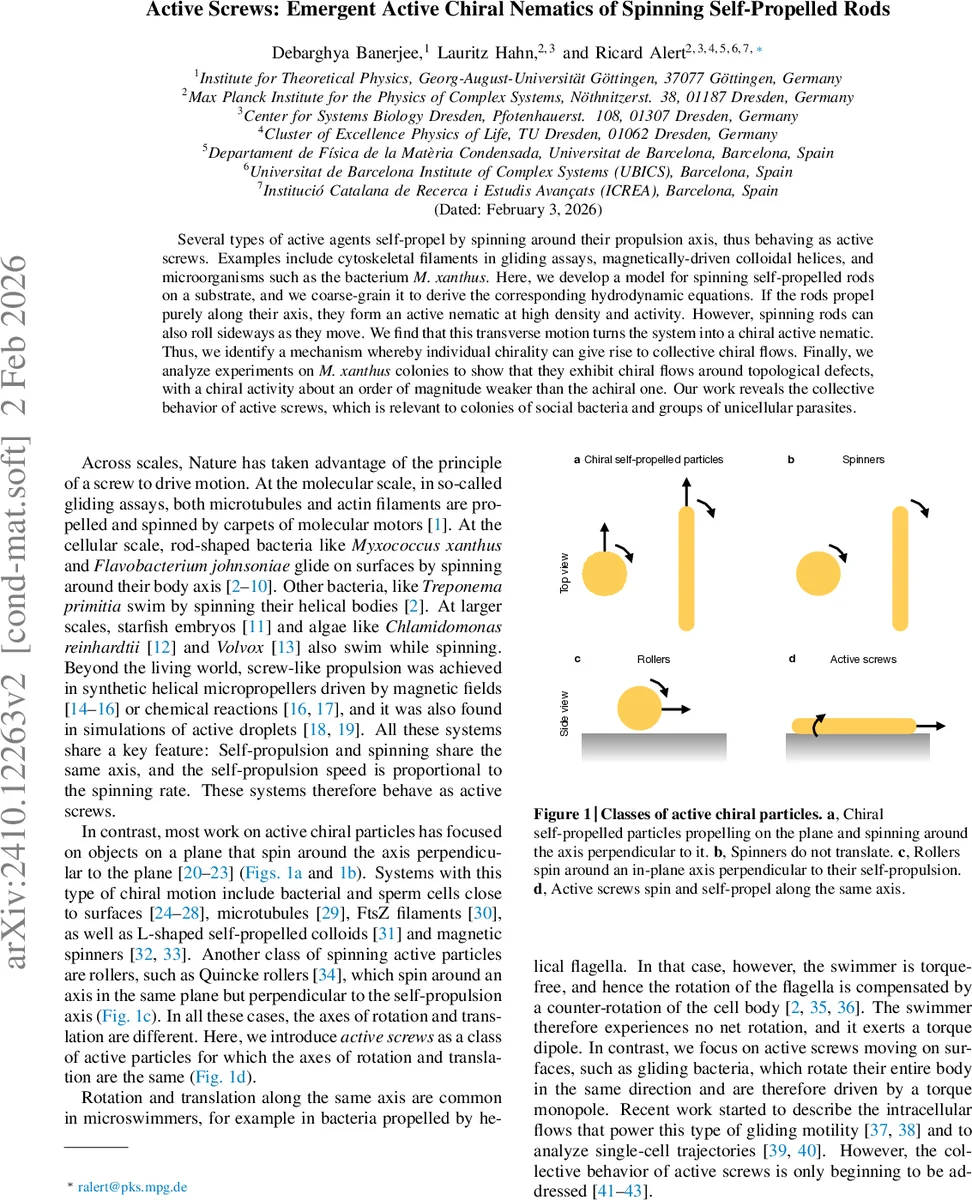
Several types of active agents self-propel by spinning around their propulsion axis, thus behaving as active screws. Examples include cytoskeletal filaments in gliding assays, magnetically-driven colloidal helices, and microorganisms like the soil bacterium $\it{M. xanthus}$. Here, we develop a model for spinning self-propelled rods on a substrate, and we coarse-grain it to derive the corresponding hydrodynamic equations. If the rods propel purely along their axis, they form an active nematic at high density and activity. However, spinning rods can also roll sideways as they move. We find that this transverse motion turns the system into a chiral active nematic. Thus, we identify a mechanism whereby individual chirality can give rise to collective chiral flows. Finally, we analyze experiments on $\it{M. xanthus}$ colonies to show that they exhibit chiral flows around topological defects, with a chiral activity about an order of magnitude weaker than the achiral one. Our work reveals the collective behavior of active screws, which is relevant to colonies of social bacteria and groups of unicellular parasites.
💡 Research Summary
The paper introduces a new class of active matter, “active screws,” which are self‑propelled rods that rotate around the same axis along which they translate. The authors first construct a microscopic model in which each particle i possesses a spinning rate (\dot\varphi_i) driven by a constant intrinsic spin (\omega) and a dichotomous noise (\Phi_i(t)) that flips with average frequency (f_{\rm rev}). Neighboring particles exchange spin torque (\tau_{ij}) proportional to the sum of their spinning rates and to the cosine of the angle between their orientations, with a distance‑dependent strength (\tau_r(r)). The translational velocity has two components: a forward component (v_i^{\parallel}= \ell_{\parallel}\dot\varphi_i) along the rod axis and, if the rod can roll, a transverse component (v_i^{\perp}= \ell_{\perp}\dot\varphi_i) perpendicular to the axis (implemented via the Levi‑Civita tensor).
The equations of motion read
\
Comments & Academic Discussion
Loading comments...
Leave a Comment