Compact LED-Based Displacement Sensing for Robot Fingers
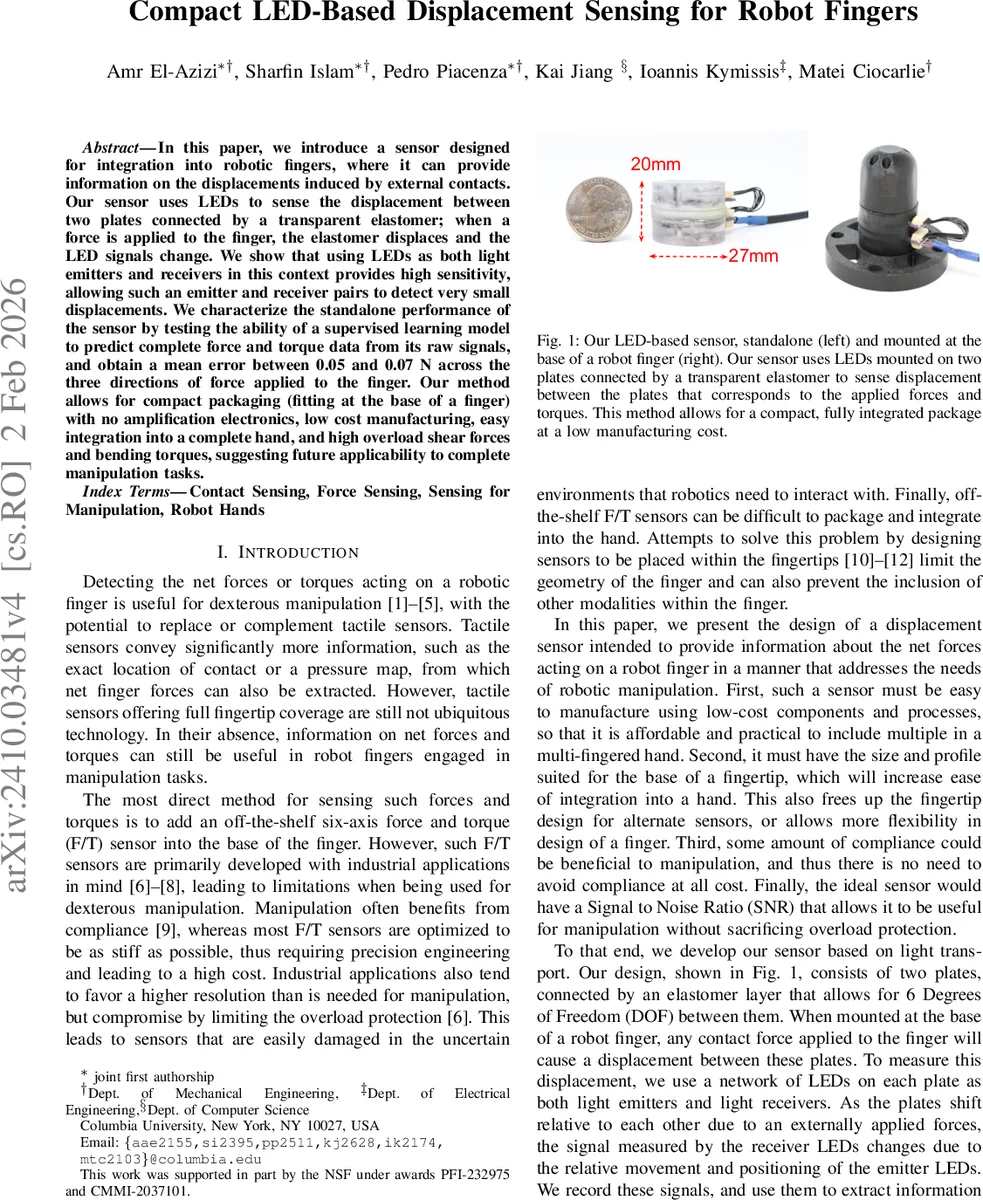
In this paper, we introduce a sensor designed for integration in robot fingers, where it can provide information on the displacements induced by external contact. Our sensor uses LEDs to sense the displacement between two plates connected by a transparent elastomer; when a force is applied to the finger, the elastomer displaces and the LED signals change. We show that using LEDs as both light emitters an receivers in this context provides high sensitivity, allowing such an emitter and receiver pairs to detect very small displacements. We characterize the standalone performance of the sensor by testing the ability of a supervised learning model to predict complete force and torque data from its raw signals, and obtain a mean error between 0.05 and 0.07 N across the three directions of force applied to the finger. Our method allows for finger-size packaging with no amplification electronics, low cost manufacturing, easy integration into a complete hand, and high overload shear forces and bending torques, suggesting future applicability to complete manipulation tasks.
💡 Research Summary
The paper presents a compact, low‑cost displacement sensor designed to be mounted at the base of robotic fingers, providing full 6‑DOF force/torque information using only light‑based sensing. Two rigid plates are connected by a transparent elastomer (PDMS) that permits six degrees of freedom. Each plate carries a custom PCB populated with infrared LEDs (SFH‑4056) that act simultaneously as emitters and receivers. When an external contact force deforms the elastomer, the relative motion of the plates changes the amount of light from each emitter that reaches its corresponding receiver LED, producing a measurable change in photocurrent.
A key contribution is the demonstration that LEDs used as receivers outperform conventional photodiodes: the LED‑LED pair exhibits a ten‑fold higher signal‑to‑noise ratio and can resolve displacements as small as 0.01 mm, whereas the photodiode signal remains buried in noise. This high sensitivity, combined with the tiny footprint of LEDs, enables a dense array of 12 sensing channels (six emitters, six receivers) within a 27 mm diameter, 20 mm height package that weighs only 16.4 g.
Electronics are kept minimal: an on‑board 12‑channel ADC digitizes the raw LED currents, and the data are transmitted over a 7‑wire SPI bus, eliminating the need for external amplification and reducing wiring complexity. The sensor operates up to 2.5 kHz, providing bandwidth suitable for dynamic manipulation tasks.
For calibration, the authors mounted the sensor on a commercial six‑axis force/torque (F/T) transducer and collected synchronized LED signals and ground‑truth wrench data while applying a wide range of forces and torques. Supervised learning models (linear regression and neural networks) were trained to map the 12‑dimensional LED signal vector to the six wrench components. The best model achieved mean force errors of 0.05–0.07 N and mean torque errors of 0.06 N·m, with coefficient‑of‑determination (R²) values of 0.937 (Fx), 0.909 (Fy), 0.998 (Fz), 0.984 (Mx), 0.984 (My), and 0.991 (Mz). Accuracy is especially high for forces in the x‑y plane and for all torque axes; prediction of the z‑axis force is weaker due to reduced optical sensitivity to vertical displacement.
Mechanical robustness was evaluated by subjecting five fabricated sensors to failure tests in shear, bending, torsion, tension, and compression using an Instron machine. The sensor withstood shear forces up to 110 N and bending torques up to 1.62 N·m before failure, while tension was the weakest mode—acceptable because a finger base rarely experiences large tensile loads. Hysteresis tests with cyclic 1 mm displacements revealed a repeatable ~5 % hysteresis, attributable to the viscoelastic nature of PDMS; this can be compensated in software with hysteresis‑aware calibration.
Compared against other low‑cost 6‑axis sensors (barometer‑based, camera‑based, and capacitive designs), the proposed LED‑LED sensor offers a unique combination of ultra‑compact size, sub‑$100 bill‑of‑materials (in low volumes), high bandwidth, and strong overload protection, all without external amplification electronics. The use of an opaque rubber shrink‑wrap sleeve further shields the device from ambient light and adds mechanical stiffness.
The authors argue that such a sensor can be mass‑produced and easily integrated into multi‑fingered robotic hands, either as a standalone wrench estimator or in conjunction with high‑resolution tactile arrays on the fingertip. By providing reliable net force/torque feedback at the finger base, the sensor enables more dexterous manipulation, better grasp stability, and the possibility of closed‑loop force control without the bulk and cost of traditional six‑axis F/T transducers.
Comments & Academic Discussion
Loading comments...
Leave a Comment