Optimally Packing a Large Square by Unit Squares
We show that a large square of sidelength $x$ can be packed by unit squares in a manner so that the wasted space $W(x) = O(x^{3/5})$.
💡 Research Summary
The paper addresses the classic geometric packing problem of covering a large square of side length $x$ with unit squares while minimizing the uncovered (wasted) area $W(x)$. The authors claim to improve the best known upper bound on $W(x)$ from $O!\bigl(x^{3+\sqrt{2}/7}\log x\bigr)$ (the result of Chung and Graham in 2009) down to $O(x^{3/5})$.
Background and Motivation
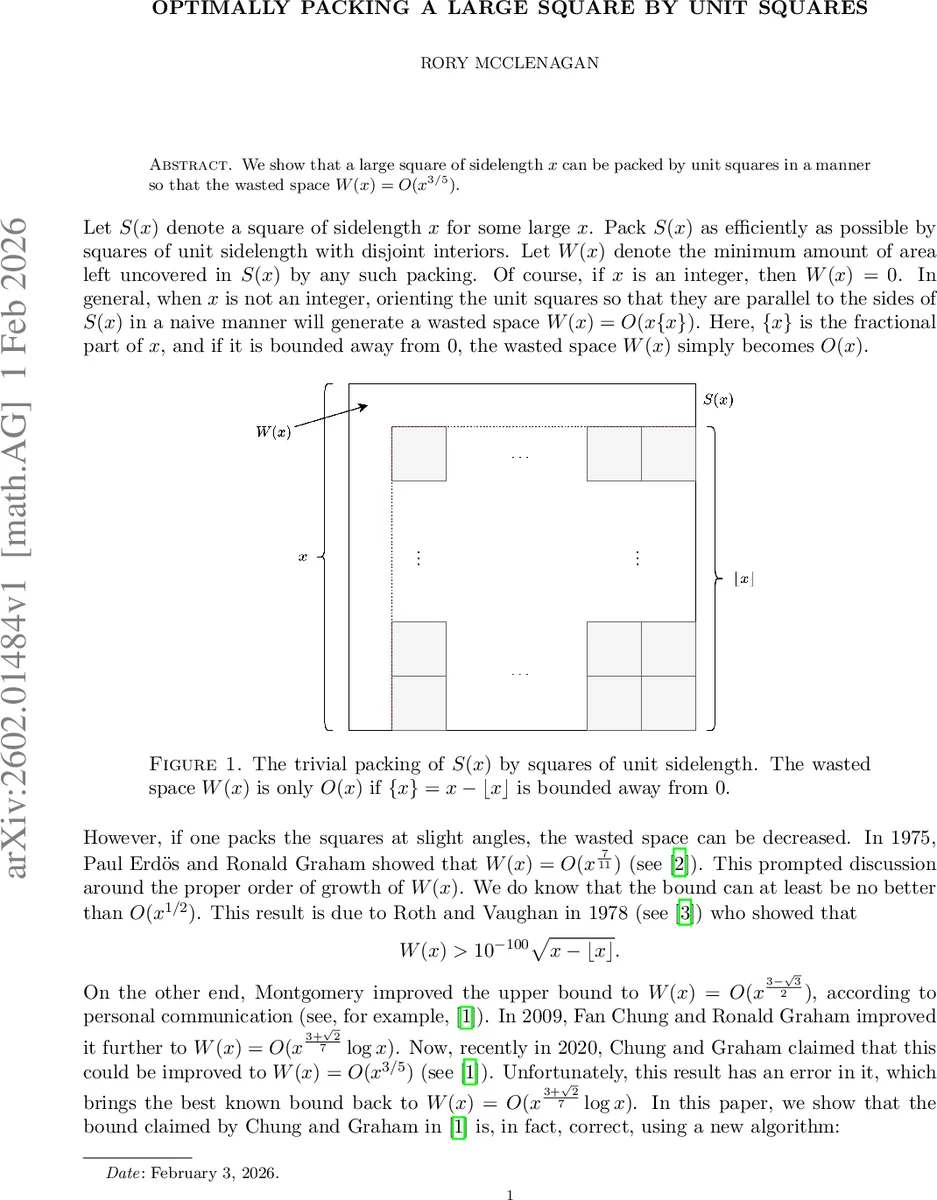
The introduction surveys the historical development of bounds for $W(x)$. Erdős and Graham (1975) proved $W(x)=O(x^{7/11})$, Roth and Vaughan (1978) gave a lower bound of order $x^{1/2}$, Montgomery later obtained $O!\bigl(x^{3-\sqrt{3}/2}\bigr)$, and Chung–Graham refined the upper bound to $O!\bigl(x^{3+\sqrt{2}/7}\log x\bigr)$. The authors note that the trivial axis‑aligned packing yields $W(x)=O!\bigl(x{x}\bigr)$, which can be as large as $O(x)$ when the fractional part ${x}$ is bounded away from zero. By allowing the unit squares to be placed at slight angles, one can reduce the waste, a technique first exploited by Erdős–Graham.
High‑Level Idea
The new algorithm proceeds in four stages:
-
Initial Stacking and Creation of a Trapezoidal Gap
The square $S(x)$ is first filled with axis‑parallel unit squares, leaving two thin rectangular strips of width $h$. One of these strips, called $R$, is then filled with “stacks” of $n$ unit squares that are inclined by a small angle $\theta$ so that each stack touches both the top and bottom of $R$. By choosing $n$ such that $1<n-h\ll1$, a Taylor expansion shows $\theta\approx1/\sqrt{h}$. This operation leaves, at each end of $R$, a small trapezoidal region $T$ of height $h$ that remains uncovered. -
First Sub‑Algorithm (Angle $\phi$)
Inside a trapezoid $T$ the authors place a near‑horizontal stack $H_0$ inclined by an angle $\phi$ against the left (vertical) wall, and a near‑vertical stack $V_0$ against the right (inclined) wall. Both stacks contain $m$ unit squares. Subsequent stacks $H_i$ and $V_i$ contain $m-i$ squares for $i=0,\dots,m-1$, forming a stair‑case pattern that fills most of $T$ except for a thin triangular strip at the top. The angle $\phi$ is defined implicitly by the equation
\
Comments & Academic Discussion
Loading comments...
Leave a Comment