Chasing the Tides: Searching for Orbital Decay Signatures in Transit Timing Data and Tidal Models for 20 Hot Jupiters
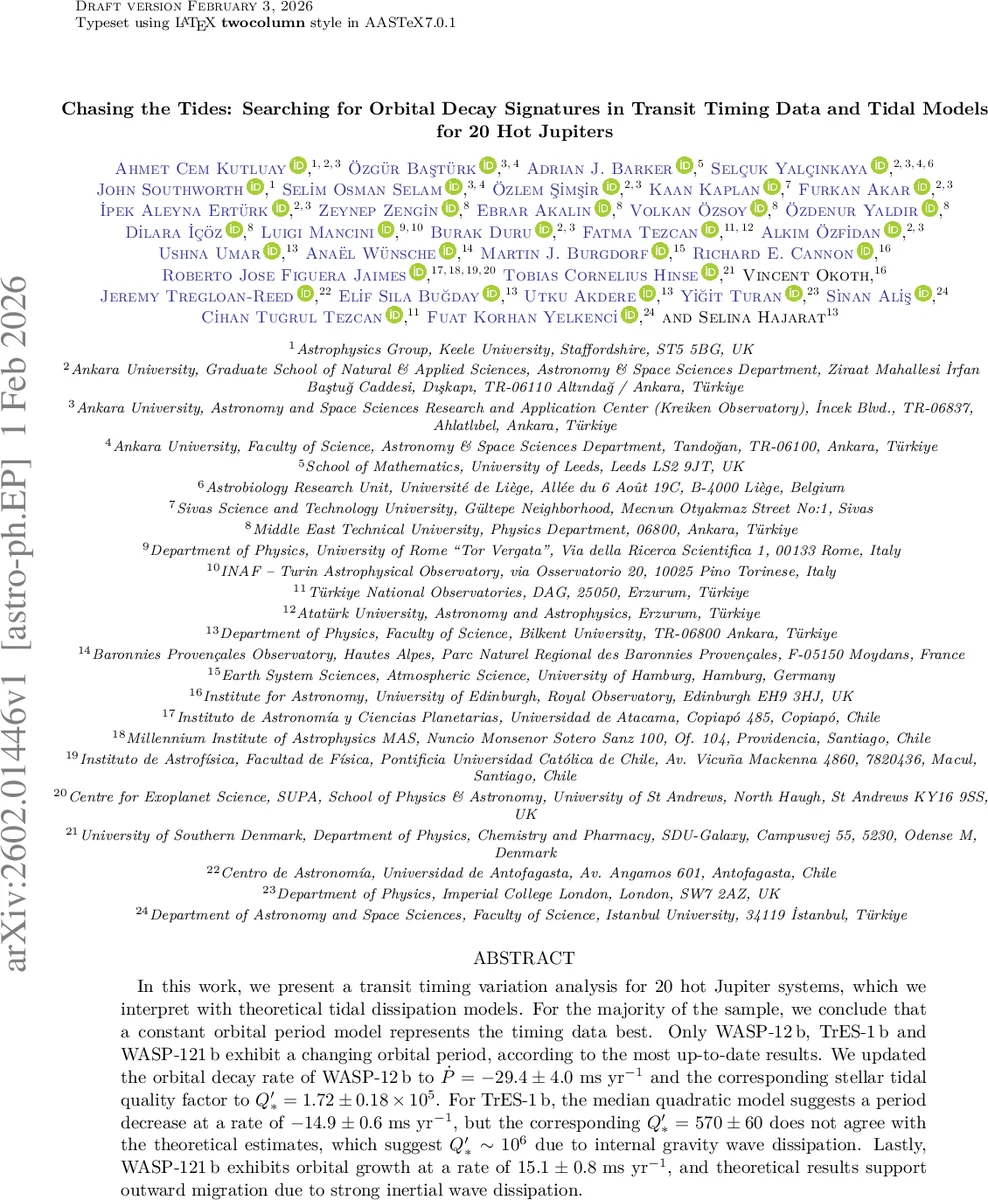
In this work, we present a transit timing variation analysis for 20 hot Jupiter systems, which we interpret with theoretical tidal dissipation models. For the majority of the sample, we conclude that a constant orbital period model represents the timing data best. Only WASP-12 b, TrES-1 b and WASP-121 b exhibit a changing orbital period, according to the most up-to-date results. We updated the orbital decay rate of WASP-12 b to $\dot{P} = -29.4 \pm 4.0 \mathrm{msyr^{-1}}$ and the corresponding stellar tidal quality factor to $Q_^{\prime} = 1.72 \pm 0.18 \times 10^5$. For TrES-1 b, the median quadratic model suggests a period decrease at a rate of $-14.9 \pm 0.6 \mathrm{msyr^{-1}}$, but the corresponding $Q_^{\prime} = 570 \pm 60$ does not agree with the theoretical estimates, which suggest $Q_*^{\prime} \sim 10^6$ due to internal gravity wave dissipation. Lastly, WASP-121 b exhibits orbital growth at a rate of $15.1 \pm 0.8 \mathrm{msyr^{-1}}$, and theoretical results support outward migration due to strong inertial wave dissipation.
💡 Research Summary
This paper presents a comprehensive transit‑timing‑variation (TTV) study of twenty hot‑Jupiter (HJ) systems, coupling the observed timing data with state‑of‑the‑art tidal‑dissipation theory. The authors first assembled a homogeneous set of mid‑transit times from space‑based missions (TESS, CHEOPS) and ground‑based facilities, extending the baseline to roughly 5–10 years for most targets. They then fitted each system with two competing ephemeris models: a linear (constant period) model and a quadratic model that allows a secular change in the orbital period (dP/dt). Model comparison employed Bayesian Information Criterion (BIC) and Akaike Information Criterion (AIC) together with Markov‑Chain Monte‑Carlo (MCMC) posterior sampling, while an additional jitter term accounted for unmodelled systematic errors.
The majority of the sample (17 out of 20) is best described by a constant‑period ephemeris; their derived dP/dt values are statistically consistent with zero (± 1–3 ms yr⁻¹). Only three systems show a significant period drift: WASP‑12 b, TrES‑1 b, and WASP‑121 b. For WASP‑12 b the authors obtain an updated decay rate of (\dot P = -29.4 \pm 4.0) ms yr⁻¹, which translates to a stellar modified tidal quality factor (Q’_\star = 1.72 \pm 0.18 \times 10^{5}). This low Q′ is consistent with the star being near the end of its main‑sequence life, where the expanding convective envelope and deepening radiative core enhance tidal dissipation, especially through inertial‑wave (IW) excitation.
TrES‑1 b exhibits a median quadratic fit indicating a period decrease of (\dot P = -14.9 \pm 0.6) ms yr⁻¹, corresponding to an implausibly low (Q’\star = 570 \pm 60). Theoretical expectations for a G‑type star of this age, where internal gravity wave (IGW) breaking should dominate, predict (Q’\star \sim 10^{6}). The authors discuss three possible explanations: residual systematics in the timing data, an atypically rapid stellar rotation or unusual internal structure that boosts IGW efficiency, or the presence of additional dissipation channels (e.g., magneto‑gravity waves, non‑linear wave breaking) not captured in current models.
WASP‑121 b shows a positive period derivative, (\dot P = +15.1 \pm 0.8) ms yr⁻¹, indicating outward migration. The inferred (Q’_\star) is of order (10^{4}), pointing to extremely efficient IW dissipation. This system’s host star rotates rapidly (≈ 1‑day period) and is close to the sub‑giant phase, conditions under which inertial waves can extract angular momentum from the star and deposit it into the planetary orbit, causing the observed expansion.
To interpret the observations, the authors compute theoretical Q′ values for three tidal mechanisms: equilibrium tides (Q′eq ≈ 10⁸, negligible for HJs on the main sequence), inertial waves (Q′IW derived from the frequency‑averaged formalism of Ogilvie & Lin 2007 and Barker 2020), and internal gravity waves (Q′IGW from the wave‑breaking criterion of Barker & Ogilvie 2010). They combine these via the reciprocal sum (1/Q’ = 1/Q’{\rm eq} + 1/Q’{\rm IW} + 1/Q’{\rm IGW}) to obtain an effective dissipation factor for each star, using stellar structure parameters extracted from MESA evolutionary models.
The paper emphasizes that the tidal quality factor is highly sensitive to stellar radius (scaling as (R_\star^{-5}) in the quadrupole term) and to the rotation rate (through the IW frequency window). Consequently, stars evolving off the main sequence can experience orders‑of‑magnitude reductions in Q′, explaining why WASP‑12 b and WASP‑121 b display strong tidal signatures while most other HJs do not.
In the discussion, the authors note that the current TTV baselines are insufficient to detect the modest dP/dt expected for typical Q′ ≈ 10⁶ systems. They advocate for continued high‑precision timing with upcoming facilities such as JWST, PLATO, and extended TESS missions, which will extend the temporal baseline to decades and reduce timing uncertainties to the sub‑second level. Complementary measurements of stellar rotation (via asteroseismology or spectroscopic v sin i) and detailed stellar interior modeling will further constrain the relative contributions of IW and IGW.
In conclusion, the study confirms the orbital decay of WASP‑12 b with an updated rate, uncovers a puzzling low‑Q′ case in TrES‑1 b that challenges existing IGW theory, and provides the first observational evidence for tidal‑driven outward migration in WASP‑121 b. The results underscore the importance of stellar evolutionary state and rotation in governing tidal dissipation, and they highlight the need for long‑term, high‑precision transit monitoring to fully map the tidal evolution of hot‑Jupiter systems.
Comments & Academic Discussion
Loading comments...
Leave a Comment