AI Meets Plasticity: A Comprehensive Survey
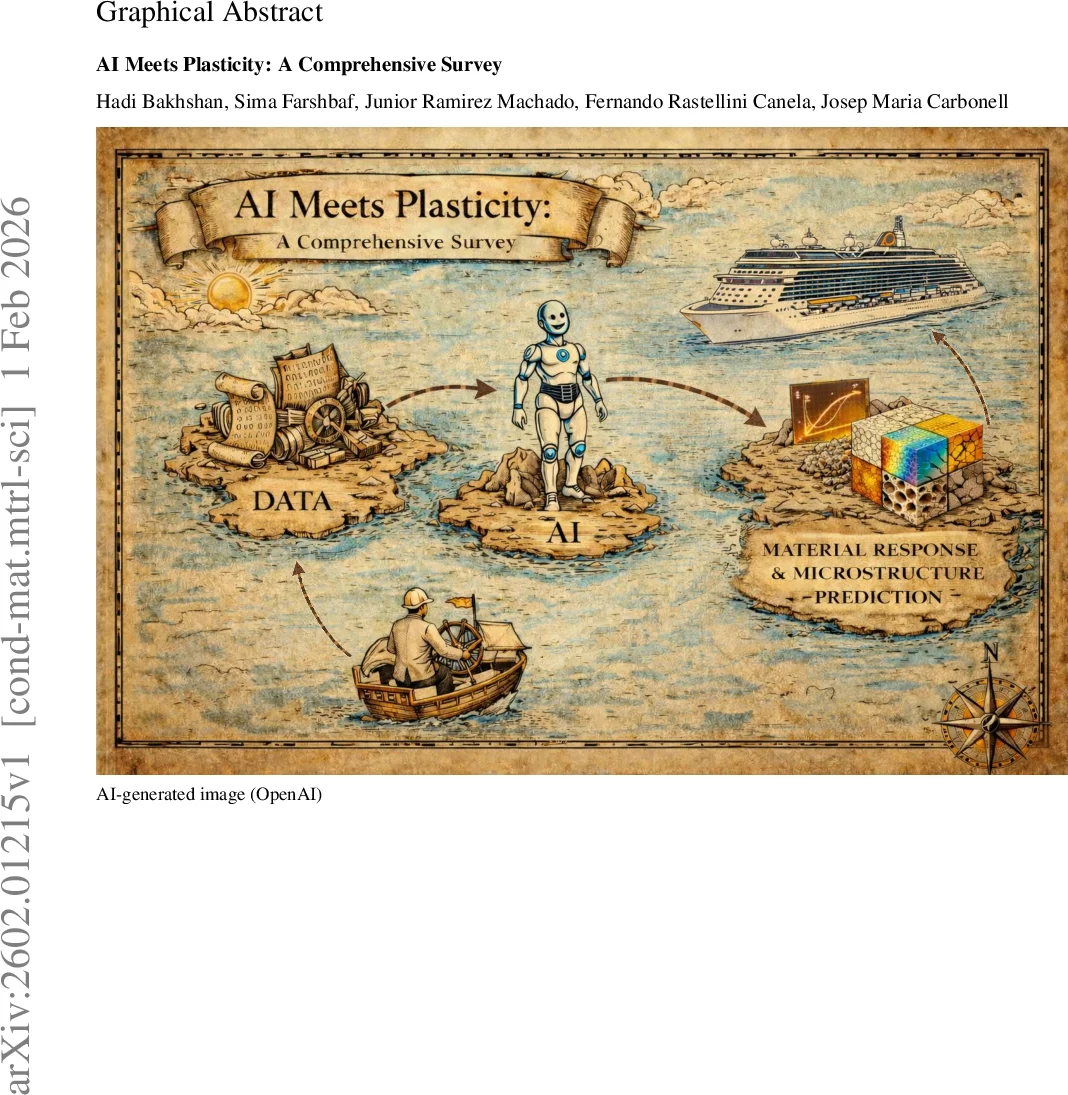
Artificial intelligence (AI) is rapidly emerging as a new paradigm of scientific discovery, namely data-driven science, across nearly all scientific disciplines. In materials science and engineering, AI has already begun to exert a transformative influence, making it both timely and necessary to examine its interaction with materials plasticity. In this study, we present a holistic survey of the convergence between AI and plasticity, highlighting state-of-the-art AI methodologies employed to discover, construct surrogate models for, and emulate the plastic behavior of materials. From a materials science perspective, we examine cause-and-effect relationships governing plastic deformation, including microstructural characterization and macroscopic responses described through plasticity constitutive models. From the perspective of AI methodology, we review a broad spectrum of applied approaches, ranging from frequentist techniques such as classical machine learning (ML), deep learning (DL), and physics-informed models to probabilistic frameworks that incorporate uncertainty quantification and generative AI methods. These data-driven approaches are discussed in the context of materials characterization and plasticity-related applications. The primary objective of this survey is to develop a comprehensive and well-organized taxonomy grounded in AI methodologies, with particular emphasis on distinguishing critical aspects of these techniques, including model architectures, data requirements, and predictive performance within the specific domain of materials plasticity. By doing so, this work aims to provide a clear road map for researchers and practitioners in the materials community, while offering deeper physical insight and intuition into the role of AI in advancing materials plasticity and characterization, an area of growing importance in the emerging AI-driven era.
💡 Research Summary
The paper “AI Meets Plasticity: A Comprehensive Survey” provides an extensive review of how artificial intelligence (AI) techniques are being integrated into the modeling, prediction, and understanding of material plasticity. It begins by outlining the multiscale nature of plastic deformation, from microscopic dislocation mechanisms to macroscopic stress‑strain behavior, and argues that traditional physics‑based constitutive models, while powerful, often struggle with complex, path‑dependent phenomena and multiphysics coupling. The authors position data‑driven science as a fourth paradigm that can complement and extend classical approaches.
The survey is organized around a detailed taxonomy that groups AI methods by their underlying philosophy (frequentist vs. probabilistic), learning paradigm (supervised, unsupervised, reinforcement), and degree of physical interpretability (white‑box vs. black‑box).
Datasets and Sampling – The authors discuss the variety of data sources relevant to plasticity: high‑resolution microstructure images (EBSD, SEM), full‑field experimental measurements, and large‑scale computational outputs from molecular dynamics, crystal plasticity finite element methods, and multiscale simulations. They describe sampling strategies such as uniform, importance‑driven, and active learning to ensure representative coverage of the high‑dimensional input space.
Classical Machine Learning – Techniques such as polynomial and nonlinear regression, support vector machines (SVM), decision‑tree ensembles (bagging, boosting), and symbolic regression are reviewed. Specific case studies include SVM‑based surrogate models for yield functions and constitutive laws, highlighting how kernel methods can capture complex yield surfaces with relatively few training points.
Deep Learning – A broad spectrum of neural architectures is covered:
- Artificial Neural Networks (ANNs) for direct yield‑function surrogates and parameter identification.
- Convolutional Neural Networks (CNNs) for microstructure characterization, linking image features to mechanical properties.
- Recurrent Neural Networks (RNNs), LSTMs, GRUs for time‑dependent plasticity and viscoplastic behavior.
- Transformers and attention mechanisms for handling long‑range dependencies in loading histories.
- Graph Neural Networks (GNNs) for representing grain‑boundary networks and crystal orientation graphs, enabling path‑dependent predictions.
- Kolmogorov‑Arnold Networks (KANs) and multimodal fusion models that combine image, scalar, and sequence data.
The authors emphasize that deep models excel at capturing highly nonlinear relationships but often act as black boxes, motivating the need for physics‑aware designs.
Physics‑Aware Neural Networks – The survey details physics‑informed neural networks (PINNs) that embed governing PDEs, thermodynamic constraints, and constitutive equations directly into the loss function, ensuring that predictions respect fundamental laws. Physics‑encoded neural networks (PENNs) enforce exact symmetries or invariances through architectural design. Neural operators such as DeepONet and Fourier Neural Operators (FNO) are presented as scalable tools for learning mappings between entire fields, enabling rapid surrogate evaluations of complex constitutive models.
Probabilistic Methods and Uncertainty Quantification – Gaussian Processes (GP) and Bayesian Neural Networks (BNN) are discussed as means to quantify epistemic and aleatory uncertainties in model predictions and parameter estimates. The authors illustrate GP‑based surrogate construction for constitutive parameters and highlight the value of predictive confidence intervals in experimental design and risk‑aware decision making.
Generative AI – Generative adversarial networks (GANs), normalizing flows, variational autoencoders (VAEs), diffusion models, and large language models (LLMs) are surveyed for tasks such as microstructure reconstruction, field‑variable synthesis, and data augmentation. GAN‑based microstructure generation is shown to preserve statistical descriptors while allowing exploration of unseen processing conditions.
Discussion and Future Directions – The paper proposes best‑practice guidelines covering dataset suitability, model selection, and performance evaluation metrics (MAE, R², calibration curves). Limitations identified include lack of interpretability for deep black‑box models, high computational cost for training large networks, and difficulty in fully integrating physics across scales. Prospective research avenues include:
- Coupling AI with multiphysics simulations (thermal, chemical, damage).
- Real‑time, online learning for adaptive control in manufacturing.
- Development of standardized, open‑access plasticity datasets and benchmark suites.
- Leveraging LLMs for knowledge extraction, hypothesis generation, and automated constitutive law discovery.
In conclusion, the survey delivers a comprehensive, well‑structured taxonomy of AI methods applied to material plasticity, evaluates their strengths and weaknesses, and outlines a clear roadmap for researchers and practitioners aiming to harness AI for more accurate, efficient, and physically consistent plasticity modeling.
Comments & Academic Discussion
Loading comments...
Leave a Comment