Novel linear, decoupled, and energy dissipative schemes for the Navier-Stokes-Darcy model and extension to related two-phase flow
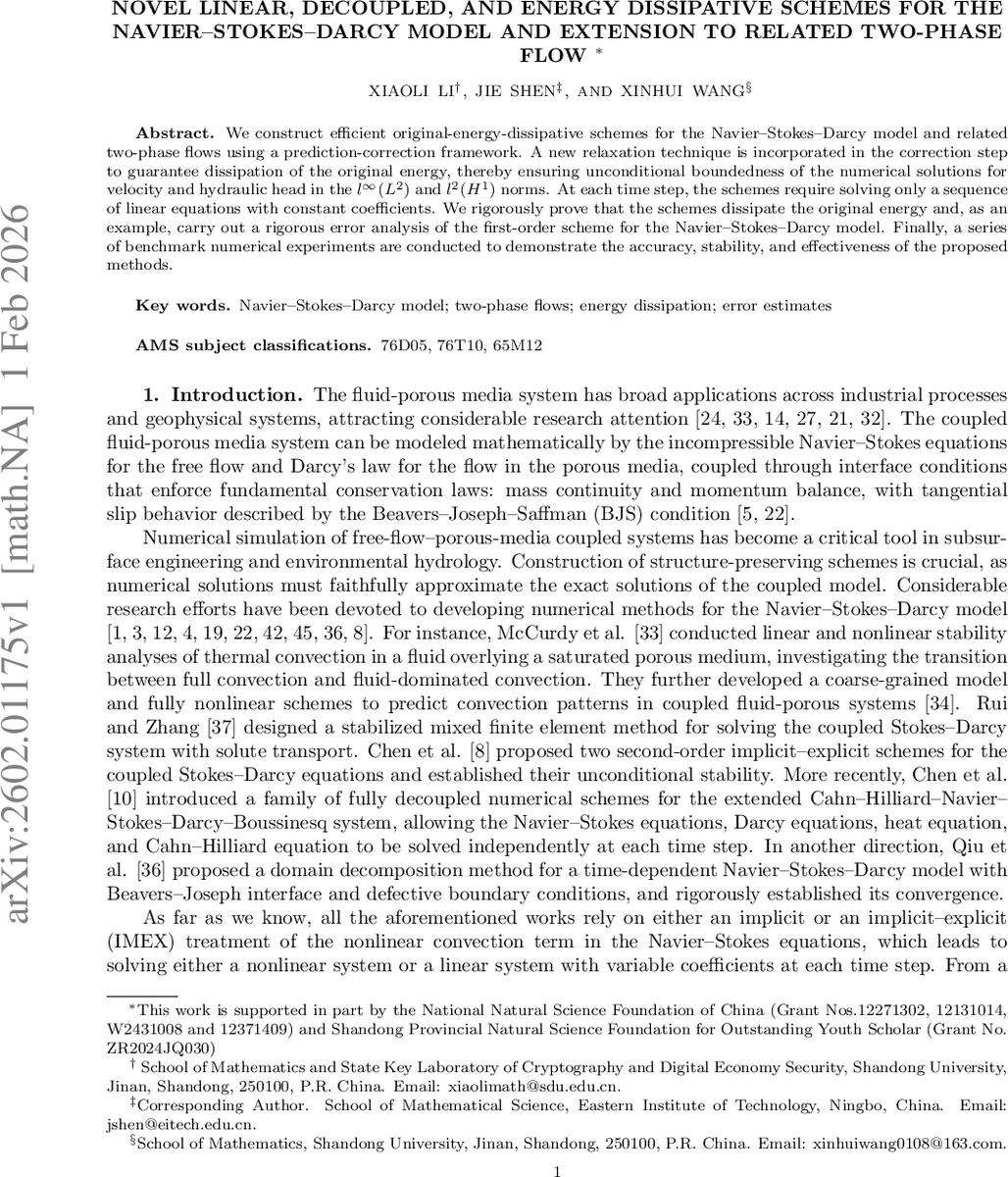
We construct efficient original-energy-dissipative schemes for the Navier-Stokes-Darcy model and related two-phase flows using a prediction-correction framework. A new relaxation technique is incorporated in the correction step to guarantee dissipation of the original energy, thereby ensuring unconditional boundedness of the numerical solutions for velocity and hydraulic head in the $l^{\infty}(L^2)$ and $l^2(H^1)$ norms. At each time step, the schemes require solving only a sequence of linear equations with constant coefficients. We rigorously prove that the schemes dissipate the original energy and, as an example, carry out a rigorous error analysis of the first-order scheme for the Navier-Stokes-Darcy model. Finally, a series of benchmark numerical experiments are conducted to demonstrate the accuracy, stability, and effectiveness of the proposed methods.
💡 Research Summary
The paper addresses the long‑standing challenge of designing efficient, structure‑preserving time‑integration schemes for the coupled Navier‑Stokes–Darcy system, which models the interaction between a free‑flow region governed by the incompressible Navier‑Stokes equations and a porous‑media region governed by Darcy’s law. The authors introduce a prediction‑correction framework that incorporates a novel relaxation factor, denoted ξ(t)≡1, to enforce the exact dissipation of the original physical energy rather than a modified surrogate.
In the prediction step, the nonlinear convection term is treated explicitly, and the free‑flow and porous‑media subproblems are solved separately as linear systems with constant coefficients. This yields a fully decoupled algorithm: a Stokes‑type linear solve for the velocity–pressure pair and a scalar diffusion‑type solve for the hydraulic head. The correction step computes the provisional energy Ẽⁿ⁺¹ and determines ξⁿ⁺¹ from a simple linear algebraic relation that guarantees ξⁿ⁺¹≥0. The updated solution is then obtained by scaling the provisional fields with ξⁿ⁺¹, ensuring that the discrete energy Eⁿ⁺¹=ξⁿ⁺¹Ẽⁿ⁺¹ satisfies the discrete analogue of dE/dt≤0.
Two schemes are constructed: a first‑order method based on backward Euler for the linear terms and explicit treatment of convection, and a second‑order method that combines Crank‑Nicolson for diffusion with an Adams‑Bashforth extrapolation for convection. Both schemes are proved to be uniquely solvable, unconditionally stable, and to preserve the original energy dissipation without any time‑step restriction.
A rigorous error analysis is carried out for the first‑order scheme. Assuming sufficient regularity of the exact solution (H² spatial regularity and appropriate time derivatives), the authors derive optimal O(Δt) error bounds in the L² norm for velocity and hydraulic head, as well as bounds for the discrete energy error. The analysis is performed in two dimensions with a scalar hydraulic conductivity for simplicity, but the methodology extends to three dimensions and tensorial conductivities.
The framework is further extended to a multiphase flow model that couples the Cahn‑Hilliard equation (for phase separation) with the Navier‑Stokes–Darcy system. The same prediction‑correction strategy applies: the phase field is advanced via a linearized Cahn‑Hilliard solve, while the fluid and porous subproblems remain decoupled. The combined scheme retains linearity, decoupling, and exact energy dissipation for the total free‑energy (kinetic + potential + interfacial).
Extensive numerical experiments validate the theoretical results. Convergence tests confirm the expected temporal orders. Benchmark simulations of filtration through a porous slab, buoyancy‑driven bubble dynamics, and two‑phase flow scenarios demonstrate the schemes’ accuracy, robustness, and computational efficiency. Each time step requires only the solution of constant‑coefficient linear systems, leading to a substantial reduction in computational cost compared with traditional implicit or IMEX approaches that involve variable‑coefficient or nonlinear solves.
In summary, the authors deliver the first linear, fully decoupled, and original‑energy‑dissipative time‑integration methods for the Navier‑Stokes–Darcy model, provide rigorous stability and error analysis, and successfully generalize the approach to complex multiphase flow problems, thereby offering a powerful tool for simulations in subsurface engineering, environmental hydrology, and related fields.
Comments & Academic Discussion
Loading comments...
Leave a Comment