Direct vs. Score-based Selection: Understanding the Heisenberg Effect in Target Acquisition Across Input Modalities in Virtual Reality
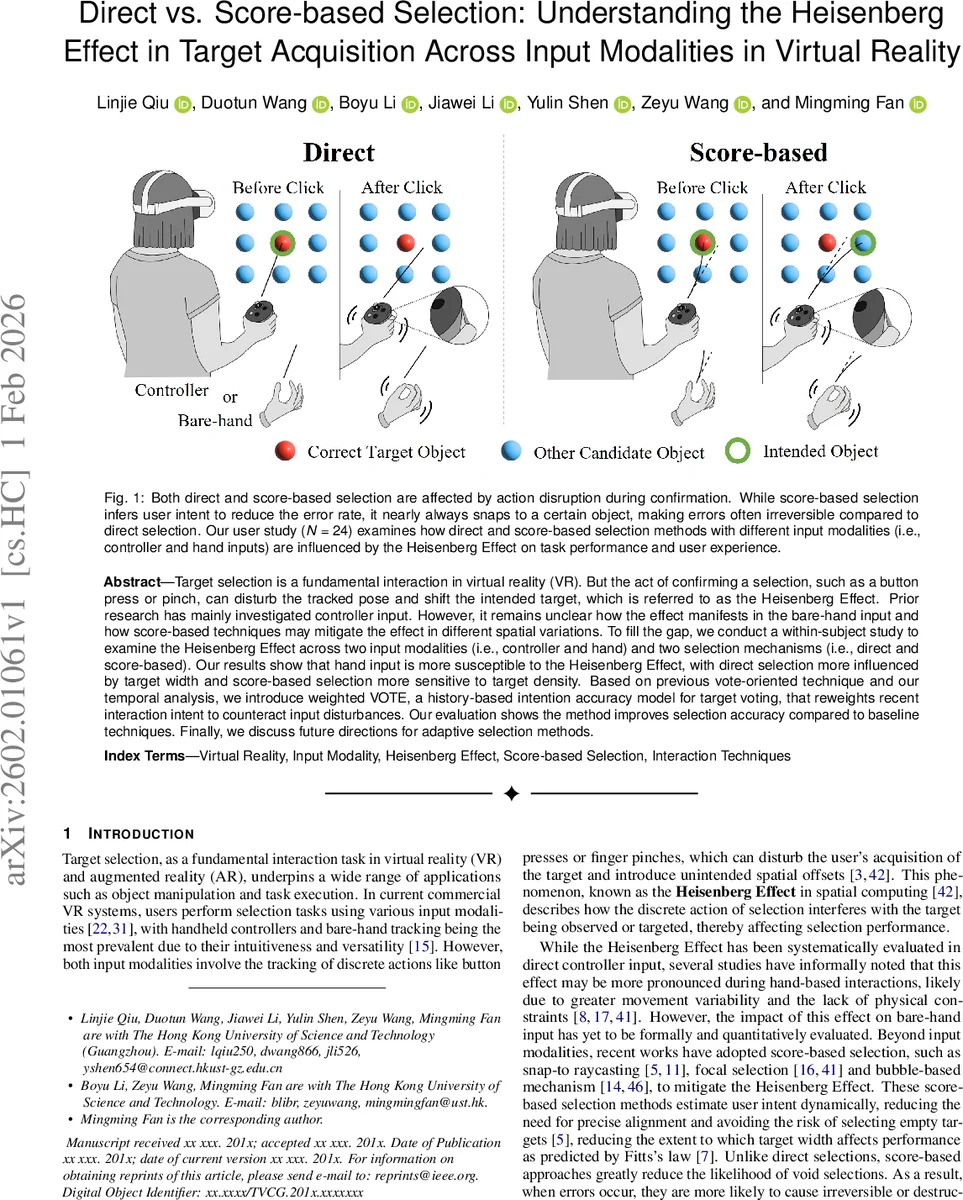
Target selection is a fundamental interaction in virtual reality (VR). But the act of confirming a selection, such as a button press or pinch, can disturb the tracked pose and shift the intended target, which is referred to as the Heisenberg Effect. Prior research has mainly investigated controller input. However, it remains unclear how the effect manifests in the bare-hand input and how score-based techniques may mitigate the effect in different spatial variations. To fill the gap, we conduct a within-subject study to examine the Heisenberg Effect across two input modalities (i.e., controller and hand) and two selection mechanisms (i.e., direct and score-based). Our results show that hand input is more susceptible to the Heisenberg Effect, with direct selection more influenced by target width and score-based selection more sensitive to target density. Based on previous vote-oriented technique and our temporal analysis, we introduce weighted VOTE, a history-based intention accuracy model for target voting, that reweights recent interaction intent to counteract input disturbances. Our evaluation shows the method improves selection accuracy compared to baseline techniques. Finally, we discuss future directions for adaptive selection methods.
💡 Research Summary
This paper investigates the “Heisenberg Effect” in virtual reality (VR) target selection, a phenomenon where the act of confirming a selection (e.g., a button press or a pinch) perturbs the tracked pose and causes a spatial offset between the intended and actual target. While prior work has largely focused on controller‑based direct selection, the authors extend the analysis to bare‑hand tracking and to score‑based selection techniques, which infer user intent from spatial and temporal cues.
A within‑subject study with 24 right‑handed participants examined four technique combinations: direct controller (DC), direct hand (DH), score‑based controller (SC), and score‑based hand (SH). Independent variables were target width (14 cm, 28 cm, 42 cm) and target spacing (30 cm, 50 cm, 70 cm) in a 7 × 7 grid positioned 8 m from the user. Dependent measures included selection time, overall error rate, Heisenberg error rate (selections that start inside a target but end outside), and Heisenberg magnitude (angular offset between start and end of the selection gesture). Hand pinch onset was detected using a combination of thumb‑index distance velocity and palm rotational velocity to ensure precise timing.
Key findings:
- Hand input suffers a higher Heisenberg error than controller input. Direct hand selections produced a 71.86 % Heisenberg error, while score‑based hand selections still incurred 46.86 % error, comparable to controller‑based scores (47.50 %).
- Direct selection performance is strongly affected by target width, following classic Fitts’ law trends; wider targets reduce error. Score‑based selection is relatively insensitive to width but highly sensitive to target density—errors rise sharply as spacing decreases, due to snap‑to mechanisms being attracted to neighboring objects.
- As task difficulty increases, Heisenberg magnitude decreases, suggesting users subconsciously stabilize their hands under higher perceived difficulty.
To mitigate these disturbances, the authors propose Weighted VOTE, an extension of prior history‑based voting methods (VOTE, BackTracer). They fit a third‑order polynomial to model temporal accuracy trends and derive a decay function γ(t)=α·exp(−β·Δt) that gives recent intention samples higher weight. This weighted score replaces the uniform voting in the original VOTE algorithm, allowing the system to prioritize the most recent, likely‑correct intent while still considering past evidence.
Evaluation of Weighted VOTE showed error reductions across all technique conditions. The most dramatic improvement occurred for score‑based hand input, where the overall error dropped from 21.96 % to 7.54 %, reaching parity with controller‑based performance (score‑based controller error improved to 8.18 %).
Contributions:
- Extends systematic analysis of the Heisenberg Effect to both controller and hand modalities, and to direct and score‑based selection mechanisms.
- Provides quantitative evidence that target width primarily impacts direct selection, while target density dominates score‑based selection performance.
- Introduces Weighted VOTE, a history‑aware intention model that significantly mitigates Heisenberg‑induced errors, especially for hand‑based interactions.
- Offers insights into adaptive selection methods, suggesting future work on dynamic weighting, machine‑learning‑driven intent prediction, and application to moving targets or mixed‑reality scenarios.
Overall, the study highlights the importance of accounting for input‑induced disturbances in VR UI design and demonstrates that leveraging temporally weighted historical intent can substantially improve selection accuracy across diverse interaction techniques.
Comments & Academic Discussion
Loading comments...
Leave a Comment