Adaptive Dual-Weighting Framework for Federated Learning via Out-of-Distribution Detection
Federated Learning (FL) enables collaborative model training across large-scale distributed service nodes while preserving data privacy, making it a cornerstone of intelligent service systems in edge-cloud environments. However, in real-world service-oriented deployments, data generated by heterogeneous users, devices, and application scenarios are inherently non-IID. This severe data heterogeneity critically undermines the convergence stability, generalization ability, and ultimately the quality of service delivered by the global model. To address this challenge, we propose FLood, a novel FL framework inspired by out-of-distribution (OOD) detection. FLood dynamically counteracts the adverse effects of heterogeneity through a dual-weighting mechanism that jointly governs local training and global aggregation. At the client level, it adaptively reweights the supervised loss by upweighting pseudo-OOD samples, thereby encouraging more robust learning from distributionally misaligned or challenging data. At the server level, it refines model aggregation by weighting client contributions according to their OOD confidence scores, prioritizing updates from clients with higher in-distribution consistency and enhancing the global model’s robustness and convergence stability. Extensive experiments across multiple benchmarks under diverse non-IID settings demonstrate that FLood consistently outperforms state-of-the-art FL methods in both accuracy and generalization. Furthermore, FLood functions as an orthogonal plug-in module: it seamlessly integrates with existing FL algorithms to boost their performance under heterogeneity without modifying their core optimization logic. These properties make FLood a practical and scalable solution for deploying reliable intelligent services in real-world federated environments.
💡 Research Summary
The paper introduces FLood, a novel federated learning (FL) framework that tackles the pervasive non‑IID data problem by leveraging out‑of‑distribution (OOD) detection signals. The authors reinterpret data heterogeneity as a measurable OOD phenomenon: during each communication round, the current global model is used to compute an OOD confidence score (e.g., maximum softmax probability or Energy score) for every local sample. Samples whose scores fall below a preset threshold τ are labeled “pseudo‑OOD,” indicating that they deviate from the global data manifold.
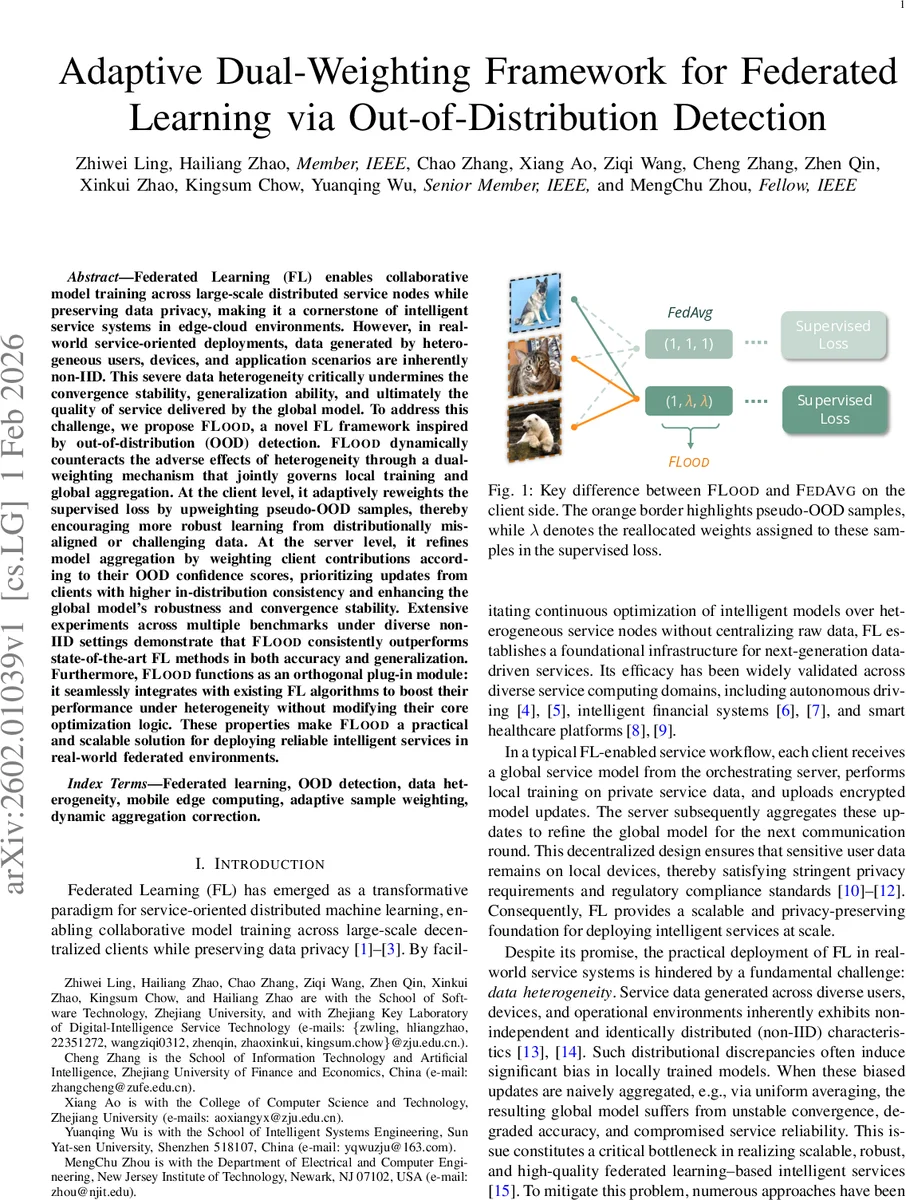
FLood employs a dual‑weighting strategy. On the client side, the supervised loss is re‑weighted per‑sample: ordinary in‑distribution (ID) samples keep weight 1, while pseudo‑OOD samples receive an amplified weight λ > 1. This forces local optimizers to focus more on challenging, distributionally misaligned data, thereby producing updates that are more aligned with the global objective. On the server side, each client aggregates its OOD scores (e.g., the mean or a high percentile) into a single statistic q_k and transmits it to the orchestrating server. The server then rescales the standard data‑size‑based aggregation weight p_k by a function φ(q_k), typically an exponential decay φ(q)=exp(−α·q). Consequently, clients whose data are more consistent with the evolving global distribution (low q_k) receive higher influence in the global model update.
A key advantage of FLood is its plug‑in nature: only the loss computation on clients and the aggregation rule on the server are altered, so it can be layered on top of existing FL algorithms such as FedAvg, FedProx, FedNova, FedAvgM, or FedDyn without modifying their core optimization logic. The authors demonstrate this compatibility by integrating FLood with several baselines and observing consistent performance gains.
Extensive experiments were conducted on image (CIFAR‑10/100, FEMNIST) and text (Shakespeare) benchmarks under a variety of non‑IID configurations, including Dirichlet label‑skew with concentration parameters α ranging from 0.1 to 1.0, feature‑skew, and label‑skew scenarios. Across all settings, FLood outperformed the baselines by 2–6 percentage points in test accuracy, and it showed markedly faster convergence when heterogeneity was severe (α = 0.1). Moreover, OOD detection metrics such as AUROC for distinguishing true OOD samples were also superior, indicating that the OOD scores used for weighting are reliable indicators of distributional alignment.
The paper provides a theoretical intuition: OOD scores approximate the KL‑divergence between a client’s local data distribution and the global model’s implicit distribution. By up‑weighting high‑divergence samples during local training, the expected local loss becomes more representative of the global data manifold. Similarly, the server‑side re‑weighting implements a confidence‑based weighted average, reducing the detrimental impact of biased updates from highly divergent clients.
Limitations are acknowledged. Computing OOD scores adds overhead to resource‑constrained edge devices; thus, lightweight OOD estimators or on‑device approximations are needed for real‑world deployment. The current implementation relies on a single scoring function; future work could explore ensembles or meta‑learning to obtain more robust OOD estimates. Privacy considerations arise when transmitting OOD statistics; secure aggregation or differential privacy mechanisms would be required in privacy‑sensitive settings. Finally, extending FLood to asynchronous FL, model compression, or encrypted training pipelines remains an open research direction.
In summary, FLood offers a practical, theoretically motivated solution to the non‑IID challenge in federated learning by turning data heterogeneity into an actionable OOD signal and applying it both to local loss re‑weighting and global aggregation weighting. Its plug‑in design, strong empirical results, and compatibility with existing FL methods make it a compelling addition to the toolbox for deploying reliable intelligent services in heterogeneous, privacy‑preserving federated environments.
Comments & Academic Discussion
Loading comments...
Leave a Comment