Mitigating Data Centers Load Risks and Enabling Grid Support Functions through Grid-Forming Control
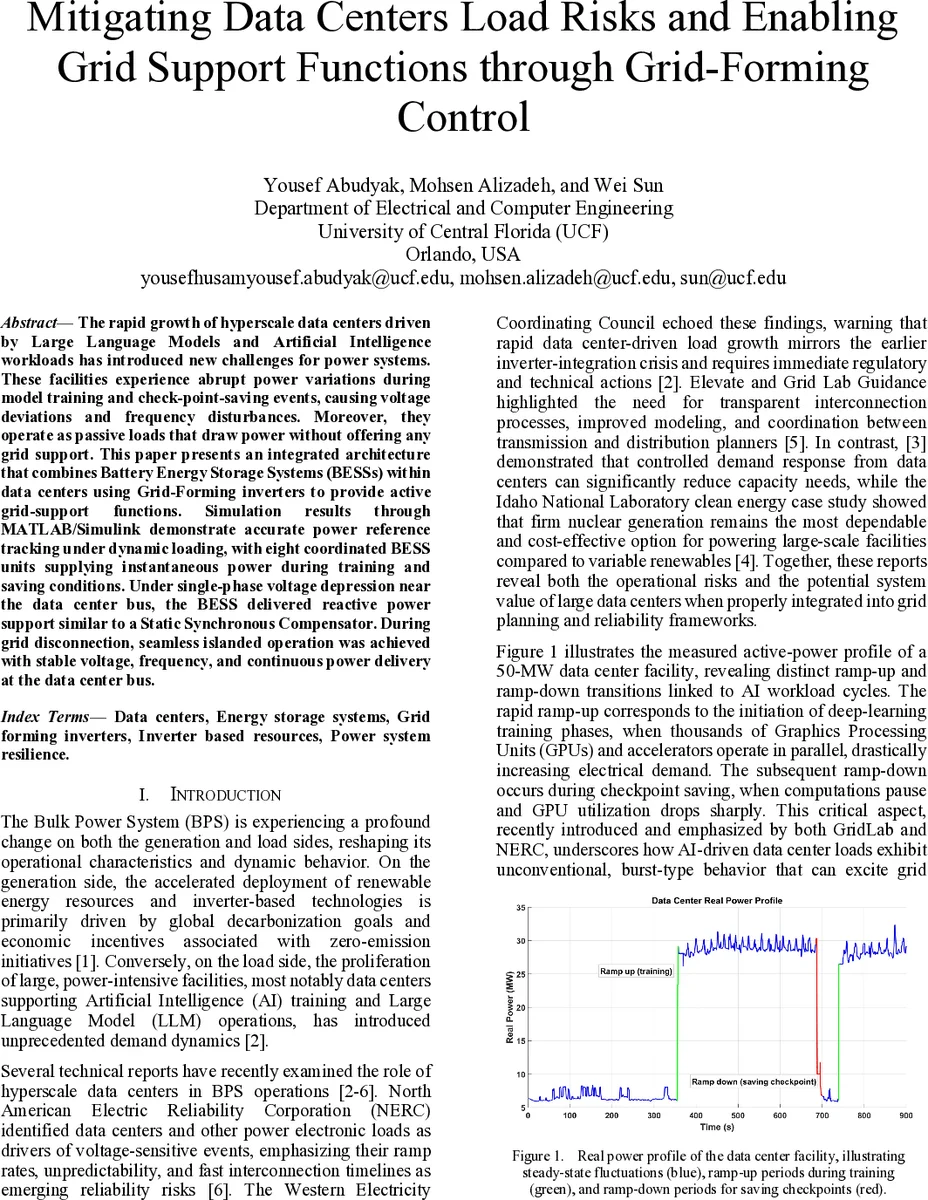
The rapid growth of hyperscale data centers driven by Large Language Models and Artificial Intelligence workloads has introduced new challenges for power systems. These facilities experience abrupt power variations during model training and check-point-saving events, causing voltage deviations and frequency disturbances. Moreover, they operate as passive loads that draw power without offering any grid support. This paper presents an integrated architecture that combines Battery Energy Storage Systems (BESSs) within data centers using Grid-Forming inverters to provide active grid-support functions. Simulation results through MATLAB/Simulink demonstrate accurate power reference tracking under dynamic loading, with eight coordinated BESS units supplying instantaneous power during training and saving conditions. Under single-phase voltage depression near the data center bus, the BESS delivered reactive power support similar to a Static Synchronous Compensator. During grid disconnection, seamless islanded operation was achieved with stable voltage, frequency, and continuous power delivery at the data center bus.
💡 Research Summary
The paper addresses the emerging stability challenges posed by hyperscale data centers that host AI training and large language model (LLM) workloads. These facilities exhibit “burst‑type” power demand patterns: rapid ramps up during training and abrupt drops during checkpoint saving. Such dynamics can cause significant voltage sags and frequency excursions on the bulk power system (BPS), especially as data centers become large, fast‑acting, power‑electronic loads. Traditional data‑center designs rely on N+1 or 2N redundancy, diesel generators, and UPS systems to guarantee uninterrupted service, but they remain passive consumers of grid power and do not contribute to grid stability.
To turn these massive loads into active grid‑support assets, the authors propose integrating Battery Energy Storage Systems (BESS) equipped with Grid‑Forming (GFM) inverters directly inside the data‑center premises. The architecture envisions eight 5 MW BESS units (total 40 MW) co‑located with the data‑center’s medium‑voltage (MV) bus. The GFM inverter employs a hierarchical control scheme: an L‑C filter (L₁, C₁) and equivalent grid‑side inductance (L₂) shape the hardware interface; measured three‑phase voltages and currents are transformed to the d‑q frame; inner voltage and current PI loops generate reference currents and voltages; an outer power‑control layer computes instantaneous active (P) and reactive (Q) powers, filters them, and applies frequency‑power (K_f) and voltage‑reactive‑power (K_v) droop characteristics. By setting the voltage‑reference angle to zero (V* = 0), the d‑axis current controls active power while the q‑axis current controls reactive power, achieving decoupled regulation.
Simulation studies are carried out in MATLAB/Simulink using a realistic 50 MW data‑center load profile that reproduces the training‑checkpoint cycles. Four key scenarios are examined:
-
Baseline (no BESS) – Direct grid connection leads to pronounced voltage drops during high‑load periods and frequency deviations down to 59.5 Hz (loading) and up to 60.3 Hz (unloading).
-
Active‑power support with BESS‑GFM – The eight BESS units share the load equally, tracking the power reference within milliseconds. Voltage sags are largely eliminated, and frequency swings are reduced to 59.8 Hz / 60.15 Hz.
-
Reactive‑power support (STATCOM‑like) – A single line‑to‑ground fault is applied two miles from the data center. The GFM‑BESS injects approximately 5 MVAr of reactive power according to the preset voltage‑droop, restoring the nearby bus voltage to the acceptable 0.9–1.1 p.u. range while the data‑center’s 6 MW load continues uninterrupted.
-
Islanded operation after grid disconnection – When the grid is severed, the GFM‑BESS seamlessly transitions to island mode, maintaining stable voltage and frequency without violating limits. Power delivery to the data center experiences only a microsecond‑scale spike, demonstrating that the BESS can replace diesel generators with far faster dynamics.
The results confirm that the proposed BESS‑GFM integration (a) mitigates voltage and frequency disturbances caused by AI‑driven load variability, (b) provides fast, STATCOM‑level reactive power during fault conditions, and (c) enables uninterrupted, stable islanded operation when the utility grid is lost. The authors also discuss practical considerations such as measurement noise, communication latency, and the need for coordination with existing protection schemes. Future work is outlined to explore multi‑data‑center coordination, scalability, and validation under broader network conditions, as well as the adoption of long‑duration storage technologies (thermal, flow batteries) to further enhance resilience.
Overall, the paper demonstrates that embedding storage‑based grid‑forming control within hyperscale data centers transforms them from passive reliability risks into valuable, fast‑responding grid assets, thereby strengthening overall power‑system reliability and resilience.
Comments & Academic Discussion
Loading comments...
Leave a Comment