Evolving Interdependent Operators with Large Language Models for Multi-Objective Combinatorial Optimization
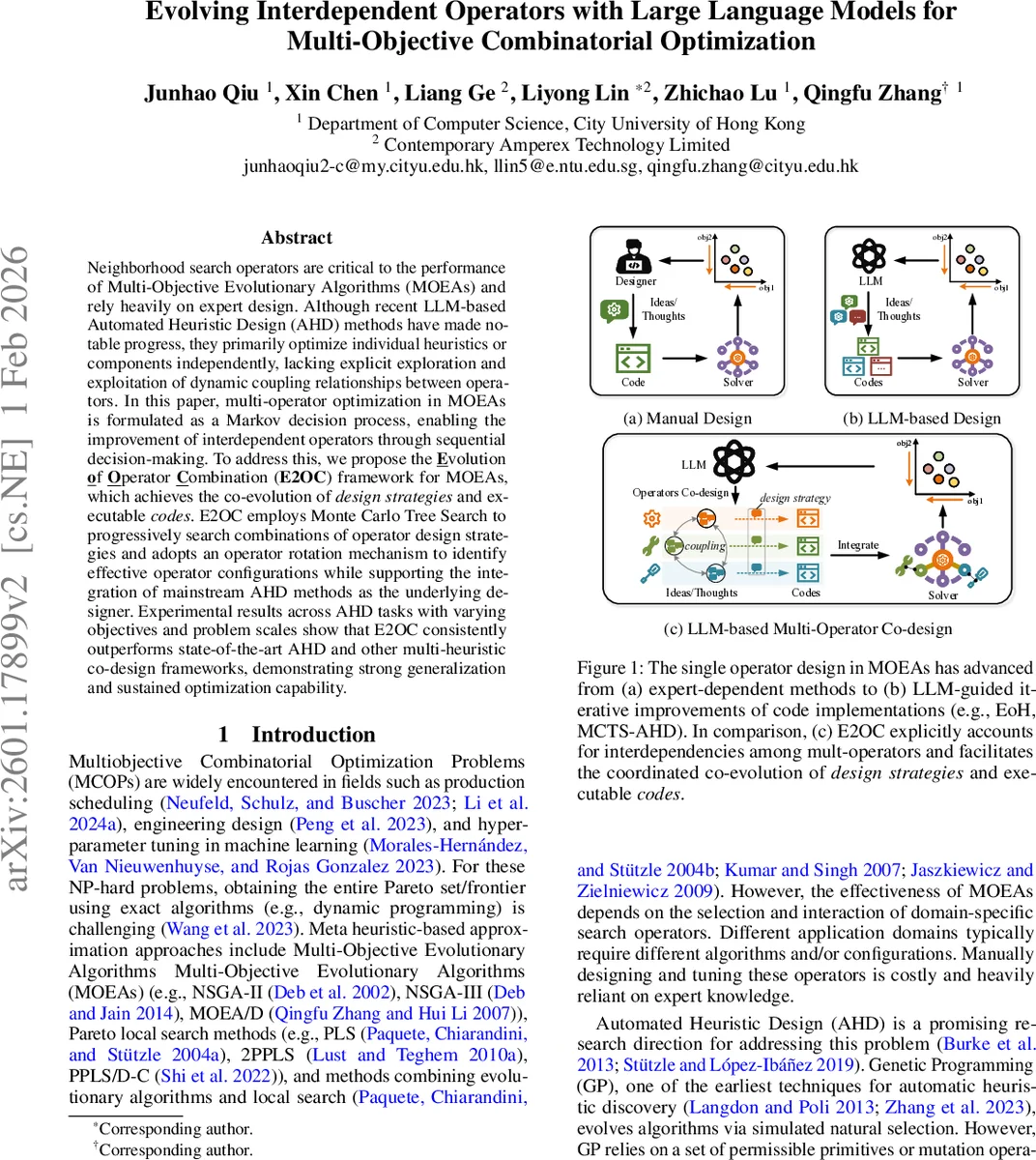
Neighborhood search operators are critical to the performance of Multi-Objective Evolutionary Algorithms (MOEAs) and rely heavily on expert design. Although recent LLM-based Automated Heuristic Design (AHD) methods have made notable progress, they primarily optimize individual heuristics or components independently, lacking explicit exploration and exploitation of dynamic coupling relationships between operators. In this paper, multi-operator optimization in MOEAs is formulated as a Markov decision process, enabling the improvement of interdependent operators through sequential decision-making. To address this, we propose the Evolution of Operator Combination (E2OC) framework for MOEAs, which achieves the co-evolution of design strategies and executable codes. E2OC employs Monte Carlo Tree Search to progressively search combinations of operator design strategies and adopts an operator rotation mechanism to identify effective operator configurations while supporting the integration of mainstream AHD methods as the underlying designer. Experimental results across AHD tasks with varying objectives and problem scales show that E2OC consistently outperforms state-of-the-art AHD and other multi-heuristic co-design frameworks, demonstrating strong generalization and sustained optimization capability.
💡 Research Summary
The paper addresses a critical gap in the automated design of Multi‑Objective Evolutionary Algorithms (MOEAs): while recent Large Language Model (LLM)‑based Automated Heuristic Design (AHD) methods have succeeded in evolving single operators, they ignore the dynamic coupling among multiple operators that is essential for effective exploration‑exploitation balance in complex Multi‑Objective Combinatorial Optimization Problems (MCOPs). To fill this gap, the authors formulate multi‑operator optimization as a Markov Decision Process (MDP) and introduce the Evolution of Operator Combination (E2OC) framework, which co‑evolves design strategies (expressed as textual “design thoughts”) and executable code for a set of K operators.
E2OC consists of four tightly integrated components. First, a warm‑start phase uses an algorithm generator G guided by an initial prompt tuple p₀ to produce a diverse pool of candidate operators. Valid candidates are evaluated on a set of problem instances, and elite operators are identified. A prompt generator then extracts improvement suggestions from these elites, forming a repository of design thoughts—semantic descriptions of how each operator could be refined. Second, the design thoughts constitute a multi‑domain language space. Internal relationships capture hierarchies among thoughts for the same operator, while external relationships encode cross‑operator dependencies such as complementarity or conflict. Because these relationships are linguistic rather than numeric, conventional optimization cannot directly manipulate them.
Third, the framework employs a progressive Monte Carlo Tree Search (MCTS) to explore combinations of design thoughts. Each node in the tree represents a partial combination of thoughts; edges correspond to adding a new thought for a yet‑unfilled operator slot. Node selection follows the Upper Confidence Bound (UCB) criterion, balancing empirical performance (accumulated score) against exploration of less‑visited branches. When a node is expanded, a new thought is sampled from the prompt storage and appended. The simulation step instantiates the full operator set according to the current path, runs the MOEA on the benchmark problems, and evaluates the resulting solution set with scalar quality indicators such as Hypervolume (HV) or Inverted Generational Distance (IGD). The obtained score updates the node’s statistics, guiding future selections.
Fourth, E2OC introduces an operator rotation mechanism. Rather than redesigning the entire operator suite at once, the algorithm fixes one operator while iteratively rotating and re‑optimizing the others. This systematic rotation uncovers synergistic pairings and mitigates the risk of local optima that can arise when all operators are altered simultaneously. The rotation also provides a natural way to incorporate any underlying AHD method (e.g., EoH, MCTS‑AHD) as the “designer” that generates code from the selected design thoughts.
The authors evaluate E2OC on two widely studied MCOP benchmarks with two‑ and three‑objective configurations, comparing against state‑of‑the‑art AHD approaches and recent multi‑heuristic co‑design frameworks. Across all settings, E2OC consistently achieves higher HV and lower IGD, demonstrating superior convergence and diversity. Notably, the framework maintains performance gains even when computational budget for operator generation is limited, highlighting its efficiency. Ablation studies confirm that both the MCTS‑driven strategy search and the operator rotation contribute significantly to the observed improvements.
In summary, E2OC offers a novel paradigm for automated multi‑operator design in MOEAs: (1) it extracts and structures human‑readable design ideas from elite operators, (2) it navigates the combinatorial space of interdependent thoughts using MCTS, and (3) it refines operator sets through a rotation‑based evolutionary loop. This joint evolution of strategy and code enables the discovery of highly effective operator combinations with minimal hand‑crafting, advancing the frontier of LLM‑assisted metaheuristic design and opening avenues for applying similar co‑evolutionary techniques to other complex algorithmic domains.
Comments & Academic Discussion
Loading comments...
Leave a Comment