Calabi-Yau structures on derived and singularity categories of symmetric orders
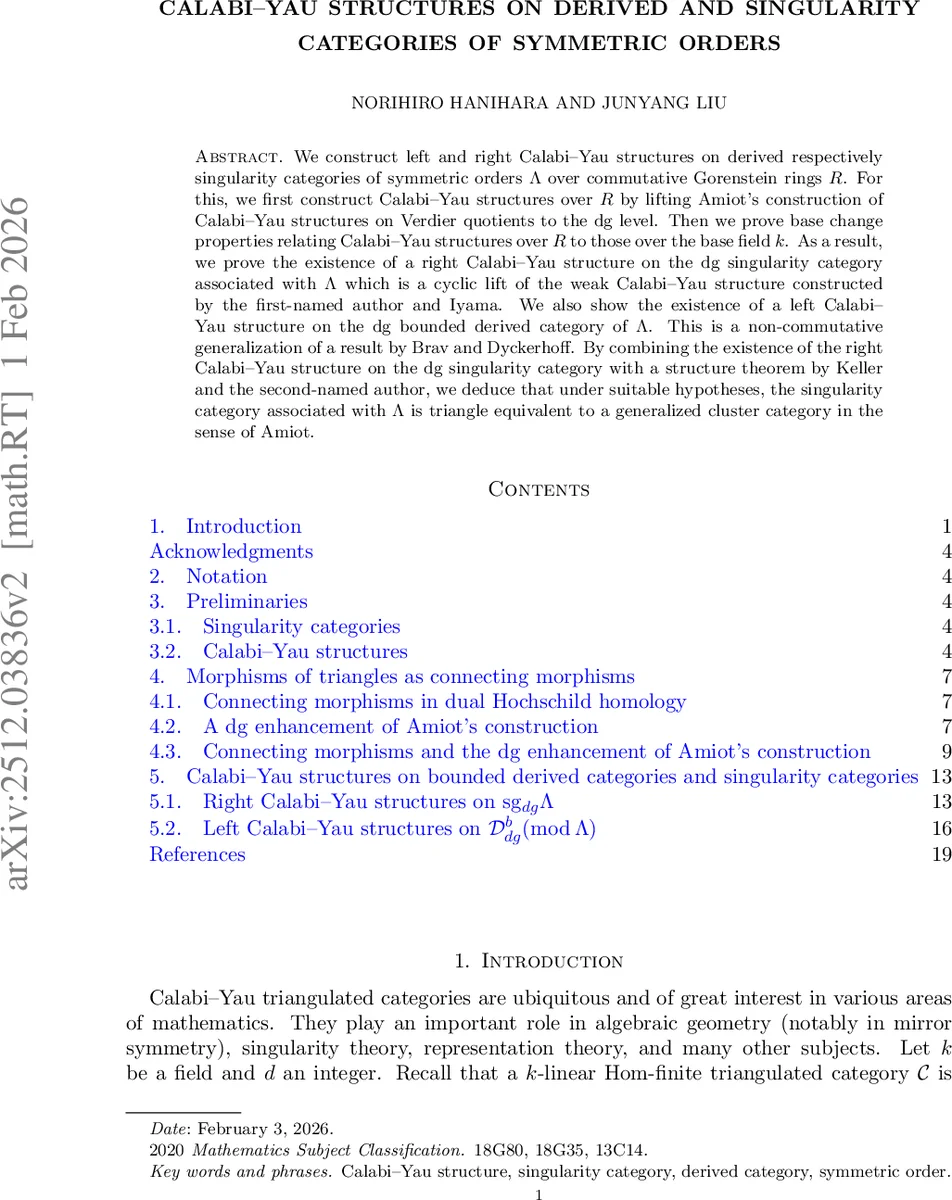
We construct left and right Calabi-Yau structures on derived respectively singularity categories of symmetric orders $Λ$ over commutative Gorenstein rings $R$. For this, we first construct Calabi-Yau structures over $R$ by lifting Amiot’s construction of Calabi-Yau structures on Verdier quotients to the dg level. Then we prove base change properties relating Calabi-Yau structures over $R$ to those over the base field $k$. As a result, we prove the existence of a right Calabi-Yau structure on the dg singularity category associated with $Λ$ which is a cyclic lift of the weak Calabi-Yau structure constructed by the first-named author and Iyama. We also show the existence of a left Calabi-Yau structure on the dg bounded derived category of $Λ$. This is a non-commutative generalization of a result by Brav and Dyckerhoff. By combining the existence of the right Calabi-Yau structure on the dg singularity category with a structure theorem by Keller and the second-named author, we deduce that under suitable hypotheses, the singularity category associated with $Λ$ is triangle equivalent to a generalized cluster category in the sense of Amiot.
💡 Research Summary
The paper develops a comprehensive framework for constructing left and right Calabi–Yau (CY) structures on the differential graded (dg) enhancements of derived and singularity categories associated with symmetric orders over commutative Gorenstein rings. The authors begin by recalling the classical setting: for a noetherian ring Λ, the bounded derived category Db(mod Λ) contains the perfect derived subcategory per Λ, and the singularity category sg Λ is defined as the Verdier quotient Db(mod Λ)/per Λ. When Λ is a symmetric R‑order of Krull dimension d with isolated singularities, classical Auslander–Reiten duality guarantees that sg Λ is a (d‑1)‑Calabi–Yau triangulated category. The goal of the paper is to lift this triangulated CY property to a genuine dg CY structure on the canonical dg enhancements of both Db(mod Λ) and sg Λ.
The central technical advance is a dg‑level analogue of Amiot’s construction of Serre functors for Verdier quotients. The authors consider a short exact sequence of small dg R‑categories 0 → B → A → C → 0, together with a dg auto‑equivalence ν of A preserving the image of B, and a bimodule M over A that is isomorphic in the derived category of A‑bimodules to A(ν?,–). By applying Hochschild homology with coefficients in the induced bimodules M_B and M_C, they obtain a distinguished triangle HH(B,M_B) → HH(A,M) → HH(C,M_C) → ΣHH(B,M_B) in the derived category of R‑modules. The connecting morphism δ : H⁰(D HH(B,M_B)) → H¹(D HH(C,M_C)) is shown (Theorem 4.3.1) to coincide with the connecting morphism used by Amiot, and under the hypothesis that the canonical map A → RHom_B(A,A) is an isomorphism, δ preserves non‑degeneracy. Consequently, δ yields a right CY structure on the dg quotient C when the appropriate non‑degeneracy holds on A.
Applying this machinery to a symmetric R‑order Λ, the authors set A = Db(dg mod Λ), B = per(dg Λ), C = sg(dg Λ), and M = A. Proposition 5.1.2 then provides a right (d‑1)‑CY structure on sg(dg Λ) over R. A base‑change result (Proposition 5.1.4) relates CY structures over R to those over the base field k, showing that the weak CY structure previously constructed by the first author and Iyama lifts to a genuine right (d‑1)‑CY structure over k (Theorem 5.1.5, denoted Theorem B). This “cyclic lift” is a central contribution, as it upgrades a homological duality to a fully fledged dg CY structure.
In parallel, the authors treat the left side. By the same exact‑sequence framework, but now focusing on the derived category Db(dg mod Λ) itself, they construct a left d‑CY structure on its dg enhancement (Theorem 5.2.5, denoted Theorem D). This generalizes the result of Brav–Dyckerhoff, which was originally proved for commutative Gorenstein algebras, to the non‑commutative setting of symmetric orders. As a corollary, the singularity category also inherits a left d‑CY structure (Corollary 5.2.6).
The paper further explores the consequences of these CY structures. Using a structure theorem of Keller and the second author, together with the right CY structure on sg(dg Λ), the authors prove that under suitable hypotheses—namely, that the singular locus of Λ is contained in a single maximal ideal and that sg Λ contains a (d‑1)‑cluster‑tilting object—the singularity category is triangle‑equivalent to a generalized cluster category in the sense of Amiot. Concretely, there exists a d‑dimensional deformed dg preprojective algebra Π such that sg Λ ≃ C_Π, where C_Π denotes the associated cluster category (Corollary 5.1.6, denoted Corollary C). This result extends a line of work beginning with Keller–Reiten’s description of singularity categories of invariant rings, through higher‑dimensional cyclic quotient singularities, to the present non‑commutative, higher‑dimensional setting.
Overall, the paper makes three major contributions: (1) a systematic dg‑level construction of CY structures on Verdier quotients via connecting morphisms in dual Hochschild homology; (2) a detailed analysis of base‑change properties that allow passage from CY structures over a Gorenstein base ring to those over a field; and (3) the identification of singularity categories of symmetric orders with generalized cluster categories via deformed dg preprojective algebras. These advances deepen the understanding of the homological geometry of non‑commutative orders and open new avenues for applications in representation theory, algebraic geometry, and homological mirror symmetry.
Comments & Academic Discussion
Loading comments...
Leave a Comment