Remarks on the maximal regularity for parabolic boundary value problems with inhomogeneous data
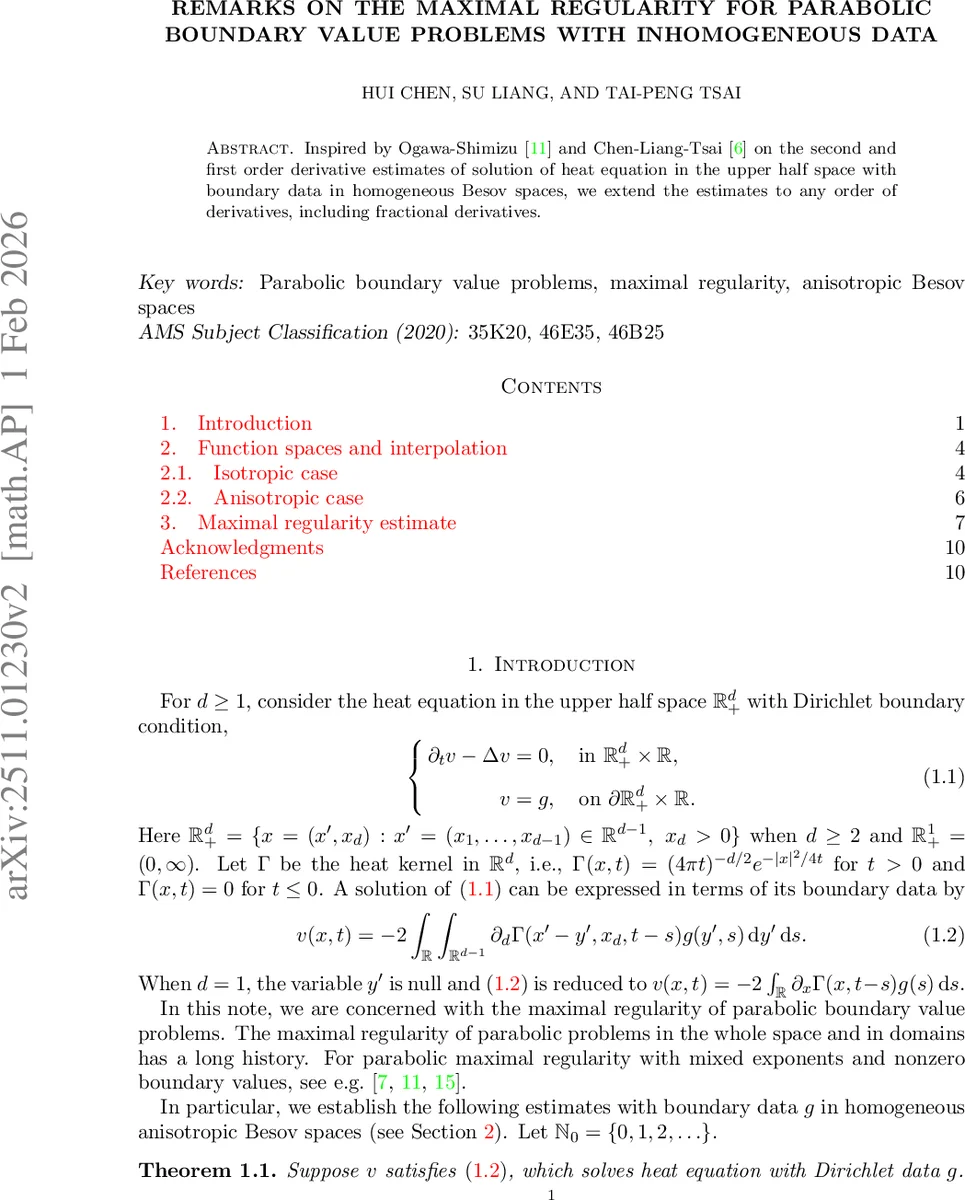
Inspired by Ogawa-Shimizu [JEE 2022] and Chen-Liang-Tsai [IMRN 2025] on the second and first order derivative estimates of solution of heat equation in the upper half space with boundary data in homogeneous Besov spaces, we extend the estimates to any order of derivatives, including fractional derivatives.
💡 Research Summary
The paper studies the heat equation in the upper half‑space ℝ⁺ᵈ with either Dirichlet or Neumann boundary conditions. Using the representation of the solution as a convolution of the boundary data with the normal derivative of the heat kernel, the authors derive maximal regularity estimates for arbitrary spatial and temporal derivatives, including fractional orders. The key novelty is that the boundary data are assumed to belong to homogeneous anisotropic Besov spaces Ḃ^{s‑1}_{p,p}(ℝ^{d‑1}×ℝ), and the estimates hold for the full range 1 ≤ p ≤ ∞ (p = 1 is allowed, which is not covered by most previous works).
The analysis proceeds by taking the Fourier transform in the tangential variables (x′,t). The transformed solution satisfies ˆv(ξ′,τ)=e^{−x_d√{|ξ′|²+iτ}} ˆg(ξ′,τ). Applying an anisotropic Littlewood‑Paley decomposition Δ_j in (x′,t) yields frequency‑localized pieces. For each dyadic block, the authors prove an L^p bound of the form ‖Δ_j ∇x^α∂t^β v‖{L^p(ℝ^{d‑1}×ℝ)} ≤ C 2^{mj} e^{−c 2^{j}x_d} ‖Δ_j g‖{L^p}, where m=|α|+2β. The exponential decay in x_d comes from the factor e^{−x_d√{|ξ′|²+iτ}} and is uniform in the dyadic scale. By Young’s inequality and scaling arguments, the L^1→L^p kernel estimate is obtained, and summing over j leads to the global estimate ‖∇x^α∂t^β v‖{L^p(ℝ⁺ᵈ×ℝ)} ≤ C ‖g‖{Ḃ^{m‑1}_{p,p}(ℝ^{d‑1}×ℝ)} (|α|+2β=m).
This is Theorem 1.1 (part (i)). Part (ii) provides the reverse trace estimate, showing that the Besov norm of the boundary data is controlled by the L^p norm of the normal derivative of order m of the solution, establishing optimality.
Using real interpolation between Sobolev, Bessel potential, and Besov spaces, the authors derive Corollary 1.2, which translates the derivative estimates into norm equivalences:
- For integer m, ‖v‖{W^{2m,m}p(ℝ⁺ᵈ×ℝ)} ≍ ‖g‖{Ḃ^{2m‑1}{p,p}(ℝ^{d‑1}×ℝ)} (valid also for p=∞).
- For any real s≥0, ‖v‖{H^{s,s/2}p} ≍ ‖g‖{Ḃ^{s‑1}{p,p}}.
- For s>0, ‖v‖{B^{s,s/2}{p,p}} ≍ ‖g‖{Ḃ^{s‑1}{p,p}}.
These results cover fractional derivatives and provide a unified framework for maximal regularity in anisotropic function spaces.
The paper also treats the Neumann problem. The solution is expressed by convolution with the heat kernel itself (instead of its normal derivative). The same Fourier‑Littlewood‑Paley analysis yields analogous estimates, with the Besov index lowered by one due to the different boundary operator. Corollary 1.3 lists the corresponding Dirichlet‑type and Neumann‑type estimates.
Technical tools include:
- Precise definitions of homogeneous Sobolev, Bessel potential, and Besov spaces, both isotropic and anisotropic.
- Real and complex interpolation formulas linking these spaces.
- Detailed kernel estimates for the Fourier multiplier e^{−x_d√{|ξ′|²+iτ}} multiplied by polynomial symbols arising from differentiation.
- Use of Young’s inequality, scaling arguments, and integration by parts to control the L^1 norm of the inverse Fourier transform of the multiplier.
The significance of the work lies in extending earlier second‑order (Ogawa‑Shimizu) and first‑order (Chen‑Liang‑Tsai) derivative estimates to arbitrary order, including non‑integer orders, and allowing the endpoint case p=1. This broader maximal regularity framework is expected to be useful in free‑boundary fluid dynamics (e.g., Navier‑Stokes with moving boundaries) and in constructing blow‑up examples where fractional derivatives play a role. The paper provides a clean, self‑contained treatment of the functional‑analytic background and demonstrates how the heat kernel’s analytic structure yields sharp boundary regularity results.
Comments & Academic Discussion
Loading comments...
Leave a Comment