Conversational Agents in Behavioral Sleep Medicine: Designing Self-Report and Analytics Tools
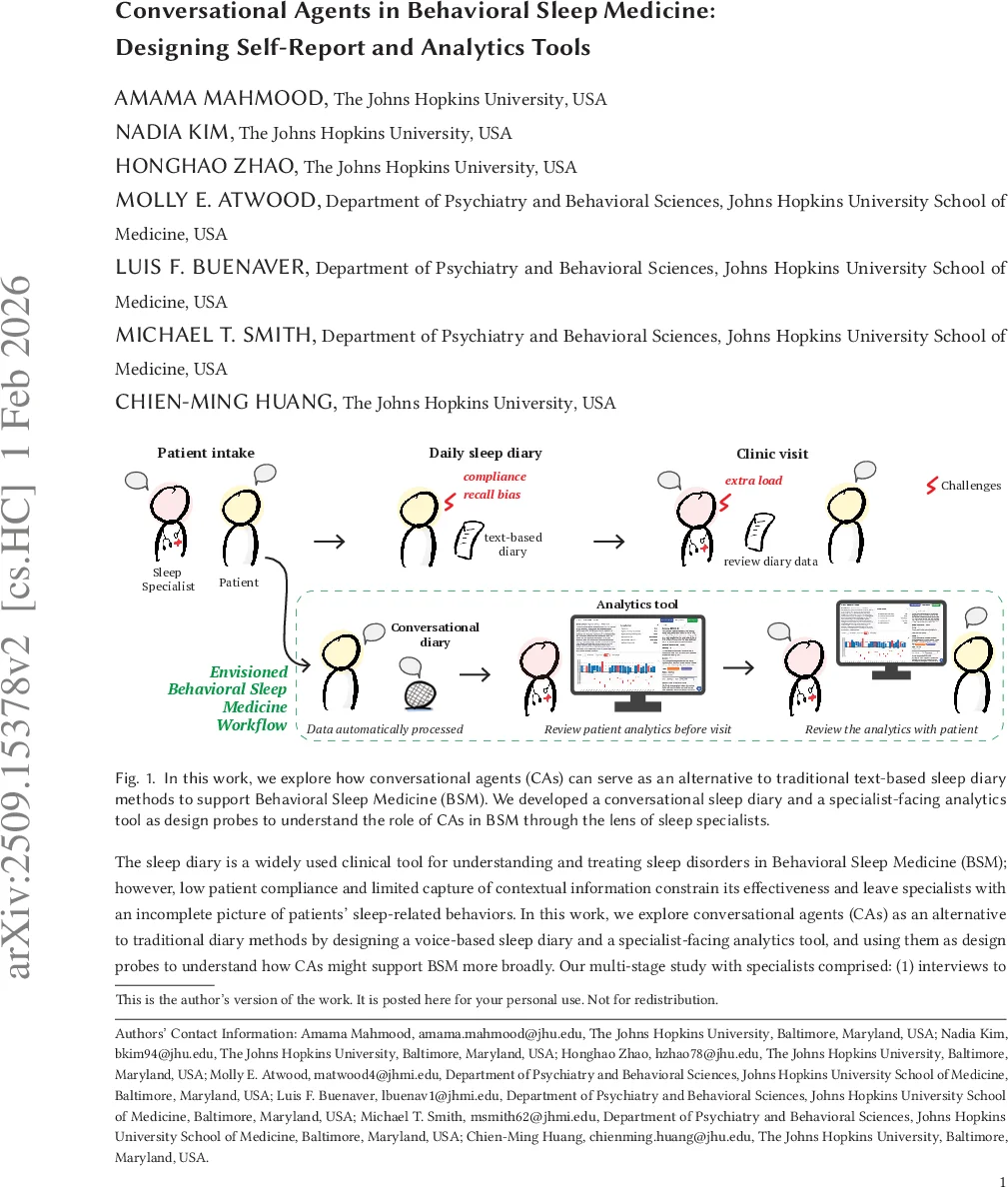
The sleep diary is a widely used clinical tool for understanding and treating sleep disorders in Behavioral Sleep Medicine (BSM); however, low patient compliance and limited capture of contextual information constrain its effectiveness and leave specialists with an incomplete picture of patients’ sleep-related behaviors. In this work, we explore conversational agents (CAs) as an alternative to traditional diary methods by designing a voice-based sleep diary and a specialist-facing analytics tool, and using them as design probes to understand how CAs might support BSM more broadly. Our multi-stage study with specialists comprised: (1) interviews to identify shortcomings of current text-based diaries, (2) iterative co-design of the conversational diary and analytics tool, and (3) focus groups to examine broader opportunities for CAs in BSM. This work offers empirical insights into how specialists envision CAs in clinical care and outlines design implications for integrating them into existing self-report practices and behavioral interventions.
💡 Research Summary
This paper investigates how conversational agents (CAs) can address longstanding shortcomings of traditional text‑based sleep diaries in Behavioral Sleep Medicine (BSM). Sleep diaries are essential for diagnosing and treating sleep disorders, especially within Cognitive Behavioral Therapy for Insomnia (CBT‑I), yet they suffer from low patient compliance, recall bias, limited capture of contextual factors (e.g., stress, environment), and a heavy manual analysis burden for clinicians. To explore whether a voice‑based, AI‑driven approach could mitigate these issues, the authors conducted a multi‑stage, specialist‑centered design study.
First, semi‑structured interviews with sleep specialists identified four primary pain points: (1) patient burden leading to poor adherence, (2) retrospective “back‑filling” causing inaccurate reports, (3) insufficient contextual information, and (4) time‑consuming manual data extraction and interpretation. These findings echoed prior literature but added nuanced insights about how diary data are often unavailable until the clinical visit, forcing clinicians to spend unpaid “pajama time” preparing for appointments.
Guided by these insights, the research team co‑designed two complementary prototypes with the specialists. The first is a large‑language‑model (LLM) powered conversational sleep diary that operates via voice (e.g., smart speakers or mobile devices). Patients answer natural‑language prompts such as “What time did you go to bed last night?” The system transcribes speech, uses the LLM to map free‑form responses onto structured fields (sleep onset latency, total sleep time, number of awakenings) while simultaneously preserving unstructured narrative content (e.g., caffeine intake, stress level, bedroom temperature). Real‑time entry reduces recall bias, and the conversational format encourages richer, more contextual reporting.
The second prototype is a specialist‑facing analytics dashboard. It ingests the structured metrics and the free‑text narratives, aligns them with objective actigraphy data, and presents them through interactive time‑series visualizations, clustering‑based pattern detection, and LLM‑generated summaries. Crucially, the dashboard automatically extracts clinically relevant cues from the narrative (e.g., “felt anxious due to work deadline”) and highlights them with color‑coded tags, thereby dramatically cutting down the manual coding effort.
After iterative refinement, the authors convened focus groups with the same specialists to envision broader applications of CAs in BSM beyond diary collection. Participants imagined using the conversational agent for pre‑treatment interviews, real‑time behavioral nudges, and post‑session reinforcement. For instance, the LLM could detect heightened anxiety in a patient’s narrative and deliver tailored CBT‑I educational content before the next session, or send motivational reminders during the night to encourage adherence to sleep restriction protocols.
Key outcomes of the study include: (1) evidence that a voice‑based, conversational diary improves patient engagement compared with static text forms; (2) demonstration that automated analytics can provide clinicians with longitudinal, context‑rich views of patient data without adding to their workload; and (3) identification of a roadmap for integrating CAs into the full therapeutic workflow of BSM, from intake through ongoing monitoring and feedback.
Limitations are acknowledged: the prototypes were evaluated in a limited pilot setting, the long‑term accuracy of LLM‑extracted information remains to be validated, and privacy/security considerations for voice data need rigorous handling. Future work should involve large‑scale clinical trials to quantify effects on treatment outcomes, assess usability across diverse patient populations, and develop standardized interoperability with electronic health record systems.
In sum, the paper makes three contributions: (1) empirical specialist insights into diary shortcomings, (2) a co‑designed LLM‑driven conversational diary and specialist analytics tool, and (3) a vision of how conversational agents can expand to support behavioral interventions throughout the BSM care continuum. The study illustrates that AI‑enhanced conversational interfaces can both enrich self‑report data and streamline clinician workflows, offering a promising path toward more effective, patient‑centered sleep medicine.
Comments & Academic Discussion
Loading comments...
Leave a Comment