Compact Moduli Spaces of Marked Cubic Plane Curves
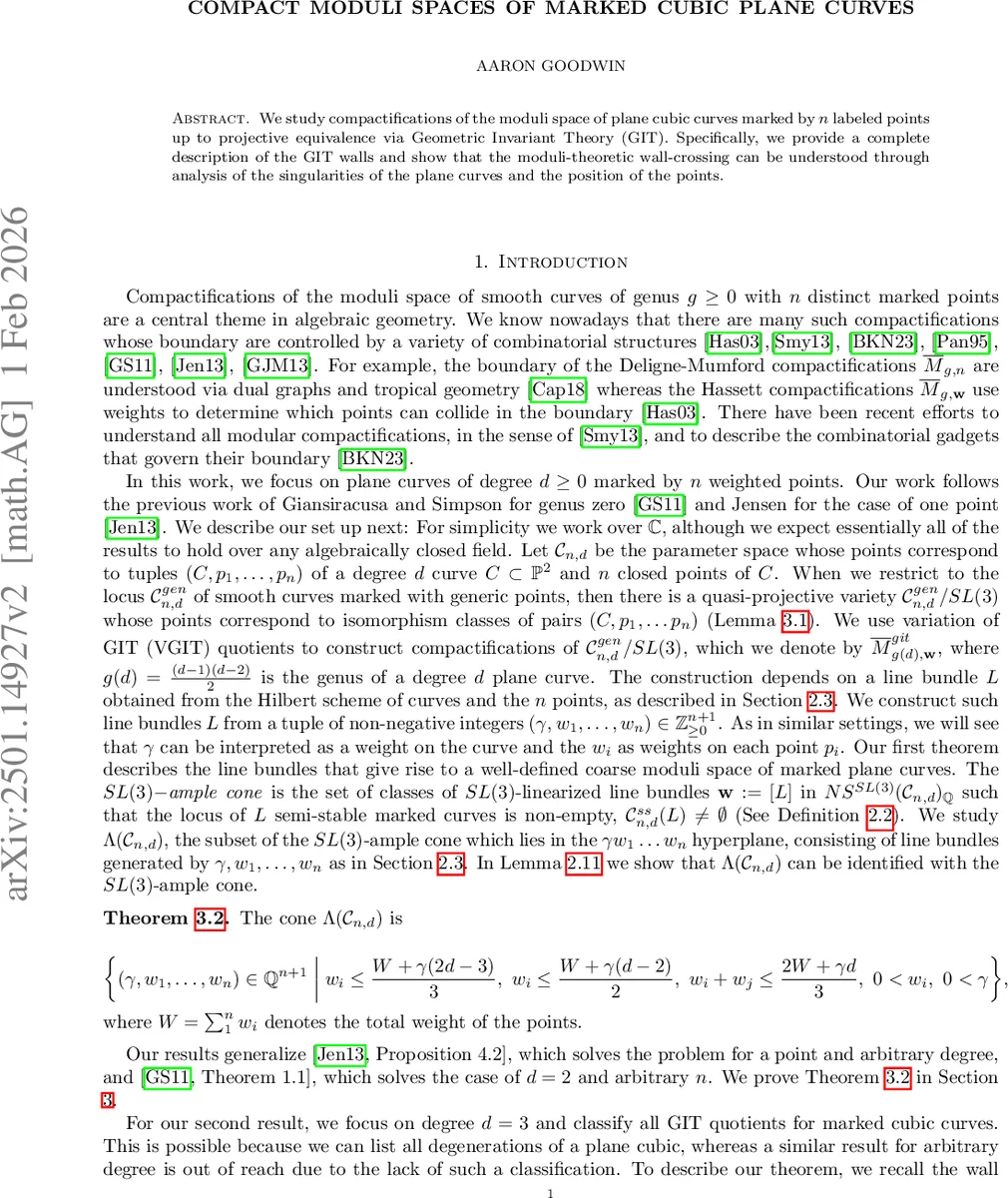
We study compactifications of the moduli space of a plane cubic curve marked by (n) labeled points up to projective equivalence via Geometric Invariant Theory (GIT). Specifically, we provide a complete description of the GIT walls and show that the moduli-theoretic wall-crossing can be understood through analysis of the singularities of the plane curves and the position of the points.
💡 Research Summary
The paper investigates compactifications of the moduli space of plane cubic curves equipped with n distinct labeled points, using Geometric Invariant Theory (GIT) and its variation (VGIT). The authors first set up a parameter space C_{n,d} whose points correspond to tuples (C, p₁,…,pₙ) with C a degree‑d plane curve and the pᵢ closed points on C. For smooth curves (the locus C_{g, en, d}) the quotient by SL(3) gives a quasi‑projective variety that parametrizes isomorphism classes of marked curves.
A linearization of the SL(3)‑action is encoded by a tuple (γ, w₁,…,wₙ) of non‑negative integers: γ is a weight on the curve, while each wᵢ weights the corresponding marked point. The authors determine precisely which such tuples give rise to a non‑empty semistable locus, thereby describing the SL(3)‑ample cone Λ(C_{n,d}) (Theorem 3.2). The cone is defined by a system of linear inequalities involving γ, wᵢ, and the total point weight W=∑wᵢ. In particular, for any d≥2, the inequalities
wᵢ ≤ W + γ·(2d−3)/3, wᵢ ≤ W + γ·(d−2)/2, wᵢ + wⱼ ≤ 2W + γ·d/3,
together with γ>0, wᵢ>0, describe the entire ample cone.
The core of the paper focuses on the cubic case d=3, where the classification of plane cubic singularities (A₁, A₂, A₃, D₄) is finite and well‑understood. Using this classification, the authors give a complete list of all interior GIT walls inside Λ(C_{n,3}). Theorem 5.1 shows that there are four families of walls, each associated to a specific singular curve type and a combinatorial choice of marked points:
- 3A₁ walls – the union of three non‑concurrent lines, with a subset I of points colliding at the node formed by two of the lines.
- A₂ walls – a cuspidal cubic, with points in I concentrated at the cusp.
- A₃ walls – a conic together with a tangent line (a tacnode), with points in I at the tacnode and points in J on the linear component.
- D₄ walls – a D₄‑type singular cubic (a cone over three points), with points in I at the singularity and three further subsets B₁,B₂,B₃ distributed on the three linear components.
Each wall is described as the intersection of a hyperplane (given by a linear equation in the wᵢ and γ) with a collection of half‑spaces that encode boundary conditions (e.g., inequalities ensuring that the hyperplane actually cuts the interior of the cone). The hyperplane equations are explicitly listed in Table 1 of the paper.
The authors then analyze the wall‑crossing behavior (Theorem 5.2). For each wall type, they introduce three canonical curves: S(T,I,0) (the strictly semistable curve lying on the wall), S(T,I,−) (the stable curve on the “negative” side), and S(T,I,+) (the stable curve on the “positive” side). For instance, crossing a 3A₁ wall replaces a stable nodal cubic (with the points of I at the node) by a stable union of a conic and a transverse line (with the points of I on the conic). Similar explicit descriptions are given for the A₂, A₃, and D₄ cases, detailing how the marked points redistribute among components and singularities as the linearization moves across the wall.
Beyond the intrinsic GIT analysis, the paper connects these compactifications to other known moduli spaces. Using Radu Laza’s work on pairs (C,L) where C is a cubic and L a line, the authors identify a specific chamber (characterized by w₁>1, w₂>1, w₁+w₂<3) whose GIT quotient is isomorphic to the weighted projective space P(1,2,2,3). This yields an explicit isomorphism between the moduli of cubic curves with two labeled points and Laza’s labeled‑pair space M_{(1,3)}^{lab}.
Furthermore, they construct an enlarged parameter space C’{n,3} that records, in addition to the n marked points, a distinguished inflection point of the cubic. The resulting GIT quotient M{git}^{+}(1,w) is shown to contain the moduli space M_{1,n+1} of genus‑1 curves with n+1 marked points as an open subset, thereby linking the plane cubic picture to the classical moduli of elliptic curves.
Methodologically, the paper relies heavily on the Hilbert–Mumford numerical criterion: for any one‑parameter subgroup λ of SL(3), the authors compute the associated weight function μ^L(x,λ) in terms of γ and the wᵢ. This allows them to translate stability conditions into explicit linear inequalities, which in turn define the walls. The analysis of stabilizers (positive‑dimensional for the strictly semistable curves) and the identification of closed orbits are carried out using classical invariant theory of plane cubics.
In summary, the work provides a complete GIT‑theoretic description of the compactified moduli of marked plane cubics: it determines the ample cone, enumerates all interior walls, explicates the geometric transitions across each wall, and situates the resulting spaces within the broader landscape of moduli theory (Hassett‑type weighted points, Laza’s cubic‑pair spaces, and elliptic curve moduli). The techniques and results lay groundwork for extending similar analyses to higher‑degree plane curves, where the classification of singularities becomes more intricate, and suggest further exploration of the interplay between GIT, VGIT, and modular compactifications.
Comments & Academic Discussion
Loading comments...
Leave a Comment