Decay of solutions of nonlinear Dirac equations: the 2D case
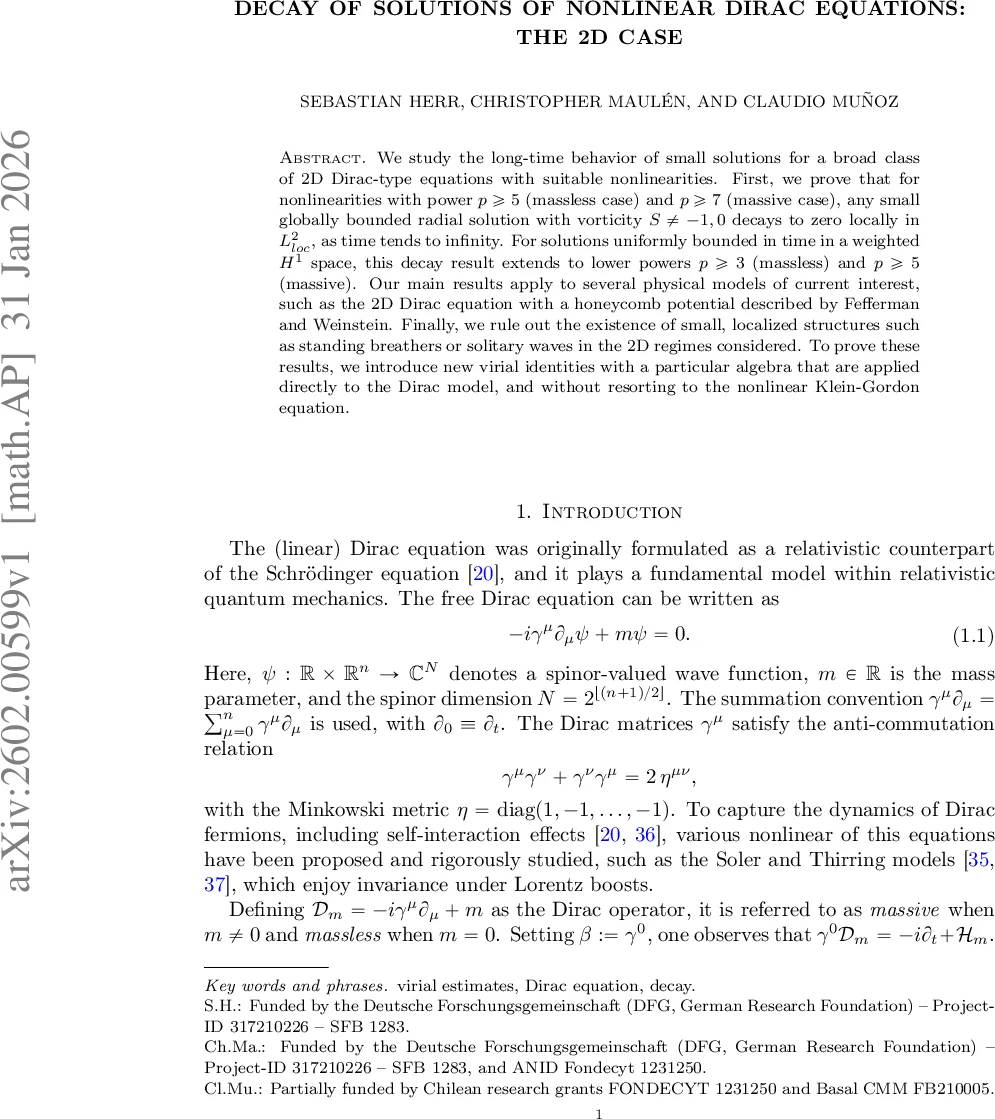
We study the long-time behavior of small solutions for a broad class of 2D Dirac-type equations with suitable nonlinearities. First, we prove that for nonlinearities with power $p\geq 5$ (massless case) and $p\geq7$ (massive case), any small globally bounded radial solution with vorticity $S\ne -1,0$ decays to zero locally in $L^2_{loc}$, as time tends to infinity. For solutions uniformly bounded in time in a weighted $H^1$ space, this decay result extends to lower powers $p\geq 3$ (massless) and $p\geq5$ (massive). Our main results apply to several physical models of current interest, such as the 2D Dirac equation with a honeycomb potential described by Fefferman and Weinstein. Finally, we rule out the existence of small, localized structures such as standing breathers or solitary waves in the 2D regimes considered. To prove these results, we introduce new virial identities with a particular algebra that are applied directly to the Dirac model, and without resorting to the nonlinear Klein-Gordon equation.
💡 Research Summary
The paper investigates the long‑time dynamics of small solutions to a broad class of two‑dimensional (2D) nonlinear Dirac equations. The authors focus on equations of the form
i ∂ₜψ = Dₘψ + W(ψ),
where Dₘ = −iγ^μ∂_μ + m is the Dirac operator (massless when m = 0, massive otherwise) and W is a polynomial‑type nonlinearity satisfying a structural gauge symmetry. By imposing a radial ansatz with a non‑trivial vorticity parameter S∈ℤ{0, −1}, the system reduces to a 2×2 complex radial system for the components (ϕ₁, ϕ₂).
The main results are two decay theorems. In the first theorem, assuming the nonlinearity behaves like |ϕ|^{p} for small amplitudes, the authors prove that any global solution which remains uniformly bounded in a weighted Sobolev space E_δ (defined by the norm ∥ψ∥{E_δ}² = ∫(r^{2δ}|∇ψ|² + r^{2δ‑2}|ψ|²)dx) decays locally in L²: for every fixed radius R,
lim{t→∞} ∥ϕ(t)∥_{L²(B_R)} = 0.
This holds provided the power p exceeds a critical threshold: p ≥ 5 in the massless case and p ≥ 7 in the massive case. Consequently, no small, localized standing structures (breathers or solitary waves) can exist in these regimes.
The second theorem shows that if, in addition, the solution is uniformly bounded in a weighted H¹ space (which yields an L⁸ control), the required power can be lowered to p ≥ 3 (massless) and p ≥ 5 (massive). The extra regularity compensates for the lack of strong Sobolev embeddings in two dimensions.
The novelty lies in the derivation of new virial identities that act directly on the Dirac operator, avoiding the usual “Klein‑Gordon trick” of converting the system into a second‑order wave equation. The authors introduce a radial weight a(r) = r χ_R(r) and define a virial functional V(t) = ∫ a(r) Im(ϕ·α·∇ϕ̄) dx. Differentiating V(t) in time and using the structural gauge symmetry, they obtain an inequality of the form V′(t) ≤ −C∥ϕ(t)∥_{L²(B_R)}² plus higher‑order terms that are controlled when p is large enough or when an L⁸ bound is available. Grönwall’s inequality then yields the desired local L² decay.
The analysis also treats the specific physically relevant model introduced by Fefferman and Weinstein for graphene‑like honeycomb lattices. In that model the nonlinearity takes the form
W₁ = (β₁|ϕ₁|² + β₂|ϕ₂|²)ϕ₁, W₂ = (β₂|ϕ₁|² + β₁|ϕ₂|²)ϕ₂,
which satisfies the gauge symmetry and the polynomial growth condition, so the decay theorems apply directly. This rules out the existence of small stationary or breathing states in the honeycomb Dirac model under the stated regularity assumptions.
The paper situates its contributions within the existing literature: previous works have established decay for 1D and 3D Dirac equations, often relying on better Sobolev embeddings or on transforming the problem into a nonlinear Klein‑Gordon equation. In 2D, the slower linear decay (t⁻¹) and the lack of an L⁸ embedding make the analysis substantially harder. By working directly with the Dirac operator and exploiting the radial/vorticity structure, the authors overcome these obstacles.
Finally, the authors discuss open problems: extending the results to the excluded vorticity values S = 0 or S = −1, handling non‑polynomial or gauge‑symmetry‑breaking nonlinearities, and performing numerical simulations to illustrate the virial mechanism. The work provides a robust framework for proving the absence of small localized structures in a wide class of 2D nonlinear Dirac equations, with immediate relevance to models of graphene and other Dirac materials.
Comments & Academic Discussion
Loading comments...
Leave a Comment