Essential Ingredient for Radial-Composition Correlations in Two-Component Many-Body Systems: Short-Range Attractive Central Force
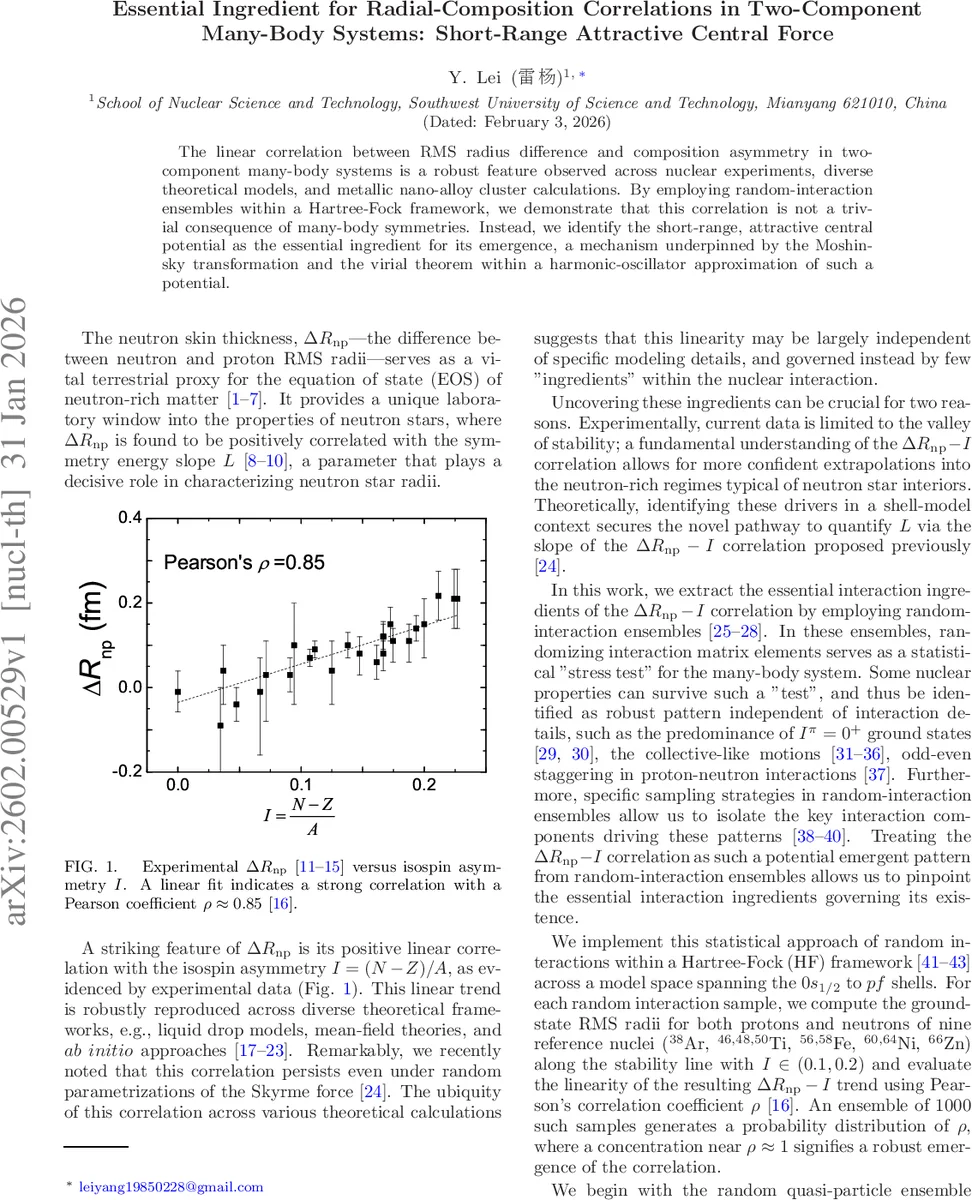
The linear correlation between RMS radius difference and composition asymmetry in two-component many-body systems is a robust feature observed across nuclear experiments, diverse theoretical models, and metallic nano-alloy cluster calculations. By employing random-interaction ensembles within a Hartree-Fock framework, we demonstrate that this correlation is not a trivial consequence of many-body symmetries. Instead, we identify the short-range, attractive central potential as the essential ingredient for its emergence, a mechanism underpinned by the Moshinsky transformation and the virial theorem within a harmonic-oscillator approximation of such a potential.
💡 Research Summary
The paper investigates a striking linear correlation between the root‑mean‑square (RMS) radius difference (ΔR) of the two components in a many‑body system and the asymmetry of their composition (I). This correlation has been observed in a wide range of nuclear experiments, theoretical models (liquid‑drop, mean‑field, ab‑initio) and even in metallic nano‑alloy clusters (Au‑Ag). The authors ask whether this linearity is a trivial consequence of generic many‑body symmetries or whether it stems from specific ingredients of the underlying interaction.
To address this, they construct random‑interaction ensembles (RIE) within a Hartree‑Fock (HF) framework. For each random sample they compute ground‑state neutron and proton RMS radii for nine nuclei (38Ar, 46‑50Ti, 56‑58Fe, 60‑64Ni, 66Zn) spanning isospin asymmetries I≈0.1–0.2. The Pearson correlation coefficient ρ between ΔR_np and I is used as a quantitative measure of linearity. An ensemble of 1000 RIE samples yields a distribution of ρ values.
Four types of ensembles are examined: (i) random quasi‑particle ensemble (RQE) that maximizes interaction freedom while preserving fundamental symmetries, (ii) random central‑force ensemble, (iii) random tensor‑force ensemble, and (iv) random spin‑orbit ensemble. The RQE, tensor, and spin‑orbit ensembles produce virtually no samples with ρ>0.9, indicating that symmetry alone does not guarantee the observed linearity. In contrast, the random central‑force ensemble shows a pronounced peak at ρ≈0.95, with about 20 % of samples exceeding ρ>0.8. This identifies the central (radial) part of the nuclear force as the primary driver.
The authors then focus on the “successful” central‑force samples (ρ>0.85). They average the singlet (S=0) and triplet (S=1) radial matrix elements V_S^{n′l}_{nl} and compare them with the matrix elements of a three‑dimensional harmonic‑oscillator (HO) potential ⟨n′l|r²|nl⟩. The successful samples display a near‑linear scaling for Δn=n′−n=0,1 and a strong suppression for |Δn|>1, effectively reproducing the HO selection rules. This suggests that the essential physics can be captured by an effective HO‑type mean field.
Through the Moshinsky transformation, a two‑body HO interaction can be recast as independent particles moving in a global HO potential. In such a potential the virial theorem enforces a proportionality between a single‑particle energy and its mean‑square radius. Consequently, as nucleons (or atoms) fill higher HO shells, the spatial extent of each species grows linearly with particle number, producing a direct proportionality between composition asymmetry I and radius difference ΔR.
To verify the emergence of an HO‑like mean field, the authors analyze the HF single‑particle spectra of the successful samples. They find clear shell gaps at the HO magic numbers (2, 8, 28) and quantify “HO‑likeness” using two metrics: the ratio of average intra‑shell spacing to major gaps (h_gi/h_Gi) and the relative variance of major gaps (ΔG/h_Gi). Successful samples cluster at low values of both metrics, confirming that the underlying mean field closely resembles an HO potential.
A further test employs a parametrized central HO potential V(r)=V₀(r−r₀)². A repulsive HO (V₀<0) yields a negative correlation (ρ≈−0.8), whereas an attractive HO (V₀>0) produces robust positive correlations, especially when the minimum lies within r₀≲1.5 p/ℏω. Increasing the attraction strength (V₀≥2) drives P(ρ>0.9) to 100 %. This demonstrates that a short‑range attractive central force is both necessary and sufficient for the ΔR‑I linearity.
The universality of the mechanism is illustrated by extending the analysis to AuₓAg₃₀₉₋ₓ nano‑alloy clusters, where the pair potential is also short‑range and attractive. By defining ΔR_Au‑Ag and I_Au‑Ag analogously to the nuclear case, the authors find piecewise linear relationships with ρ≥0.97, each segment corresponding to the filling of specific electronic shells. This mirrors the nuclear shell‑filling behavior and confirms that the same underlying physics operates across vastly different energy and size scales.
In summary, the paper provides a comprehensive, statistically robust demonstration that the linear ΔR‑I correlation in two‑component many‑body systems originates from three intertwined ingredients: (1) a short‑range attractive central interaction, (2) the emergence of an effective harmonic‑oscillator‑like mean field, and (3) the virial theorem linking single‑particle energy to spatial extent. The result is a universal fingerprint of short‑range attraction, applicable to nuclei, atomic clusters, and potentially any binary many‑body system where the interaction is dominated by a short‑range attractive central component.
Comments & Academic Discussion
Loading comments...
Leave a Comment