Localized, High-resolution Geographic Representations with Slepian Functions
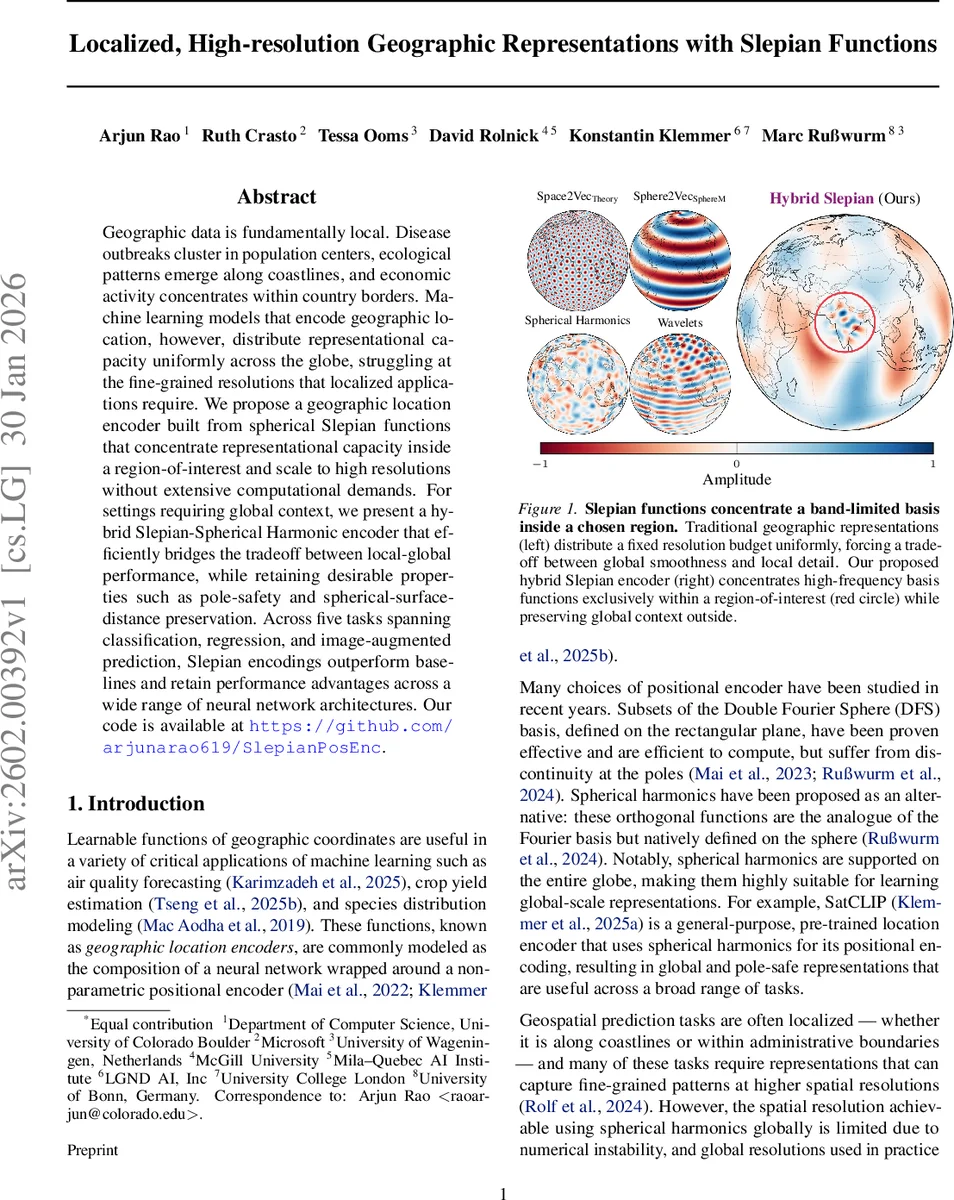
Geographic data is fundamentally local. Disease outbreaks cluster in population centers, ecological patterns emerge along coastlines, and economic activity concentrates within country borders. Machine learning models that encode geographic location, however, distribute representational capacity uniformly across the globe, struggling at the fine-grained resolutions that localized applications require. We propose a geographic location encoder built from spherical Slepian functions that concentrate representational capacity inside a region-of-interest and scale to high resolutions without extensive computational demands. For settings requiring global context, we present a hybrid Slepian-Spherical Harmonic encoder that efficiently bridges the tradeoff between local-global performance, while retaining desirable properties such as pole-safety and spherical-surface-distance preservation. Across five tasks spanning classification, regression, and image-augmented prediction, Slepian encodings outperform baselines and retain performance advantages across a wide range of neural network architectures.
💡 Research Summary
The paper addresses a fundamental mismatch between the inherently local nature of many geospatial phenomena and the uniform, global resolution of most learned geographic position encoders. Traditional encoders such as Double Fourier Sphere (DFS), Random Fourier Features, or spherical harmonics (SH) allocate the same amount of representational capacity to every point on the Earth. While SH are mathematically elegant and pole‑safe, they become numerically unstable beyond modest band‑limits (L ≈ 40) in 32‑bit or mixed‑precision training, and achieving fine‑grained detail requires a quadratic increase in dimensionality, which is computationally prohibitive.
To overcome these limitations, the authors propose using spherical Slepian functions as a regional positional encoding basis. A Slepian function is a band‑limited function that maximally concentrates its energy inside a prescribed region R ⊂ S². Solving the concentration problem yields an eigenvalue problem K g = µ g, where K is a symmetric matrix built from integrals of SH over R. The eigenvalues µ quantify how much of each mode’s energy lies inside R. The trace of K, known as the regional Shannon number N(R, Lᵣ) ≈ (area(R)/4π)*(Lᵣ+1)², provides an “information budget” for the region at a given band‑limit Lᵣ. By selecting the top K = ⌈N⌉ eigenfunctions (those with µ≈1), the encoder captures high‑frequency detail where it matters while discarding modes that are essentially zero inside R.
Computationally, constructing Slepian functions for arbitrary regions would require solving a dense eigenproblem of size D = (Lᵣ+1)², which is infeasible for high Lᵣ. The authors therefore restrict themselves to spherical caps—circular patches defined by an angular radius Θ. For caps the concentration matrix block‑diagonalizes by order m, reducing each block to at most Lᵣ × Lᵣ. This makes it possible to pre‑compute high‑resolution cap Slepian bases once, then rotate them to any desired center, avoiding the O(D²) cost. The number of well‑concentrated modes for a cap is analytically N_Θ(Lᵣ) = (1 − cos Θ)/2 · (Lᵣ+1)², giving a direct handle on the trade‑off between region size and dimensionality.
Because a pure regional Slepian encoder lacks global context, the authors introduce a hybrid encoder. It concatenates (i) a high‑resolution regional Slepian component Φ_Slep(x) (computed at Lᵣ) and (ii) a low‑resolution global SH component Φ_SH(x) (computed at a much smaller L_g). The resulting feature vector Φ_Hybrid(x) =
Comments & Academic Discussion
Loading comments...
Leave a Comment