On Safer Reinforcement Learning Policies for Sedation and Analgesia in Intensive Care
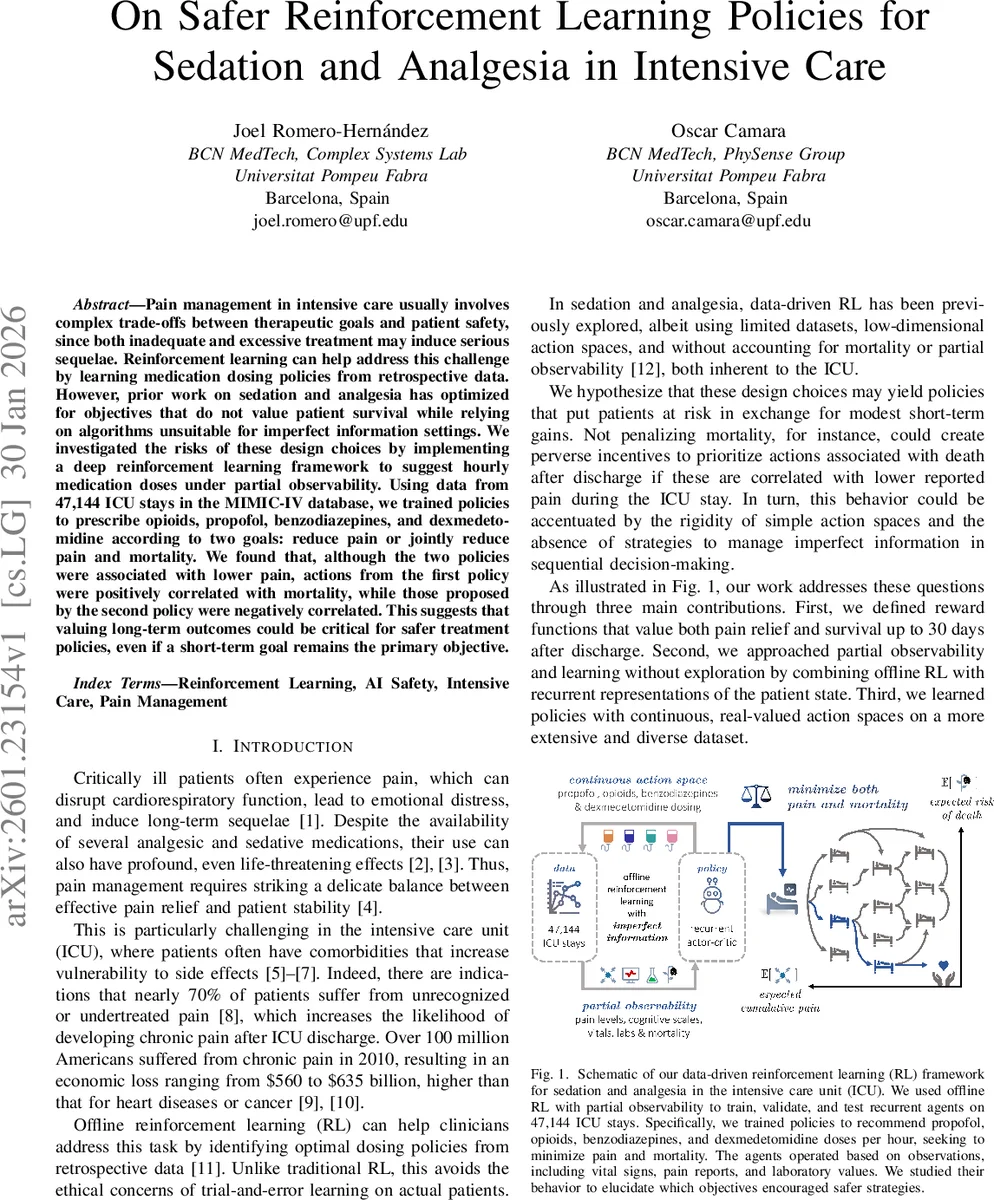
Pain management in intensive care usually involves complex trade-offs between therapeutic goals and patient safety, since both inadequate and excessive treatment may induce serious sequelae. Reinforcement learning can help address this challenge by learning medication dosing policies from retrospective data. However, prior work on sedation and analgesia has optimized for objectives that do not value patient survival while relying on algorithms unsuitable for imperfect information settings. We investigated the risks of these design choices by implementing a deep reinforcement learning framework to suggest hourly medication doses under partial observability. Using data from 47,144 ICU stays in the MIMIC-IV database, we trained policies to prescribe opioids, propofol, benzodiazepines, and dexmedetomidine according to two goals: reduce pain or jointly reduce pain and mortality. We found that, although the two policies were associated with lower pain, actions from the first policy were positively correlated with mortality, while those proposed by the second policy were negatively correlated. This suggests that valuing long-term outcomes could be critical for safer treatment policies, even if a short-term goal remains the primary objective.
💡 Research Summary
This paper tackles the critical problem of balancing analgesia and sedation in intensive care units (ICUs) by developing safer reinforcement learning (RL) policies that operate under partial observability. Using a large cohort of 47,144 ICU stays extracted from the MIMIC‑IV database, the authors construct a partially observable Markov decision process (POMDP) where the hidden patient state is inferred from a history of 22 hourly observations (vital signs, laboratory values, pain scores, neurological assessments, etc.) and four continuous medication actions (opioids, propofol, benzodiazepines, dexmedetomidine).
The methodological pipeline consists of three main components: (1) a recurrent state encoder built from gated recurrent units (GRU) that learns to predict the next observation and the probability of 30‑day mortality, thereby providing a compact latent representation of the patient’s condition; (2) a double‑critic architecture (two independent Q‑networks) that estimates the expected return for any continuous dosage vector, using the minimum of the two critics to mitigate over‑estimation bias; and (3) a behavior‑regularized actor network that proposes dosage vectors by maximizing the first critic’s value while staying close to the clinician’s recorded actions through an L2 behavior‑cloning term. The actor‑critic system is trained entirely offline (off‑policy) with target networks updated via Polyak averaging, which reduces distributional shift between the behavior policy and the learned policy.
Crucially, the authors design two reward functions to explore the impact of safety considerations. Both rewards penalize higher pain scores at each timestep, scaled by a weight wₛ. The first reward (Policy A) sets the mortality weight wₘ to zero, thus ignoring long‑term survival and focusing solely on short‑term pain reduction. The second reward (Policy B) assigns wₘ = 10 × wₛ, making a unit increase in mortality ten times more costly than any possible improvement in pain, thereby explicitly encouraging survival‑aware behavior.
Training proceeds on 64 % of the data, with 16 % reserved for validation and 20 % held out for post‑hoc policy analysis. Missing values are first imputed with a sample‑and‑hold approach, then refined using multiple imputation by chained equations (MICE). Outliers are removed using quantile thresholds appropriate for each variable type. Hyperparameters (latent dimension 64, two hidden layers per network, tanh for the encoder, LeakyReLU for the critics and actor, orthogonal initialization, etc.) are selected based on validation performance.
Results show that both policies achieve lower average pain scores on the test set compared with the clinician baseline. However, actions suggested by Policy A are positively correlated with 30‑day mortality, indicating that a pain‑only objective can produce dangerous dosing patterns. In contrast, Policy B’s recommendations are negatively correlated with mortality, demonstrating that incorporating a survival penalty leads to safer, more clinically acceptable strategies. The analysis also highlights that the recurrent encoder successfully captures both short‑term dynamics (vital sign trends) and long‑term risk (mortality probability), enabling the actor to make informed trade‑offs.
The paper’s contributions are threefold: (i) it introduces a scalable off‑policy RL framework that respects the partial‑information nature of ICU data; (ii) it demonstrates the feasibility of learning continuous, multi‑drug dosing policies from a substantially larger dataset than prior work; and (iii) it empirically validates that reward designs which value long‑term outcomes are essential for safety‑critical medical applications. Limitations include the binary terminal mortality penalty (which may not capture nuanced pre‑mortality risk) and the reliance on offline evaluation, which necessitates prospective clinical trials before deployment.
In summary, this study provides strong evidence that reinforcement learning policies for sedation and analgesia must explicitly incorporate survival considerations to avoid perverse incentives and to ensure patient safety, offering a robust blueprint for future AI‑driven decision support systems in critical care.
Comments & Academic Discussion
Loading comments...
Leave a Comment