Do Good, Stay Longer? Temporal Patterns and Predictors of Newcomer-to-Core Transitions in Conventional OSS and OSS4SG
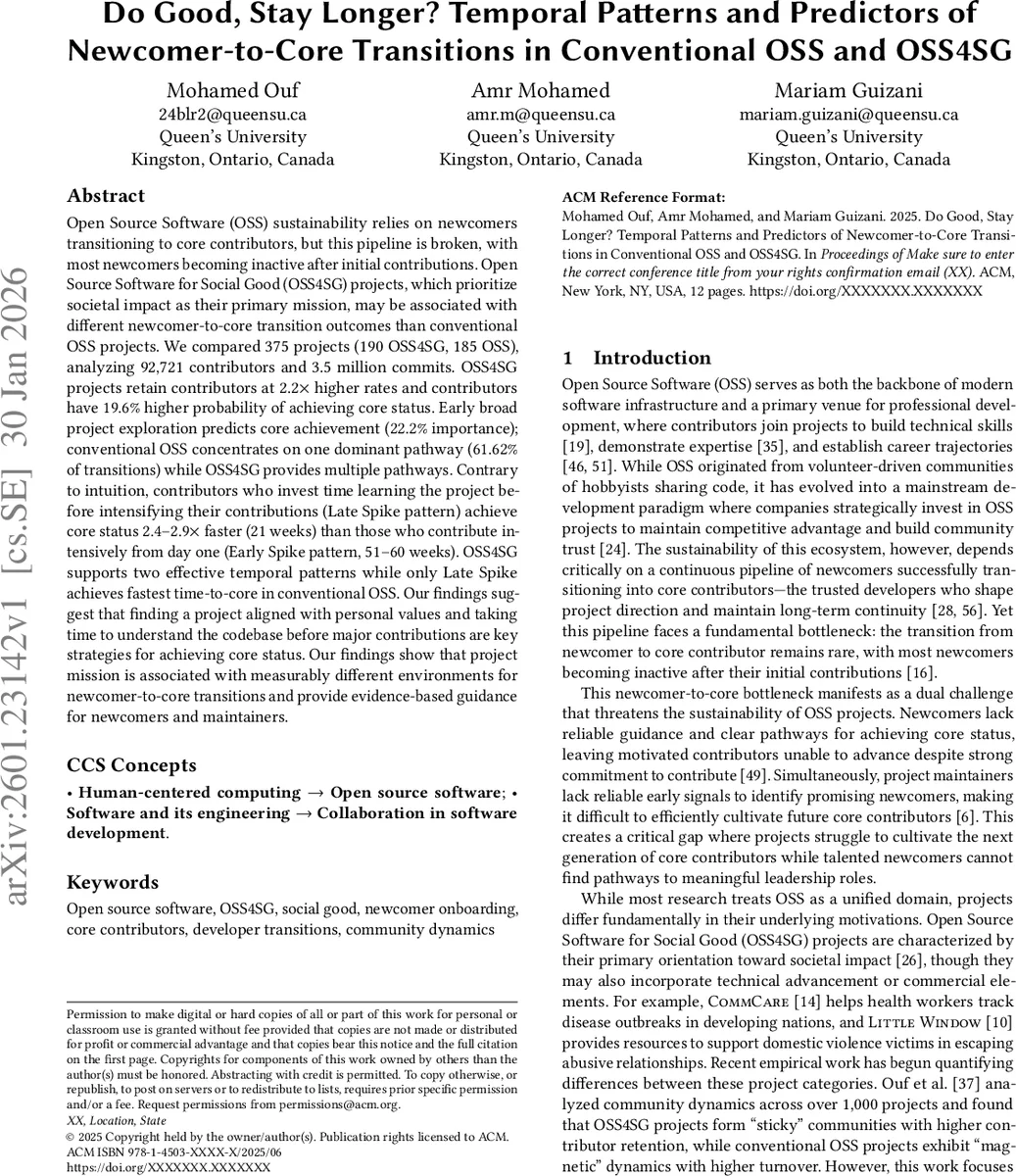
Open Source Software (OSS) sustainability relies on newcomers transitioning to core contributors, but this pipeline is broken, with most newcomers becoming inactive after initial contributions. Open Source Software for Social Good (OSS4SG) projects, which prioritize societal impact as their primary mission, may be associated with different newcomer-to-core transition outcomes than conventional OSS projects. We compared 375 projects (190 OSS4SG, 185 OSS), analyzing 92,721 contributors and 3.5 million commits. OSS4SG projects retain contributors at 2.2X higher rates and contributors have 19.6% higher probability of achieving core status. Early broad project exploration predicts core achievement (22.2% importance); conventional OSS concentrates on one dominant pathway (61.62% of transitions) while OSS4SG provides multiple pathways. Contrary to intuition, contributors who invest time learning the project before intensifying their contributions (Late Spike pattern) achieve core status 2.4-2.9X faster (21 weeks) than those who contribute intensively from day one (Early Spike pattern, 51-60 weeks). OSS4SG supports two effective temporal patterns while only Late Spike achieves fastest time-to-core in conventional OSS. Our findings suggest that finding a project aligned with personal values and taking time to understand the codebase before major contributions are key strategies for achieving core status. Our findings show that project mission is associated with measurably different environments for newcomer-to-core transitions and provide evidence-based guidance for newcomers and maintainers.
💡 Research Summary
This paper investigates the newcomer‑to‑core contributor pipeline in two distinct categories of open‑source software: conventional OSS projects and Open Source Software for Social Good (OSS4SG) projects, which prioritize societal impact. Using a rigorously constructed dataset of 375 projects (190 OSS4SG, 185 conventional OSS) that satisfy five quality criteria (minimum contributors, commits, closed pull requests, development history length, and recent activity), the authors analyze 92,721 contributors and 3.5 million commits. Core contributors are defined by the 80 % Pareto rule (the smallest set of developers accounting for 80 % of commits) and recomputed weekly to capture sustained core status.
Structural analysis reveals that OSS4SG projects retain contributors at 2.2 × the rate of conventional OSS, exhibit a 50 % higher weekly transition rate, and give newcomers a 19.6 % higher probability of becoming core members. These differences suggest that a social‑good mission creates a more “sticky” community, enhancing engagement and longevity.
Predictive modeling focuses on the first 30 days of activity. Feature importance analysis shows that early broad exploration—measured by the diversity of files and directories a newcomer touches—has the highest predictive power (22.2 % importance) for eventual core status across both project types. OSS4SG also grants direct commit access 4.2 × more frequently than conventional OSS, indicating a more permissive governance style.
Temporal dynamics are examined by clustering contribution intensity trajectories into three prototypical patterns: Early Spike (high activity at the outset that tapers off), Late Spike (low initial activity followed by a sharp increase), and Low/Gradual (steady low‑level activity). Contributors following the Late Spike pattern achieve core status in an average of 21 weeks, whereas Early Spike contributors require 51–60 weeks. In OSS4SG, both Late Spike and Low/Gradual patterns are equally effective, while in conventional OSS only Late Spike leads to the fastest transition. This counter‑intuitive finding challenges the common belief that “hit hard early” is the optimal strategy.
Pathway analysis further distinguishes the two ecosystems. Conventional OSS shows a dominant single pathway accounting for 61.62 % of all transitions, reflecting a relatively narrow set of milestones. OSS4SG, by contrast, exhibits multiple viable pathways, offering newcomers diverse routes to core status.
The authors derive actionable recommendations. For newcomers, aligning with a project’s social mission, spending time exploring the codebase broadly, and then intensifying contributions (Late Spike) maximizes the chance of rapid core integration. For maintainers, fostering an inclusive onboarding environment, allowing early low‑intensity contributions, and providing multiple avenues for gaining commit rights can cultivate future core developers, especially in OSS4SG contexts.
Methodologically, the study employs stratified sampling for conventional OSS, identity resolution via username‑and‑email normalization, and sensitivity analyses that confirm findings are robust to scaling by code size. All data and analysis scripts are publicly released (https://doi.org/10.5281/zenodo.17102959) to support replication and further research.
In sum, the mission of a project—social good versus conventional goals—has measurable effects on community structure, newcomer behavior, and the speed at which contributors ascend to core status. The paper provides the first large‑scale, comparative, and temporally aware examination of these phenomena, offering evidence‑based guidance for both aspiring contributors and project maintainers.
Comments & Academic Discussion
Loading comments...
Leave a Comment