Existence of Traveling Waves in Infinite Range FPUT Lattices
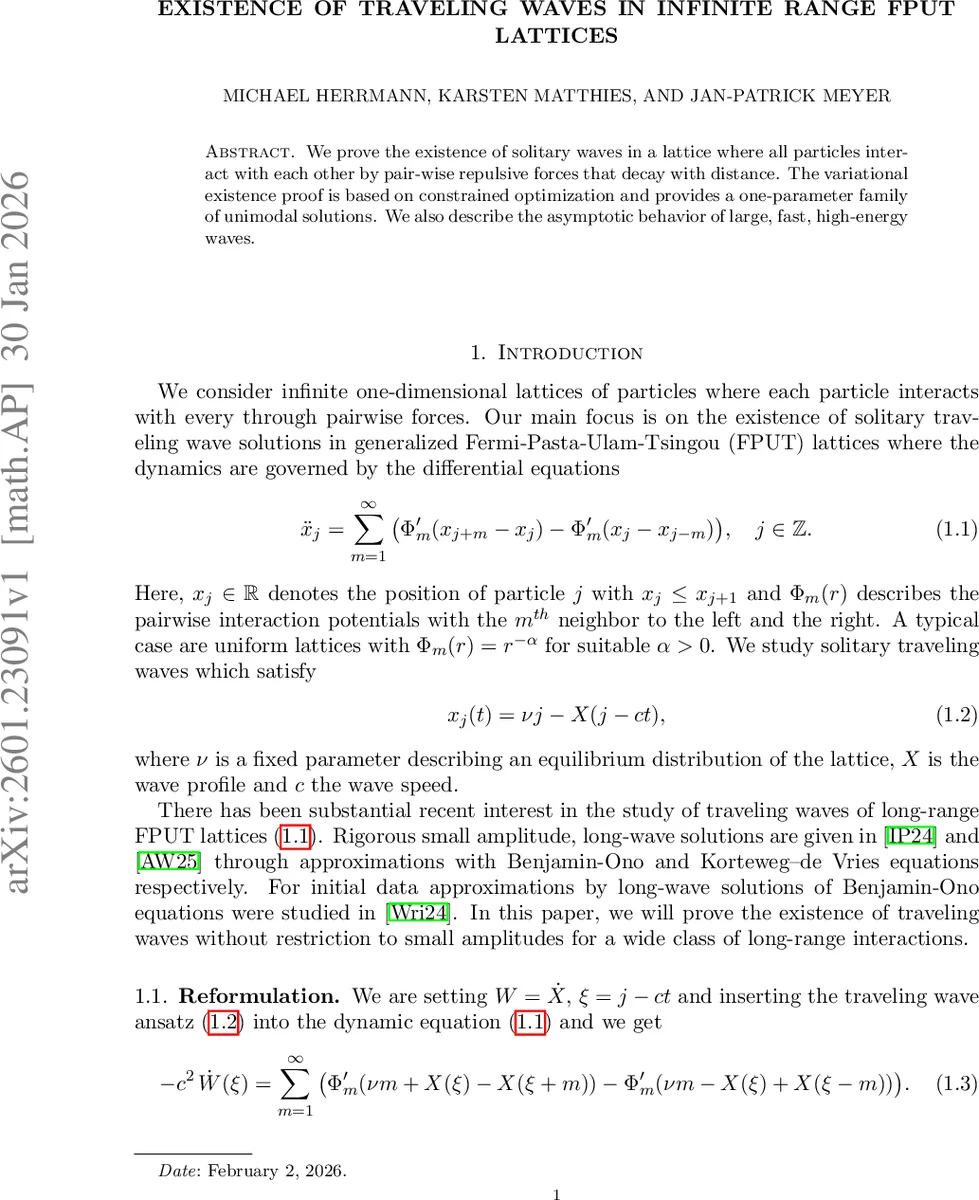
We prove the existence of solitary waves in a lattice where all particles interact with each other by pair-wise repulsive forces that decay with distance. The variational existence proof is based on constrained optimization and provides a one-parameter family of unimodal solutions. We also describe the asymptotic behavior of large, fast, high-energy waves.
💡 Research Summary
The paper addresses the existence of solitary traveling waves in an infinite one‑dimensional Fermi‑Pasta‑Ulam‑Tsingou (FPUT) lattice where each particle interacts with every other particle through a repulsive pair‑wise potential Φₘ(r) that decays with distance. The governing equations form an infinite sum (1.1) and, after inserting the traveling‑wave ansatz x_j(t)=ν_j−X(j−ct), reduce to a non‑local static equation (1.6) involving the convolution operators Aₘ. The authors’ main contribution is a rigorous variational existence proof that works for arbitrary amplitudes, not limited to the small‑amplitude, long‑wave regime previously studied via Benjamin‑Ono or KdV approximations.
The variational framework is built on the cone C of even, non‑negative, unimodal L²‑functions and its constrained subset C_K defined by the kinetic energy constraint ∥W∥₂²=2K with 0<K<ν²/2. The potential energy functional is P(W)=∫ℝ Σ{m≥1} Ψₘ(AₘW) ds, where Ψₘ(r)=Φₘ(νₘ−r)−Φₘ(νₘ)+Φₘ′(νₘ)r is a second‑order Taylor correction of Φₘ around the equilibrium distance νₘ. Under the structural assumptions (Φₘ∈C⁴, Φₘ′≤0, Φₘ″≥0, Φₘ‴≥0, strict for m=1) the corrected potentials satisfy Ψₘ(0)=Ψₘ′(0)=0, Ψₘ≥0 and are convex. Lemma 5–7 establish that P(W) is finite for all W∈C_K and that its Fréchet derivative ∂P(W)=Σ_{m≥1} Aₘ Ψₘ′(AₘW) belongs to L².
A key device is the improvement operator T(W)=μ(W) ∂P(W), μ(W)=∥W∥₂ ∥∂P(W)∥₂, which maps C_K into itself (Lemma 9) and strictly increases the potential energy unless W is already a fixed point (Lemma 10). Fixed points of T satisfy (1.6) with wave speed c=μ(W)−½, thus solving the original traveling‑wave problem. By constructing a maximizing sequence {W_n} for P on C_K and applying a concentration‑compactness argument, the authors obtain a strongly convergent subsequence whose limit W∈C_K is a maximizer. Consequently, a one‑parameter family {W_K, c_K} of solitary waves exists for every admissible K.
The paper further compares the maximized energy P(K) with its quadratic part Q(K)=sup_{W∈C_K}½∫ Σ Φₘ″(νₘ)(AₘW)² ds. Lemma 11 shows Q(K)=K Σ Φₘ″(νₘ) m², while Lemma 12 proves P(K)>Q(K), confirming that the nonlinear contributions are essential.
In the high‑energy limit K→ν²/2, the authors prove that W_K converges to an indicator function (a “compacton‑like” profile) and the wave speed c_K diverges to infinity, mirroring the behavior known for finite‑range FPUT lattices. For small K, the solutions are expected to approach the long‑wave Benjamin‑Ono or KdV solitary waves derived in earlier works, although the rigorous limit is left for future investigation.
Overall, the work extends variational techniques to infinite‑range, non‑local lattice models, overcomes convergence issues of infinite series, and provides a comprehensive existence theory for solitary traveling waves of arbitrary amplitude, together with detailed asymptotic descriptions in both low‑ and high‑energy regimes. This bridges a gap between mathematical rigor and physical intuition for long‑range interacting crystal models.
Comments & Academic Discussion
Loading comments...
Leave a Comment