Gender Disparities in StackOverflow's Community-Based Question Answering: A Matter of Quantity versus Quality
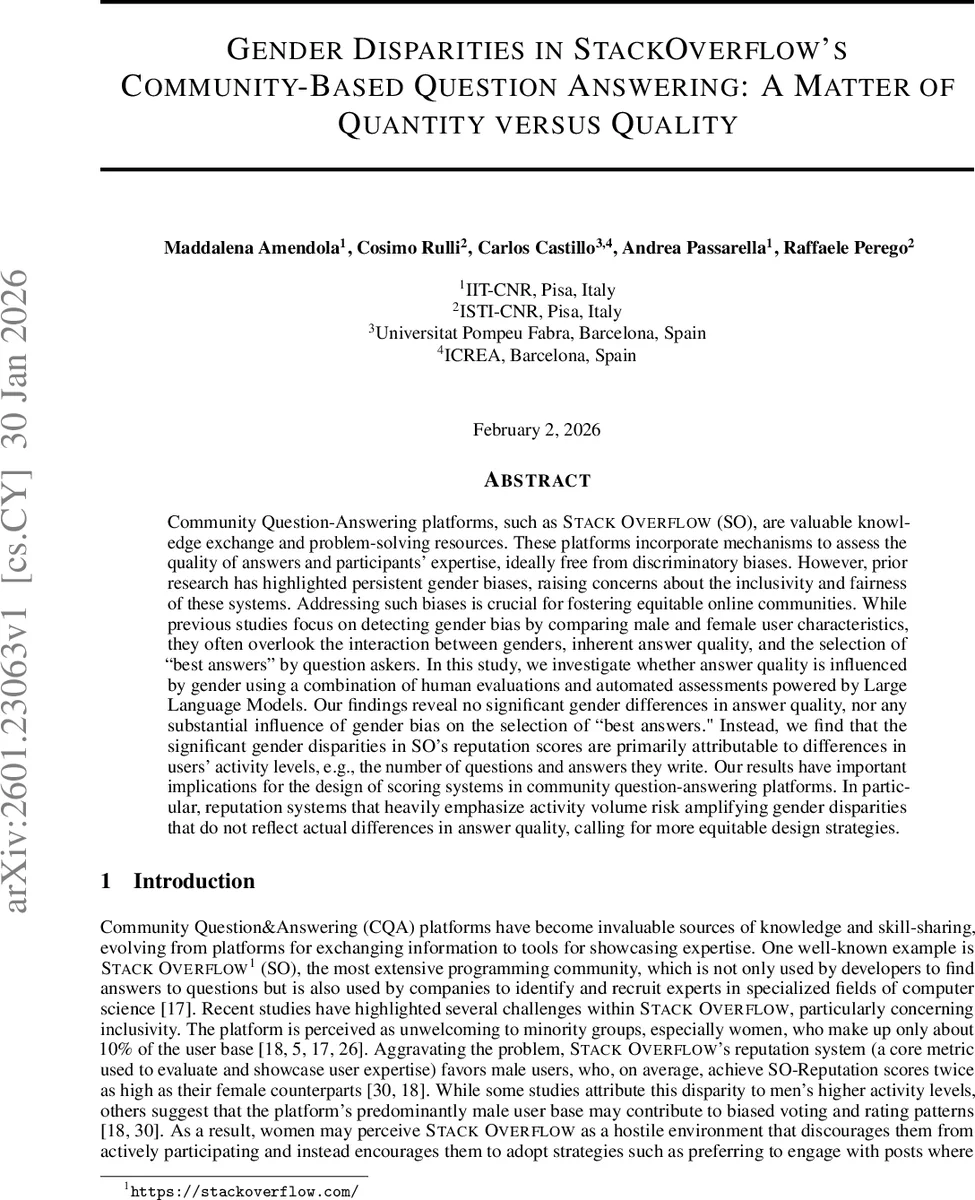
Community Question-Answering platforms, such as Stack Overflow (SO), are valuable knowledge exchange and problem-solving resources. These platforms incorporate mechanisms to assess the quality of answers and participants’ expertise, ideally free from discriminatory biases. However, prior research has highlighted persistent gender biases, raising concerns about the inclusivity and fairness of these systems. Addressing such biases is crucial for fostering equitable online communities. While previous studies focus on detecting gender bias by comparing male and female user characteristics, they often overlook the interaction between genders, inherent answer quality, and the selection of best answers'' by question askers. In this study, we investigate whether answer quality is influenced by gender using a combination of human evaluations and automated assessments powered by Large Language Models. Our findings reveal no significant gender differences in answer quality, nor any substantial influence of gender bias on the selection of best answers." Instead, we find that the significant gender disparities in SO’s reputation scores are primarily attributable to differences in users’ activity levels, e.g., the number of questions and answers they write. Our results have important implications for the design of scoring systems in community question-answering platforms. In particular, reputation systems that heavily emphasize activity volume risk amplifying gender disparities that do not reflect actual differences in answer quality, calling for more equitable design strategies.
💡 Research Summary
This paper investigates gender disparities on Stack Overflow (SO), focusing on whether answer quality differs between male and female contributors and how reputation scores are affected. Prior work has documented a persistent gender gap: women constitute roughly 10 % of users and have reputation scores about half those of men. However, most earlier studies relied on aggregate user metrics (e.g., reputation, vote counts) without directly assessing the content quality of answers.
To fill this gap, the authors adopt a three‑pronged methodology. First, they infer user gender using the widely‑used genderComputer tool, which maps usernames and country information to binary gender labels. Human validation on a Mechanical Turk sample shows approximately 90 % precision for male and 80 % for female classifications, confirming reasonable reliability for the purpose of studying perceived gender. Second, they evaluate answer quality through both human judgments and large language model (LLM) assessments. Human raters score answers on accuracy, completeness, and readability using a 5‑point scale, while state‑of‑the‑art LLMs (GPT‑based) generate comparable scores. The agreement between human and LLM evaluations reaches 76 %, indicating that LLMs can serve as a trustworthy proxy for large‑scale quality assessment. Third, they conduct a feature‑based statistical analysis of key SO metrics such as reputation, up‑votes, down‑votes, view counts, and acceptance rates, comparing male and female users overall and within the subset of questions that receive answers from both genders.
The results are striking. (1) Answer quality shows no statistically significant gender difference: average human scores for male and female answers differ by less than 0.02 points, and LLM scores mirror this parity. (2) The selection of “best answers” (answers marked as accepted by askers) is not systematically biased toward either gender; the difference in acceptance rates is under 2 %, far below any practical threshold. (3) Reputation disparities are largely explained by activity patterns. Men post more answers and receive slightly higher up‑vote rates per answer, while women tend to ask more questions. Because the current reputation algorithm heavily rewards answer activity, men accumulate reputation faster, creating the observed gap. (4) In threads where both male and female answers are present, women exhibit higher relative activity, suggesting homophilic behavior and a supportive sub‑community among female users.
The paper contributes three main insights. First, it provides the first direct, content‑level comparison of answer quality across genders on SO, overturning the assumption that women’s lower reputation reflects inferior contributions. Second, it demonstrates that LLMs can reliably automate answer‑quality evaluation at scale, opening avenues for future large‑scale bias audits. Third, it highlights a design flaw in SO’s reputation system: the over‑emphasis on quantitative activity (especially answer count) amplifies gender disparities that are not grounded in actual performance. The authors propose redesigning reputation metrics to incorporate qualitative signals—such as question‑asking contributions, content‑based quality scores, and acceptance ratios—to mitigate bias.
In conclusion, while male and female users on Stack Overflow produce answers of comparable quality, the platform’s current reputation mechanism disproportionately rewards high activity, which men tend to exhibit more in the form of answering. This structural bias inflates the gender gap in reputation scores without reflecting true expertise or usefulness. The study recommends revising reputation calculations to balance quantity with quality, thereby fostering a more inclusive environment and encouraging broader participation from under‑represented groups.
Comments & Academic Discussion
Loading comments...
Leave a Comment