Protecting Private Code in IDE Autocomplete using Differential Privacy
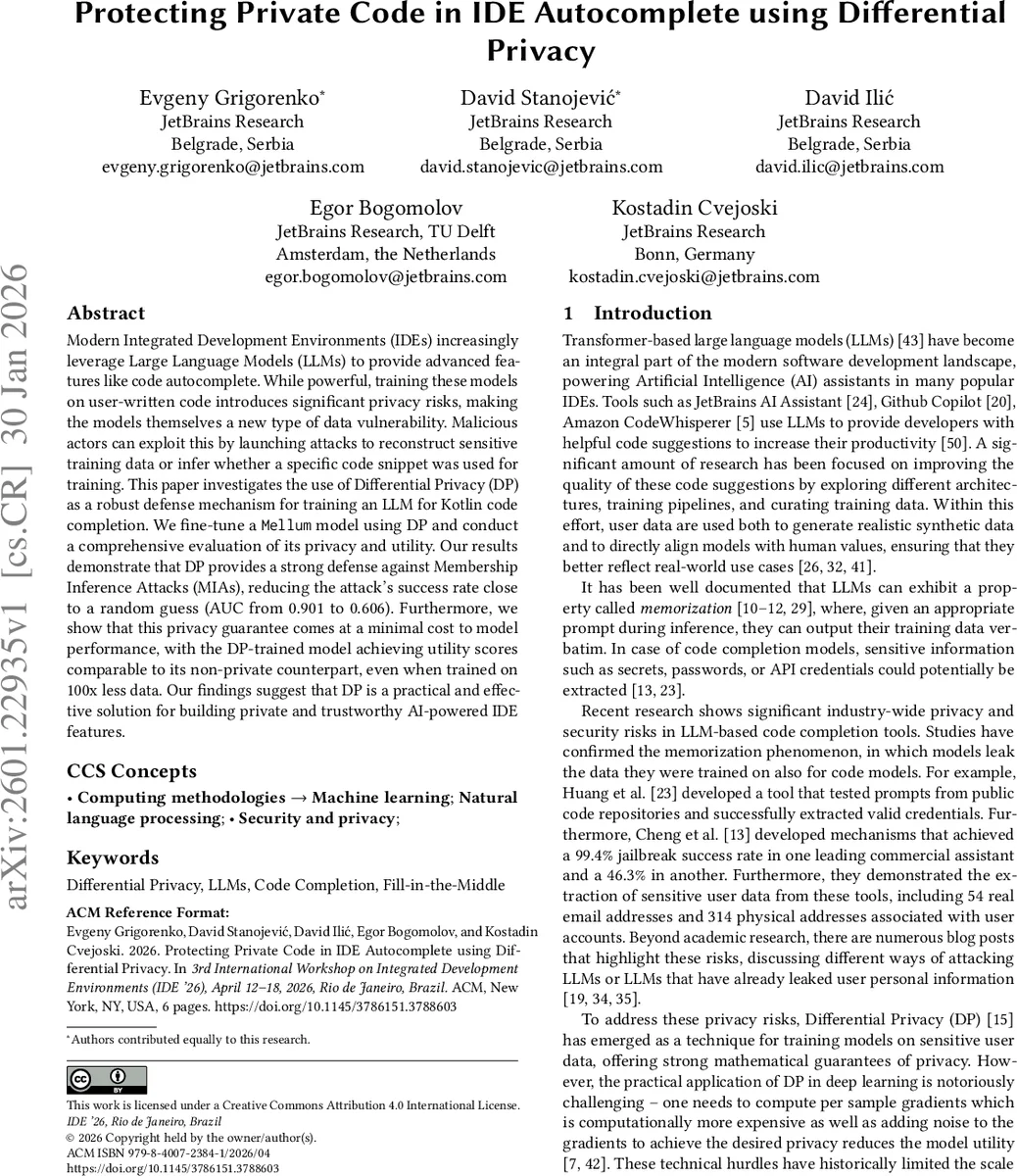
Modern Integrated Development Environments (IDEs) increasingly leverage Large Language Models (LLMs) to provide advanced features like code autocomplete. While powerful, training these models on user-written code introduces significant privacy risks, making the models themselves a new type of data vulnerability. Malicious actors can exploit this by launching attacks to reconstruct sensitive training data or infer whether a specific code snippet was used for training. This paper investigates the use of Differential Privacy (DP) as a robust defense mechanism for training an LLM for Kotlin code completion. We fine-tune a \texttt{Mellum} model using DP and conduct a comprehensive evaluation of its privacy and utility. Our results demonstrate that DP provides a strong defense against Membership Inference Attacks (MIAs), reducing the attack’s success rate close to a random guess (AUC from 0.901 to 0.606). Furthermore, we show that this privacy guarantee comes at a minimal cost to model performance, with the DP-trained model achieving utility scores comparable to its non-private counterpart, even when trained on 100x less data. Our findings suggest that DP is a practical and effective solution for building private and trustworthy AI-powered IDE features.
💡 Research Summary
The paper addresses a pressing privacy concern in modern Integrated Development Environments (IDEs) that embed large language models (LLMs) for code autocomplete. While these models dramatically boost developer productivity, they also inherit the memorization property of LLMs: given a suitable prompt, they can reproduce verbatim fragments of their training data. In the context of code completion, this can lead to the leakage of proprietary algorithms, API keys, passwords, or other sensitive information. Recent studies have demonstrated that adversaries can mount highly successful membership inference attacks (MIAs) and even jailbreak attacks to extract such data from commercial code‑completion services.
To mitigate these threats, the authors explore Differential Privacy (DP) as a formal, mathematically provable defense. They fine‑tune a 4‑billion‑parameter “Mellum” model—a LLaMA‑style transformer pre‑trained on a massive public code corpus and equipped with Fill‑in‑the‑Middle (FIM) capabilities—on an internal Kotlin codebase. The key technical contribution is the combination of DP‑Stochastic Gradient Descent (DP‑SGD) with Low‑Rank Adaptation (LoRA) for parameter‑efficient fine‑tuning. LoRA freezes the bulk of the pre‑trained weights and injects a small set of low‑rank trainable matrices, drastically reducing the dimensionality of per‑sample gradients. This reduction makes DP‑SGD computationally feasible for a model of this size because less noise is required to achieve a given privacy budget when the gradient space is smaller.
DP‑SGD proceeds as follows: (1) compute per‑example gradients for each batch; (2) clip each gradient to a predefined L2 norm C, limiting any single example’s influence; (3) average the clipped gradients and add calibrated Gaussian noise; (4) update the model parameters with this noisy average. A privacy accountant tracks the cumulative (ε, δ) loss across training steps, yielding a final privacy guarantee.
The experimental setup compares two models: (a) a non‑private baseline (Mellum Int. Base) fine‑tuned on the full 8 million‑sample internal dataset, and (b) a DP‑protected model (Mellum Int. DP) fine‑tuned on only 80 k samples (≈1 % of the data) using DP‑SGD with ε≈30 and δ=1e‑5. Both models are evaluated on a held‑out Kotlin benchmark that neither has seen during training.
Security evaluation employs a state‑of‑the‑art Likelihood Ratio Attack (LiRA), a powerful MIA that leverages reference models to calibrate membership signals. The non‑private model yields an AUC of 0.901, confirming that an attacker can reliably distinguish members from non‑members. In stark contrast, the DP model’s AUC drops to 0.606, essentially the level of random guessing, demonstrating that DP successfully suppresses the over‑confidence that fuels MIAs.
Utility assessment focuses on code‑completion quality metrics such as Exact‑Match, BLEU, and CodeBLEU. Despite training on 100× less data and injecting noise, the DP model’s scores are within 1–2 % of the non‑private baseline, indicating that the privacy‑utility trade‑off is highly favorable for this real‑world scenario. The model also retains its FIM capabilities, meaning developers can still benefit from middle‑of‑code completions (e.g., filling in function bodies or missing arguments).
The authors highlight several insights: (1) Even a relatively large privacy budget (ε≈30) can dramatically curb membership inference in the code‑completion domain; (2) LoRA’s reduction of trainable parameters is crucial for making DP‑SGD practical on billion‑parameter models; (3) The approach scales to realistic IDE workloads, offering a pathway to safely personalize code suggestions using proprietary codebases. Limitations include the fact that ε≈30 is higher than the stricter ε≤10 often advocated in theoretical DP literature, and that increased noise could erode finer‑grained stylistic or API‑usage patterns. Moreover, the study is limited to Kotlin; extending the methodology to other languages and to more aggressive privacy budgets remains future work.
In conclusion, the paper demonstrates that differential privacy, when paired with efficient fine‑tuning techniques, can provide strong, provable protection against data‑exfiltration attacks in LLM‑driven IDE features while preserving the practical utility developers expect. This work bridges a critical gap between privacy research and production‑grade developer tools, paving the way for trustworthy AI‑assisted programming environments.
Comments & Academic Discussion
Loading comments...
Leave a Comment