Design Perspective on Materials Experience: A CiteSpace-Based Bibliometric and Visual Analysis of Interdisciplinary Research
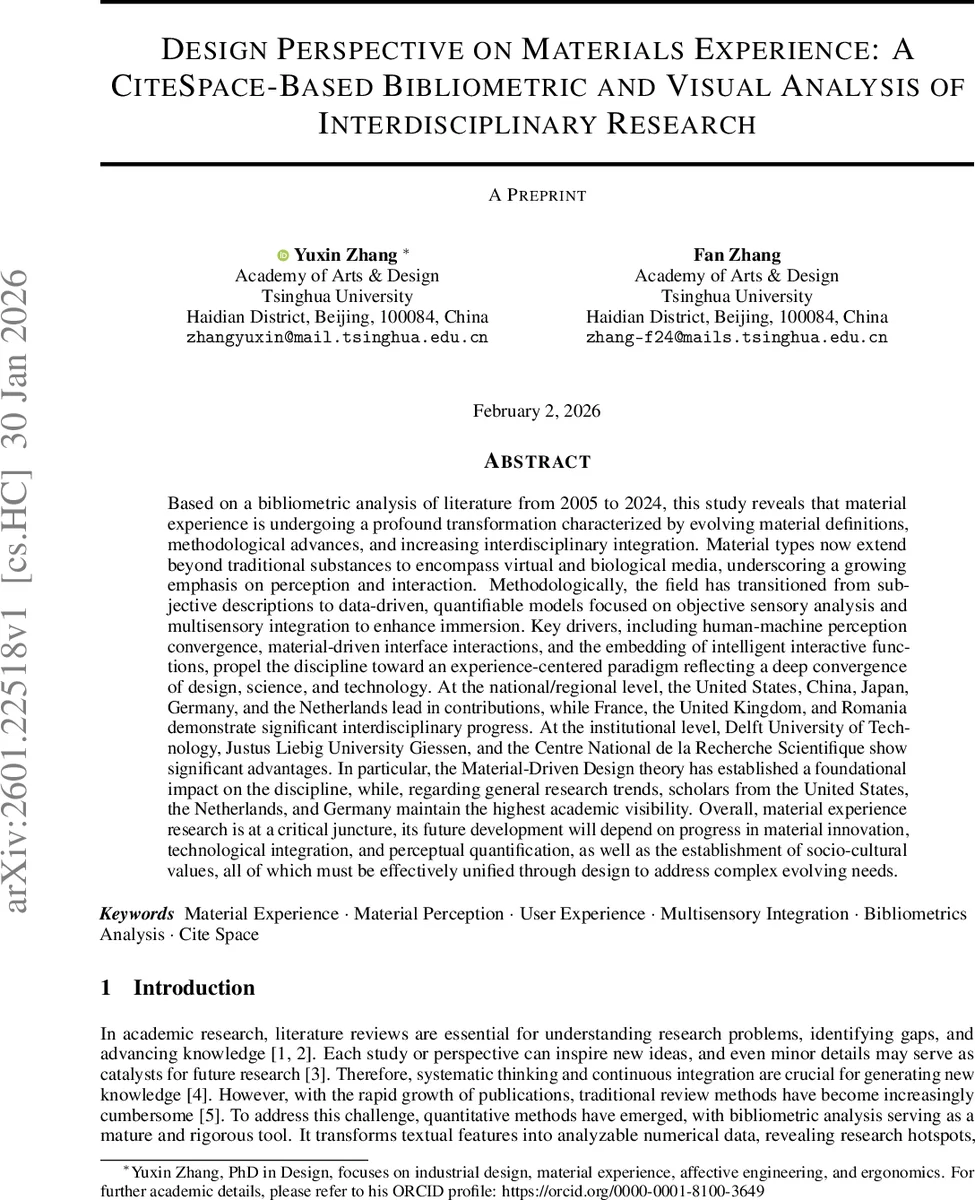
Based on a bibliometric analysis of literature from 2005 to 2024, this study reveals that material experience is undergoing a profound transformation characterized by evolving material definitions, methodological advances, and increasing interdisciplinary integration. Material types now extend beyond traditional substances to encompass virtual and biological media, underscoring a growing emphasis on perception and interaction. Methodologically, the field has transitioned from subjective descriptions to data-driven, quantifiable models focused on objective sensory analysis and multisensory integration to enhance immersion. Key drivers, including human-machine perception convergence, material-driven interface interactions, and the embedding of intelligent interactive functions, propel the discipline toward an experience-centered paradigm reflecting a deep convergence of design, science, and technology. At the national/regional level, the United States, China, Japan, Germany, and the Netherlands lead in contributions, while France, the United Kingdom, and Romania demonstrate significant interdisciplinary progress. At the institutional level, Delft University of Technology, Justus Liebig University Giessen, and the Centre National de la Recherche Scientifique show significant advantages. In particular, the Material-Driven Design theory has established a foundational impact on the discipline, while, regarding general research trends, scholars from the United States, the Netherlands, and Germany maintain the highest academic visibility. Overall, material experience research is at a critical juncture, its future development will depend on progress in material innovation, technological integration, and perceptual quantification, as well as the establishment of socio-cultural values, all of which must be effectively unified through design to address complex evolving needs.
💡 Research Summary
This paper presents a comprehensive CiteSpace‑based bibliometric and visual analysis of the “material experience” research domain spanning the period 2005–2024. After an initial retrieval of 2,831 records from the Web of Science Core Collection, two rounds of manual screening yielded a final corpus of 575 highly relevant publications (333 journal articles and 249 conference papers). The authors employed both performance analysis (descriptive statistics, regression modeling) and science‑mapping techniques (co‑citation, co‑authorship, co‑occurrence networks, clustering, burst detection) to map the knowledge structure, identify influential entities, and trace emerging trends.
Growth trajectory – Annual output follows a strong linear increase (y = 3.231 x – 6479.8, β = 3.231, p < 0.001, R² = 0.948), indicating sustained scholarly interest. Notable spikes in 2009 and 2019 correspond respectively to the early adoption of Kansei engineering/multisensory design and to policy‑driven funding surges.
Core outlets and disciplines – The “Journal of Vision” (61 papers) tops the journal list, followed by “Lecture Notes in Computer Science” (24) and open‑access venues such as “i‑Perception” and “Vision Research”. The CHI conference series contributed 31 papers (2022‑2024), underscoring the centrality of human‑computer interaction. Discipline‑wise, computer science (249 papers), engineering (126), and ophthalmology (80) dominate, while materials science and psychology each account for roughly 70 publications, reflecting the field’s interdisciplinary breadth.
Geographic and institutional landscape – The United States, China, Japan, Germany, and the Netherlands lead in publication volume and citation impact. Institutional network analysis highlights Delft University of Technology, Justus Liebig University Giessen, and the French CNRS as high‑betweenness hubs that facilitate cross‑border collaborations.
Keyword and cluster analysis – Co‑occurrence mapping reveals four major thematic clusters: (1) traditional material and affective evaluation (Kansei, affective engineering); (2) virtual/augmented reality and digital material interaction; (3) biomaterials and sustainable design; (4) data‑driven perceptual quantification and AI‑enabled interfaces. Clustering quality (modularity > 0.73) confirms distinct community structures. Burst detection shows that from 2017 onward “multisensory integration”, “human‑machine perception”, “material‑driven design”, and “intelligent interaction” experienced rapid growth, indicating a methodological shift toward objective, sensor‑based, and algorithmic approaches.
Methodological evolution – The field has moved from largely subjective, narrative descriptions toward quantifiable models that employ physiological sensing (e.g., EEG, skin conductance, haptic force), statistical analysis, and machine‑learning prediction. This transition aligns with the broader trend of multisensory integration research in HCI, VR/AR, and robotics.
Theoretical impact – The “Material‑Driven Design” theory emerges as the most cited conceptual framework, positioning design as the bridge that directly links material properties to user experience outcomes. It is identified as a foundational pillar for future research and practice.
Societal relevance – Mapping against the United Nations Sustainable Development Goals reveals strong connections to Goal 12 (Responsible Consumption & Production) and Goal 9 (Industry, Innovation & Infrastructure), suggesting that material experience research is increasingly being framed within environmental and socio‑economic contexts.
Future directions – The authors propose three converging trajectories: (i) deeper perceptual quantification through advanced sensing and AI, (ii) intelligent, adaptive interfaces that enable real‑time, personalized experiential feedback, and (iii) the fusion of physical, virtual, and biological media to generate novel design vocabularies. They argue that progress in material innovation, technological integration, and perceptual quantification—combined with culturally informed design values—will determine the discipline’s evolution toward an experience‑centered paradigm.
In sum, this study provides a data‑driven roadmap of material experience research, highlighting its rapid expansion, interdisciplinary integration, and emerging methodological paradigms. It offers scholars, designers, and technologists a clear view of the field’s past development, current hotspots, and prospective pathways, emphasizing the pivotal role of design in unifying material science, perception psychology, and intelligent technologies to meet complex, evolving human needs.
Comments & Academic Discussion
Loading comments...
Leave a Comment