On Your Own: Pro-level Autonomous Drone Racing in Uninstrumented Arenas
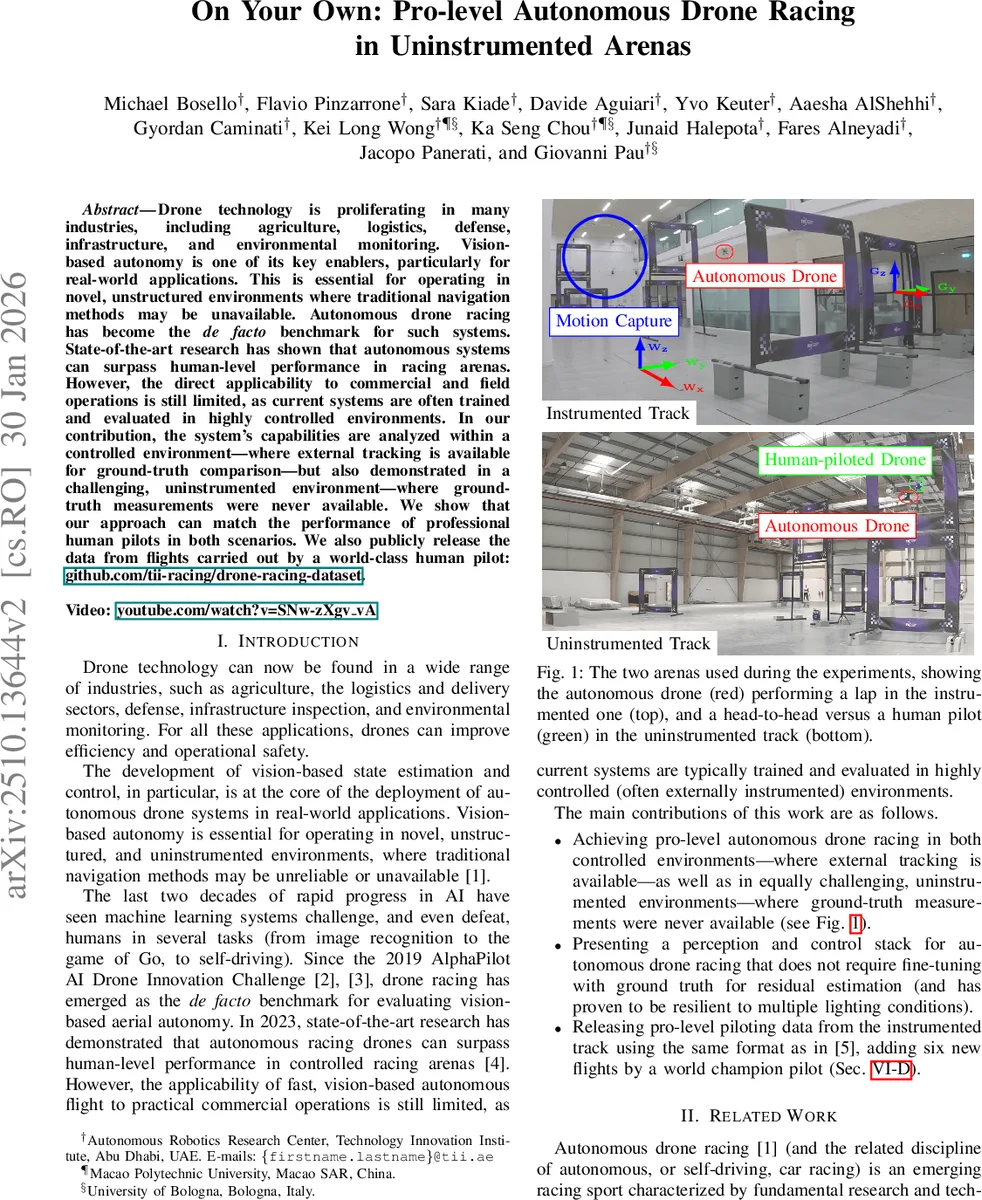
Drone technology is proliferating in many industries, including agriculture, logistics, defense, infrastructure, and environmental monitoring. Vision-based autonomy is one of its key enablers, particularly for real-world applications. This is essential for operating in novel, unstructured environments where traditional navigation methods may be unavailable. Autonomous drone racing has become the de facto benchmark for such systems. State-of-the-art research has shown that autonomous systems can surpass human-level performance in racing arenas. However, the direct applicability to commercial and field operations is still limited, as current systems are often trained and evaluated in highly controlled environments. In our contribution, the system’s capabilities are analyzed within a controlled environment – where external tracking is available for ground-truth comparison – but also demonstrated in a challenging, uninstrumented environment – where ground-truth measurements were never available. We show that our approach can match the performance of professional human pilots in both scenarios.
💡 Research Summary
The paper “On Your Own: Pro‑level Autonomous Drone Racing in Uninstrumented Arenas” presents a complete autonomous racing system that matches professional human pilots even when no external motion‑capture infrastructure is available. The authors first motivate the need for vision‑only autonomy, noting that most prior work relies on instrumented tracks that limit real‑world applicability. Their contributions are threefold: (1) a hardware platform capable of >25 m/s flight while remaining lightweight (≈665 g), (2) a perception‑state‑estimation‑control stack that does not require ground‑truth fine‑tuning, and (3) the release of a high‑quality dataset collected from a world‑champion pilot.
Hardware – The quadrotor uses an Armattan Chameleon Ti 6” frame, T‑motor F60 PROV 2020 KV motors with HQProp R38 propellers, achieving a thrust‑to‑weight ratio of about 7. Sensing is provided by an Intel RealSense T265 stereo camera (30 Hz grayscale, 200 Hz VIO) and an MPU6000 IMU (up to 500 Hz). On‑board compute is an NVIDIA Orin NX (JetPack 5.1.2, CUDA 11.4) running in MAXN power mode. A replica equipped with an HDZero FPV system mimics the autonomous drone’s mass distribution for fair human‑pilot comparisons.
Software Architecture – The flight controller runs Betaflight 4.3.2 and communicates with the Orin via a 1 Mbps MSP serial link, enabling low‑latency bidirectional data exchange. Perception consists of two CNNs: YOLOv8‑nano (3.2 M parameters) for gate bounding‑box detection and a MobileNetV3‑Small (1.1 M parameters) for the four corner key‑points. Both models are exported to ONNX, then to TensorRT FP16 engines, delivering 24–30 ms per frame on 640 × 640 images. Training leverages the RTM dataset, auto‑labeling of instrumented‑track flights, and a distillation pipeline using Grounding‑DINO for the uninstrumented track, requiring as few as 80 manually corrected frames.
State Estimation – The Intel T265 provides short‑term VIO, but its drift is corrected using gate corner detections. Each detected gate is processed with OpenCV’s iterative PnP solver (homography initialization, Levenberg‑Marquardt refinement) to obtain a 3‑D position relative to the known gate layout. A Kalman filter estimates only the translational drift vector (3‑D), with process noise σ²ₐ = 8 and measurement updates whenever a gate is visible. Mapping is enabled while relocalization and pose‑jumping are disabled to maintain smooth estimates.
Control – The system employs a hybrid strategy: a pre‑computed time‑optimal trajectory is tracked with Model Predictive Contouring Control (MPCC) or a conventional PID in low‑speed sections. High‑frequency IMU data (500 Hz) and the Betaflight override allow the control loop to run at the same rate, far exceeding the 10 Hz SBUS rates used in earlier works.
Experiments – Two arenas were used: an instrumented indoor track with motion‑capture ground truth, and an uninstrumented track with no external measurements. On the instrumented track the autonomous drone achieved an average speed of 25.63 m/s and a lap time of 5.04 s, outperforming a human champion who recorded 21.15 m/s and 5.60 s. In head‑to‑head races on the uninstrumented track, the autonomous system’s lap times differed by less than 0.2 s from the human pilot, demonstrating comparable performance despite the lack of ground truth. The vision stack’s latency and accuracy were shown to be superior to prior art, and the data‑efficiency of the labeling pipeline was highlighted.
Dataset Release – The authors publish six additional flights from a world‑champion pilot in the same format as the RTM dataset, providing raw video, IMU, VIO, and motion‑capture data for the community.
Limitations & Future Work – The current system is validated in controlled indoor lighting; outdoor illumination changes and complex backgrounds remain to be tested. Multi‑drone coordination, collision avoidance, and handling of gate‑free flight segments are identified as open challenges.
Overall, the paper delivers a robust, open‑source autonomous racing stack that bridges the gap between laboratory‑grade, instrumented experiments and real‑world, uninstrumented deployments, offering valuable insights and resources for both academic research and commercial drone applications.
Comments & Academic Discussion
Loading comments...
Leave a Comment