Inverse Theorems for Point-Sphere Incidences over Finite Fields
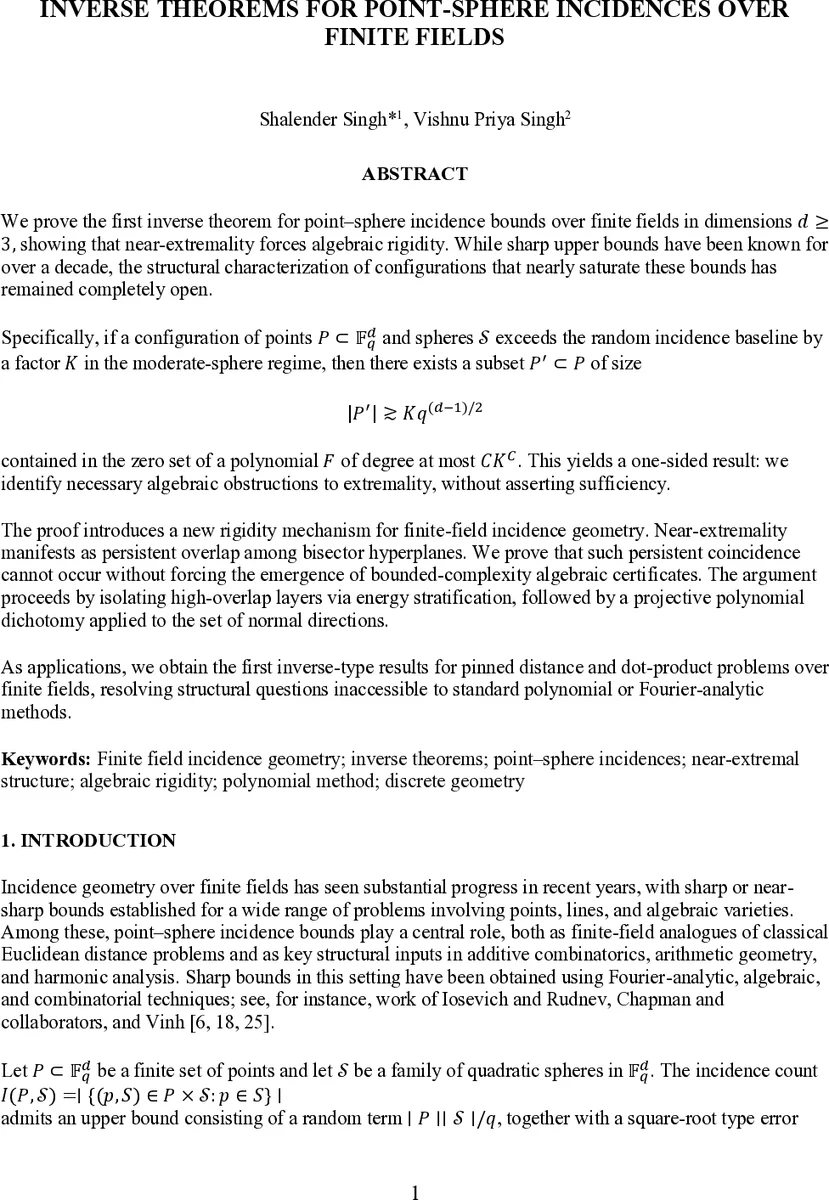
We prove the first inverse theorem for point–sphere incidence bounds over finite fields in dimensions $d \ge 3$, showing that near-extremality forces algebraic rigidity. While sharp upper bounds have been known for over a decade, the structural characterization of configurations that nearly saturate these bounds has remained completely open. Specifically, if a configuration of points $P \subset \mathbb{F}_q^d$ and spheres $\mathscr{S}$ exceeds the random incidence baseline by a factor $K$ in the moderate-sphere regime, then there exists a subset $P’ \subset P$ of size [ |P’| \gtrsim K q^{(d-1)/2} ] contained in the zero set of a polynomial $F$ of degree at most $C K^C$. This yields a one-sided result: we identify necessary algebraic obstructions to extremality, without asserting sufficiency. The proof introduces a new rigidity mechanism for finite-field incidence geometry. Near-extremality manifests as persistent overlap among bisector hyperplanes. We prove that such persistent coincidence cannot occur without forcing the emergence of bounded-complexity algebraic certificates. The argument proceeds by isolating high-overlap layers via energy stratification, followed by a projective polynomial dichotomy applied to the set of normal directions. As applications, we obtain the first inverse-type results for pinned distance and dot-product problems over finite fields, resolving structural questions inaccessible to standard polynomial or Fourier-analytic methods.
💡 Research Summary
The paper addresses a long‑standing inverse problem in finite‑field incidence geometry: what structural features must a configuration of points and spheres possess in order to almost saturate the known point–sphere incidence bound? For dimensions $d\ge 3$ the authors prove the first such “inverse theorem”. They define a configuration $(P,\mathscr S)$ to be $K$‑near‑extremal if its incidence count exceeds the random baseline by a factor $K$ (Definition 3.1). By rewriting the incidence count as an “incidence energy’’—the number of triples $(p,S_1,S_2)$ with $p\in S_1\cap S_2$—they show that near‑extremality forces a large amount of energy to concentrate on a relatively small family of sphere‑pair intersections.
The key geometric observation is that each pair of spheres determines a bisector hyperplane, and persistent overlap of many such hyperplanes can be detected by a dyadic (multiscale) energy stratification. When a high‑overlap layer exists, the set of normal vectors to the corresponding hyperplanes has unusually high additive structure in the projective space $\mathbb P^{d-1}(\mathbb F_q)$. Using a projective polynomial dichotomy, the authors prove that this structure forces the existence of a non‑zero polynomial $F$ of degree at most $O(K^C)$ whose zero set contains a large subset $P’\subset P$ with
\
Comments & Academic Discussion
Loading comments...
Leave a Comment