Conversion Layer Controls the Evolution of Magnetic Deflections Near the Alfven Surface
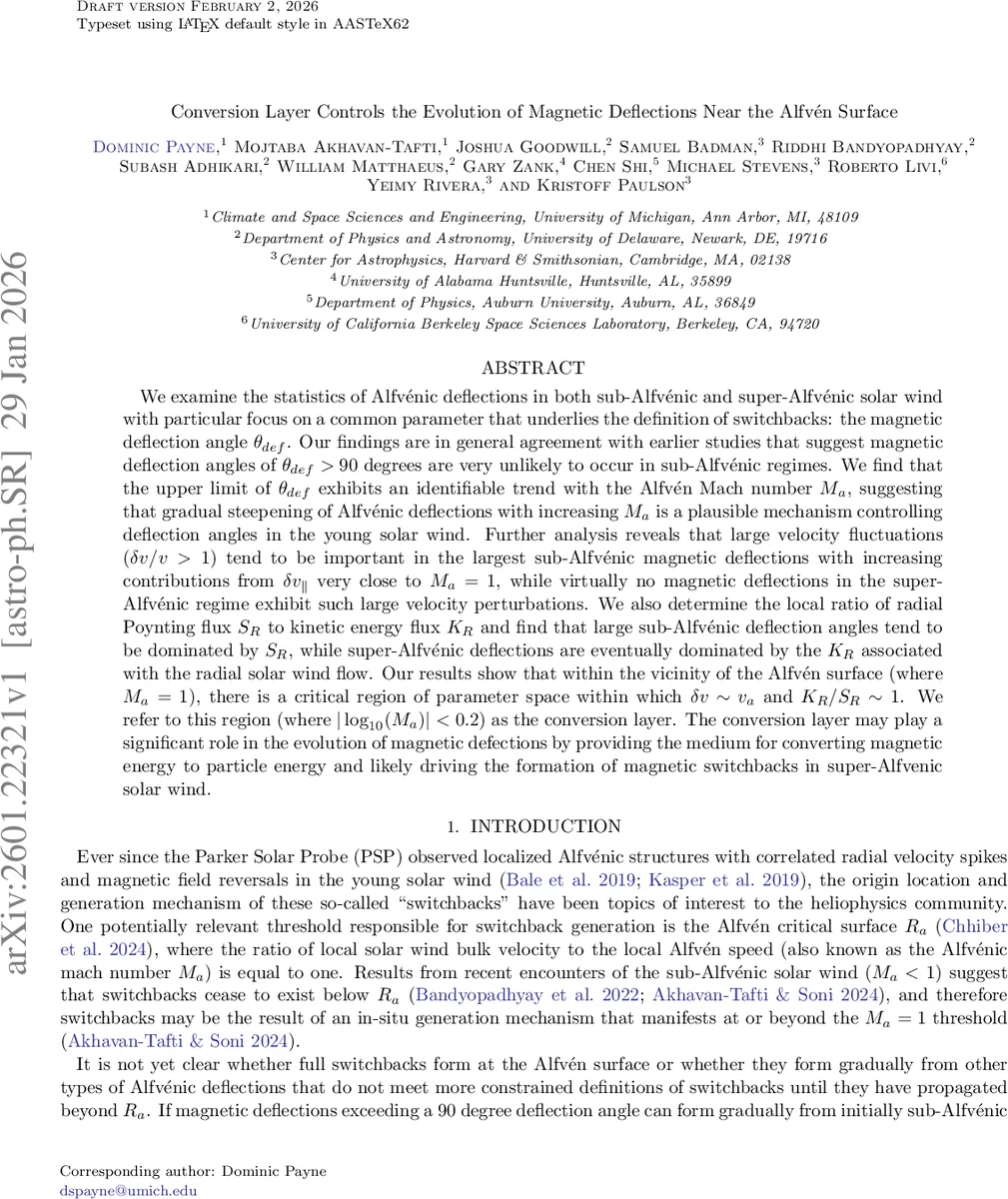
We examine the statistics of Alfvenic deflections in both sub-Alfvenic and super-Alfvenic solar wind with particular focus on a common parameter that underlies the definition of switchbacks: the magnetic deflection angle. Our findings are in general agreement with earlier studies that suggest magnetic deflection angles > 90 degrees are very unlikely to occur in sub-Alfvenic regimes. We find that their upper limit exhibits an identifiable trend with the Alfven Mach number Ma, suggesting that gradual steepening of Alfvenic deflections with increasing Ma is a plausible mechanism controlling deflection angles in the young solar wind. Further analysis reveals that large velocity fluctuations tend to be important in the largest sub-Alfvenic magnetic deflections with increasing contributions from the parallel component very close to Ma = 1, while virtually no magnetic deflections in the super-Alfvenic regime exhibit such large velocity perturbations. We also determine the local ratio of radial Poynting flux SR to kinetic energy flux KR and find that large sub-Alfvenic deflection angles tend to be dominated by SR, while super-Alfvenic deflections are eventually dominated by the KR associated with the radial solar wind flow. Our results show that within the vicinity of the Alfven surface (where Ma = 1), there is a critical region of parameter space within which velocity deflections approach the Alfven velocity and KR/SR is close to unity. We refer to this region (where | log10(Ma)| < 0.2) as the conversion layer. The conversion layer may play a significant role in the evolution of magnetic defections by providing the medium for converting magnetic energy to particle energy and likely driving the formation of magnetic switchbacks in super-Alfvenic solar wind.
💡 Research Summary
This paper presents a comprehensive statistical analysis of magnetic deflection angles (θ def) in the solar wind as a function of the local Alfvén Mach number (Ma), using high‑cadence magnetic field data from the FIELDS instrument and ion velocity and density data from the SWEAP suite aboard the Parker Solar Probe (PSP). The authors select intervals that are clearly sub‑Alfvénic (Ma < 1), super‑Alfvénic (Ma > 1), and a set of “near‑Alfvénic” intervals where Ma is close to unity, ensuring at least six consecutive hours of each regime. They compute Ma from ten‑minute averages of the proton bulk speed and the Alfvén speed (vA = |B| / √(μ0 mi n)), and define the magnetic deflection angle as the arccosine of the dot product between the instantaneous magnetic field vector and its ten‑minute mean. To isolate genuine Alfvénic structures, they filter out events with uncorrelated magnetic and velocity fluctuations, requiring both δv/v > 0.05 and δB/B > 0.05.
The two‑dimensional histogram of θ def versus log10(Ma) confirms earlier findings that deflection angles greater than 90° are essentially absent in the sub‑Alfvénic regime (log10(Ma) < 0). As Ma increases toward and beyond unity, the upper envelope of θ def rises smoothly, reaching and exceeding 90° for log10(Ma) ≥ 0. This trend indicates that the local Mach number controls the maximum possible magnetic turning, suggesting a gradual steepening of Alfvénic structures as they propagate outward.
Velocity fluctuations exhibit a pronounced dichotomy across the Ma = 1 threshold. In sub‑Alfvénic intervals, the largest magnetic deflections are accompanied by strong velocity perturbations, often with δv/v > 1, meaning the fluctuation amplitude exceeds the bulk flow speed. When normalized to the Alfvén speed, δv/vA approaches unity in the narrow band |log10(Ma)| < 0.2, but rarely exceeds it until Ma > 1. In the super‑Alfvénic regime, δv/v remains ≤ 1 for all θ def, indicating that large magnetic turnings are not driven by extreme velocity shears.
The authors also evaluate the radial Poynting flux (SR = (E × B)R/μ0, with the convective electric field E = ‑v × B) and the radial kinetic energy flux (KR = ½ n mi vR³). In the sub‑Alfvénic regime, large‑θ def events are dominated by magnetic energy transport (SR > KR). However, within the narrow “conversion layer” defined by |log10(Ma)| < 0.2, the ratio KR/SR approaches unity, indicating an equipartition of electromagnetic and kinetic energy fluxes. Beyond this layer (log10(Ma) > 0.2), KR dominates for all deflection angles, reflecting the increasing importance of bulk plasma flow in the super‑Alfvénic wind.
A simple analytic estimate (KR/SR ≈ Ma²/2) predicts KR = SR at Ma ≈ √2 ≈ 1.4, corresponding to log10(Ma) ≈ 0.15, in good agreement with the observed transition near |log10(Ma)| = 0.2. This supports the interpretation that the conversion layer marks the point where magnetic energy can be efficiently transferred to particle kinetic energy.
Further decomposition of the velocity fluctuations shows that perpendicular fluctuations (δv⊥/v) dominate deep in the sub‑Alfvénic regime, while parallel fluctuations (δv∥/v) become comparable to the perpendicular component within the conversion layer. This shift suggests a departure from pure Alfvénic behavior toward magnetosonic characteristics, consistent with earlier observations of switchback signatures that include compressive signatures.
The discussion links these statistical findings to the physics of switchback formation. The gradual increase of the upper bound of θ def with Ma implies that magnetic structures can steepen progressively as they cross the Alfvén surface, eventually exceeding 90° and becoming full switchbacks. The conversion layer provides the necessary conditions—velocity fluctuations approaching the Alfvén speed and balanced energy fluxes—for instabilities such as Kelvin‑Helmholtz to develop, enhancing turbulence and facilitating the conversion of magnetic energy into particle energy. Consequently, small‑amplitude Alfvénic deflections observed below the Alfvén surface can evolve through the conversion layer into the large‑amplitude, magnetic‑field‑reversal structures seen in the super‑Alfvénic wind.
In summary, the paper establishes a quantitative relationship between magnetic deflection angles and the local Alfvén Mach number, introduces the concept of a conversion layer (|log10(Ma)| < 0.2) as a critical region for magnetic‑to‑kinetic energy conversion, and proposes that this layer plays a pivotal role in the generation and evolution of solar‑wind switchbacks. The findings provide a unified framework that reconciles sub‑Alfvénic and super‑Alfvénic observations and suggest future work should focus on high‑resolution simulations and targeted PSP observations to resolve the microphysics within the conversion layer.
Comments & Academic Discussion
Loading comments...
Leave a Comment