Bound-state-free Förster resonant shielding of strongly dipolar ultracold molecules
We propose a method to suppress collisional loss in strongly dipolar, rotationally excited ultracold molecules using a combination of static (dc) and microwave (ac) electric fields. By tuning two excited pair molecular rotational states into a Förster resonance with a dc field, simultaneously driving excited rotational transitions with an ac field removes all long-range bound states, allowing near complete suppression of all two- and three-body collisional loss channels. While permitting tunable dipolar and anti-dipolar interactions, this bound-state-free ac/dc scheme is not subject to photon-changing collisions that are the primary source of two-body loss in shielding with two microwave fields, used to achieve the first molecular Bose-Einstein condensate [Bigagli et al., Nature 631, 289 (2024)]. Using NaCs as a representative example for strongly dipolar molecules, close-coupling calculations are performed to show that bound-state-free shielding can achieve ratios of elastic-to-loss rates $\gtrsim 10^{6}$ at 100 nK, with currently accessible ac and dc field generation technologies. This work opens new opportunities for realizing large, long-lived samples of strongly interacting degenerate molecular gases with tunable long-range interactions.
💡 Research Summary
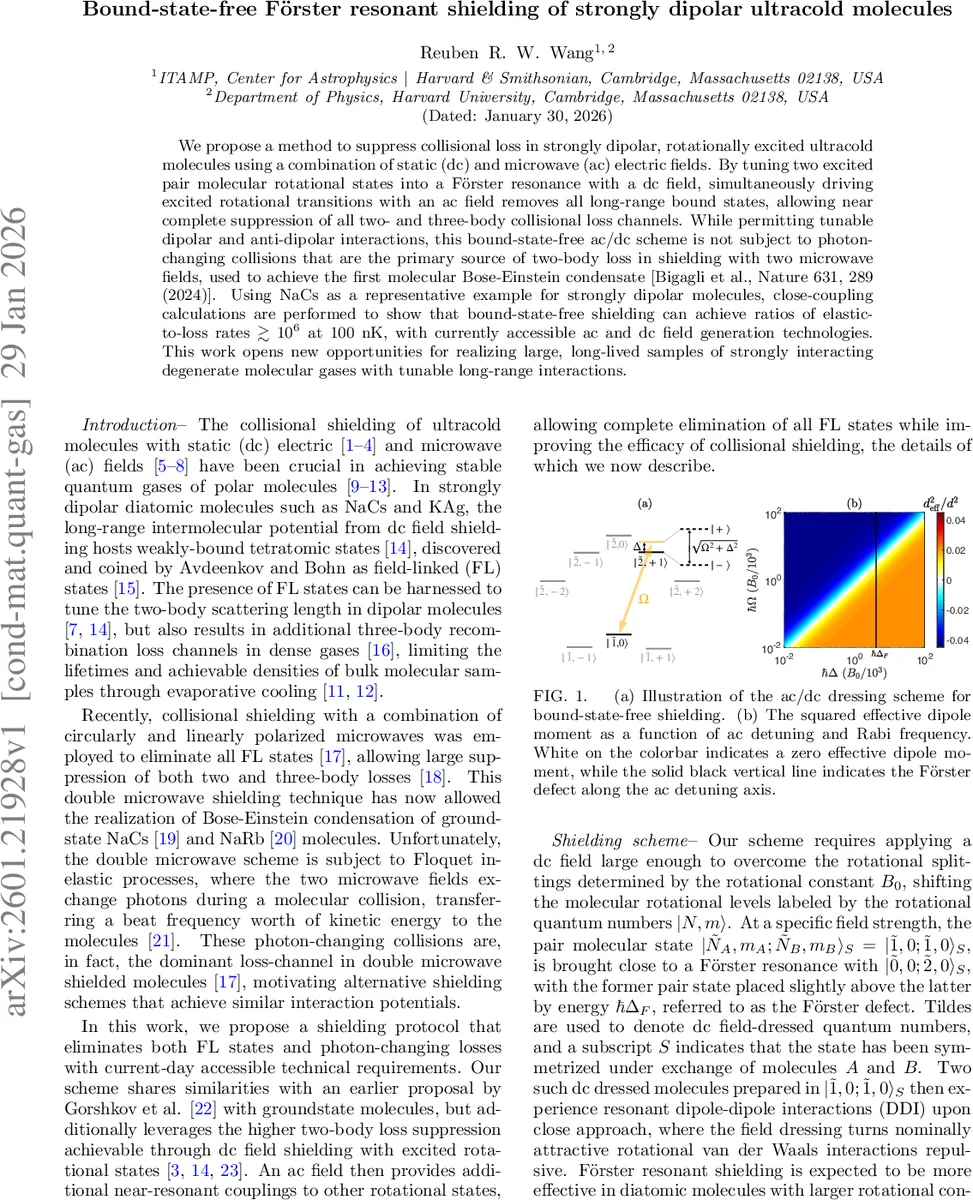
The authors present a novel collisional shielding scheme for strongly dipolar ultracold molecules that combines a static (dc) electric field with a single microwave (ac) field. The method is designed to eliminate long‑range bound “field‑linked” (FL) states that have previously limited the lifetime of dense molecular gases, while also removing the dominant photon‑changing loss channel that plagues double‑microwave shielding. The core idea is to use a dc field to bring two excited‑rotational pair states, specifically |˜1,0;˜1,0⟩ and |˜0,0;˜2,0⟩, into a Förster resonance. At a dc field strength of roughly d E_dc ≈ 3.25 B₀ (where B₀ is the rotational constant), the energy defect Δ_F is on the order of a few megahertz. Simultaneously, a circularly polarized microwave drives the |˜1,0⟩ → |˜2,+1⟩ transition with Rabi frequency Ω and blue detuning Δ. By choosing Ω and Δ such that Ω ≈ 0.733 Δ and Δ ≈ 1.5 Δ_F, the first‑order dipole‑dipole interaction is completely cancelled (the effective dipole moment d_eff² = 0). This “compensation point” removes all FL states from the long‑range potential, leaving only a second‑order repulsive interaction that is isotropic with respect to the intermolecular axis.
The resulting repulsive barrier reaches a height of about 0.08 B₀, significantly larger than the ~0.02 B₀ barrier obtained with the double‑microwave scheme. Consequently, tunneling into the short‑range region where chemical reactions occur is strongly suppressed. Losses are then dominated by non‑adiabatic transitions into other microwave‑dressed channels rather than by short‑range chemistry. Close‑coupling scattering calculations for NaCs at a collision energy of 100 nK show that the elastic collision rate remains essentially constant as Ω is varied, while the total loss rate drops dramatically with increasing Ω, reaching values as low as 10⁻¹⁹ cm³ s⁻¹. This yields an elastic‑to‑loss ratio γ that can exceed 10⁹ for the largest Rabi frequencies considered, comfortably satisfying the requirement γ ≫ 10⁴ for efficient evaporative cooling into a quantum‑degenerate regime.
A further advantage of the scheme is the tunability of the effective dipole moment. By varying the ratio Ω/Δ, the system can be switched continuously between conventional dipolar (head‑to‑tail attractive), fully compensated (no first‑order dipole), and anti‑dipolar (side‑by‑side attractive) interaction regimes. This provides a powerful knob for engineering anisotropic interactions, controlling scattering lengths, and exploring exotic many‑body phases such as dipolar supersolids or topological superfluids.
Practical considerations are addressed: maintaining the Förster defect within 10⁻³ B₀ requires dc field stability at the level of ~0.5 V cm⁻¹, which is well within current experimental capabilities. The required microwave powers to achieve Ω ≈ 2π × 0.5 MHz are also readily attainable with existing sources. Although the analysis is performed for a rigid‑rotor ¹Σ molecule, the authors argue that the scheme should remain robust for ²Σ molecules because nuclear and electronic spins can be made spectators to the collision dynamics.
In summary, the ac/dc bound‑state‑free Förster shielding protocol eliminates both FL bound states and photon‑changing loss channels, delivering elastic‑to‑loss ratios up to 10⁶–10⁹ at experimentally realistic field strengths. This opens a clear pathway toward creating large, long‑lived samples of strongly interacting dipolar gases, enabling evaporative cooling to quantum degeneracy, quantum simulation of anisotropic Hamiltonians, and the investigation of novel quantum phases in ultracold molecular systems.
Comments & Academic Discussion
Loading comments...
Leave a Comment