The Leibniz adjunction in homotopy type theory, with an application to simplicial type theory
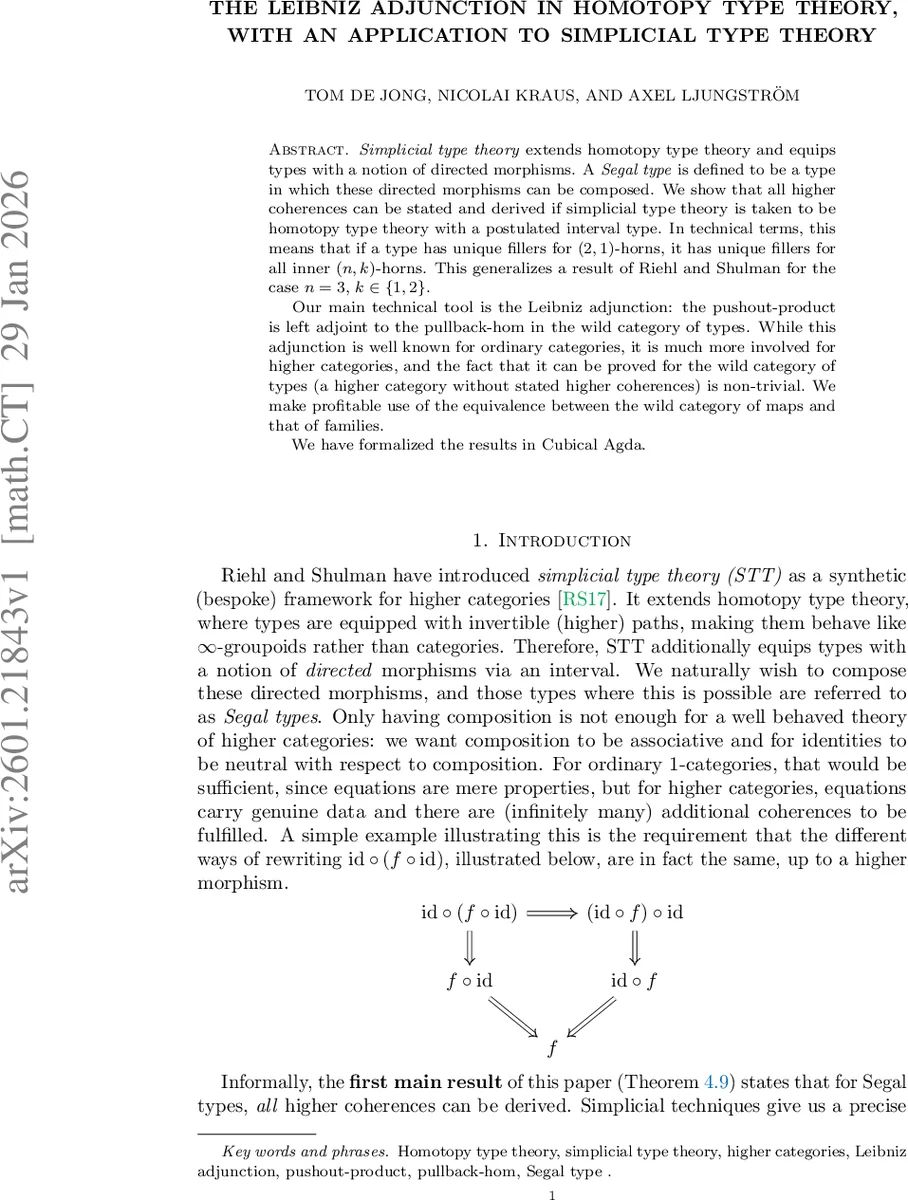
Simplicial type theory extends homotopy type theory and equips types with a notion of directed morphisms. A Segal type is defined to be a type in which these directed morphisms can be composed. We show that all higher coherences can be stated and derived if simplicial type theory is taken to be homotopy type theory with a postulated interval type. In technical terms, this means that if a type has unique fillers for $(2,1)$-horns, it has unique fillers for all inner $(n,k)$-horns. This generalizes a result of Riehl and Shulman for the case $n = 3, k \in {1, 2}$. Our main technical tool is the Leibniz adjunction: the pushout-product is left adjoint to the pullback-hom in the wild category of types. While this adjunction is well known for ordinary categories, it is much more involved for higher categories, and the fact that it can be proved for the wild category of types (a higher category without stated higher coherences) is non-trivial. We make profitable use of the equivalence between the wild category of maps and that of families. We have formalized the results in Cubical Agda.
💡 Research Summary
The paper “The Leibniz Adjunction in Homotopy Type Theory, with an Application to Simplicial Type Theory” develops a higher‑categorical adjunction inside homotopy type theory (HoTT) and uses it to obtain a sweeping coherence result for Segal types. The authors work in plain HoTT equipped with a postulated interval type, rather than in the meta‑level simplicial type theory of Riehl–Shulman. Their interval is required only to be a bounded distributive lattice (a poset), without any totality or modality assumptions. This minimal setup allows the whole development to be formalised in Cubical Agda.
The central categorical notion is that of a “wild category”. A wild category has a type of objects and a type family of arrows, together with identities and a composition operation, but it imposes no truncation conditions on the arrow types and it does not require higher coherence data for associativity or unit laws. The wild category of types (objects are types in a universe, arrows are functions) is automatically univalent, so object equality coincides with isomorphism. The authors introduce two equivalent presentations of this wild category: the “Map” category, whose objects are triples (A, B, f) and whose arrows are commuting squares, and the “Fam” category, whose objects are dependent families (A, B : A→U) and whose arrows are pairs of a map between bases together with a dependent map between fibres. The equivalence between Map and Fam follows from the univalence axiom (the usual equivalence between functions and Σ‑types) and is proved as an isomorphism of wild categories.
With this machinery in place, the paper proves a higher‑dimensional version of the classical Leibniz construction: the pushout‑product of two maps is left adjoint to the pullback‑hom of two maps, now regarded as functors on the wild category of maps (or families). Concretely, for maps f : A→B and g : X→Y, the pushout‑product f ⊠ g is defined as the induced map from the pushout of the diagram A×X ← A×Y → B×X, which can be identified with the “reverse join” of the fibres (Proposition 3.4). The pullback‑hom f ⋔ g is defined via a universal property involving post‑composition by g and pre‑composition by f, yielding a map from a certain dependent product of constant families. The authors verify the adjunction by constructing the unit and counit natural transformations and checking the triangle identities; the proofs rely heavily on contractibility of singleton types and the “type‑theoretic axiom of choice” (a basic equivalence between Σ‑ and Π‑styles). The result is formalised as Theorem 3.16.
The adjunction is then applied to Segal types. A Segal type is defined as a type X that has a unique filler for every inner (2, 1)‑horn Λ²₁→X. In simplicial language, a (2, 1)‑horn corresponds to two composable directed edges; a unique filler supplies a canonical composite and a 2‑cell witnessing associativity up to higher homotopy. Using the Leibniz adjunction, the authors show that if a type has unique fillers for (2, 1)‑horns, then it automatically has unique fillers for all inner (n, k)‑horns, for any n≥2 and 0<k<n. This is Theorem 4.9, a generalisation of the result of Riehl–Shulman (which covered only n=3, k∈{1,2}) and a type‑theoretic analogue of Lurie’s Corollary 2.3.2.2 on Segal objects. Consequently, all higher coherence data (associativity, unit laws, and all higher associators) are derivable from the single (2, 1)‑horn condition.
All definitions, lemmas, and theorems are mechanised in Cubical Agda 2.8.0, using the cubical library for path types and the interval. The formalisation includes:
- the definition of wild categories and the equivalence Map ≃ Fam,
- the explicit construction of pushout‑product and pullback‑hom on families,
- the proof of the Leibniz adjunction (Theorem 3.16),
- the Segal‑type coherence theorem (Theorem 4.9),
- auxiliary results such as closure of left‑orthogonal maps under pushout‑products (Lemma 4.5).
The code is publicly available at https://github.com/leibniz-stt/agda‑formalization, with an HTML interface that links each theorem in the paper to its formal statement (marked by the symbol “Ó”). The authors also discuss related work, noting that similar orthogonality closure results have been formalised in Agda‑unimath and by Toth, but their proof proceeds via the Leibniz adjunction rather than direct combinatorial arguments.
In summary, the paper makes two major contributions. First, it establishes that the Leibniz pushout‑product/pullback‑hom adjunction holds in the wild category of types, despite the lack of explicit higher coherence data. Second, it leverages this adjunction to prove that a single (2, 1)‑horn filling condition suffices to guarantee all higher Segal coherences, thereby providing a clean, type‑theoretic characterisation of higher‑categorical composition. The complete formalisation in Cubical Agda not only validates the results but also supplies a reusable library for future work on higher‑dimensional type theory and synthetic higher category theory.
Comments & Academic Discussion
Loading comments...
Leave a Comment