Decentralized Analysis Approach for Oscillation Damping in Grid-Forming and Grid-Following Heterogeneous Power Systems
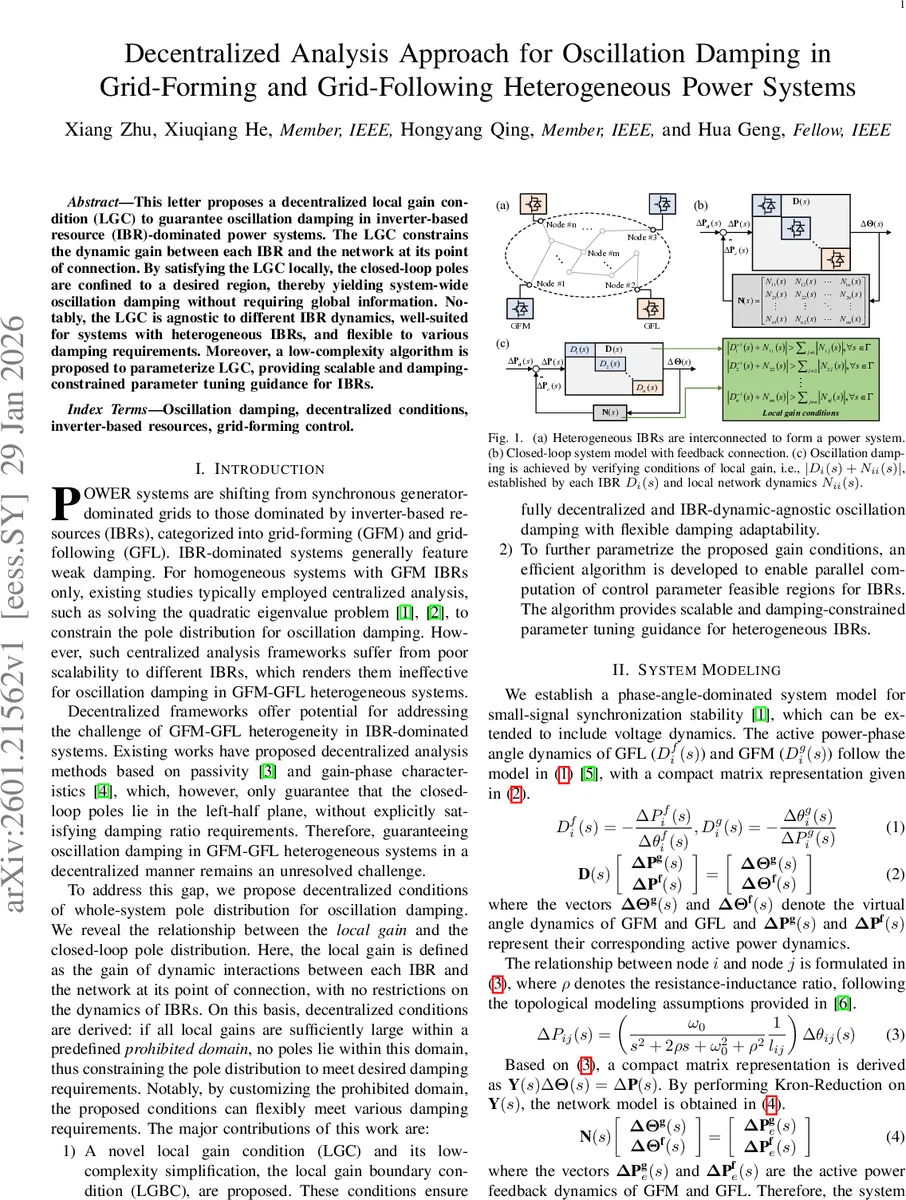
This letter proposes a decentralized local gain condition (LGC) to guarantee oscillation damping in inverter-based resource (IBR)-dominated power systems. The LGC constrains the dynamic gain between each IBR and the network at its point of connection. By satisfying the LGC locally, the closed-loop poles are confined to a desired region, thereby yielding system-wide oscillation damping without requiring global information. Notably, the LGC is agnostic to different IBR dynamics, well-suited for systems with heterogeneous IBRs, and flexible to various damping requirements. Moreover, a low-complexity algorithm is proposed to parameterize LGC, providing scalable and damping-constrained parameter tuning guidance for IBRs.
💡 Research Summary
The paper addresses the pressing challenge of ensuring adequate oscillation damping in modern power systems that are increasingly dominated by inverter‑based resources (IBRs). Unlike traditional grids that rely on synchronous generators, future grids will contain a mixture of grid‑forming (GFM) and grid‑following (GFL) converters, often with heterogeneous control dynamics. Existing centralized small‑signal stability analyses—such as solving quadratic eigenvalue problems—scale poorly with system size and cannot easily accommodate diverse IBR models. Moreover, prior decentralized approaches based on passivity or gain‑phase criteria guarantee only that closed‑loop poles lie in the left‑half plane, without enforcing a minimum damping ratio, which is essential for practical power‑system operation.
To fill this gap, the authors propose a Decentralized Local Gain Condition (LGC). The system is modeled as a feedback interconnection of two blocks: a diagonal matrix D(s) that captures each IBR’s dynamic gain, and a network matrix N(s) that represents the linearized admittance seen at each converter’s point of connection. The characteristic equation of the closed‑loop system is
\
Comments & Academic Discussion
Loading comments...
Leave a Comment