Conformal Geodesics Cannot Spiral -- Erratum
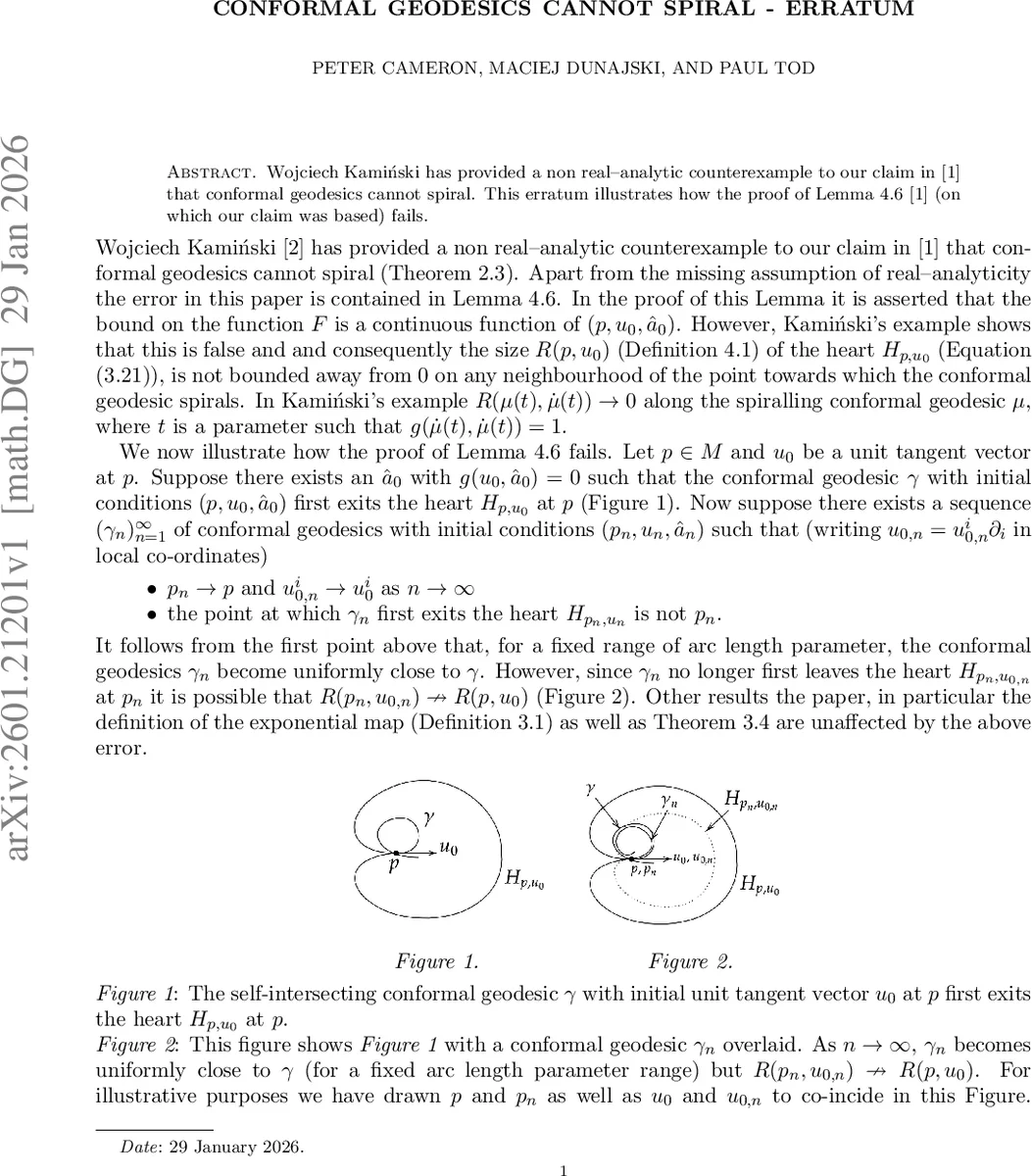
Wojciech Kamiński has provided a non real-analytic counterexample to our claim in [1] that conformal geodesics cannot spiral. This erratum illustrates how the proof of Lemma 4.6 [1] (on which our claim was based) fails.
💡 Research Summary
**
The paper entitled “Conformal Geodesics Cannot Spiral – Erratum” serves as a correction to the authors’ earlier work (Cameron, Dunájski, and Tod, 2024) in which they claimed that conformal geodesics cannot exhibit spiralling behaviour. The correction is prompted by a counterexample constructed by Wojciech Kamiński (2025) that demonstrates a non‑real‑analytic conformal geodesic which does indeed spiral. The authors explain precisely where their original proof fails, focusing on Lemma 4.6, which was the linchpin for the spiralling‑impossibility theorem (Theorem 2.3).
Background of the original claim
In the original article the authors introduced the notion of a “heart” (H_{p,u_{0}}) (Definition 4.1) associated with a point (p) and a unit tangent vector (u_{0}). The heart is a neighbourhood in the tangent bundle bounded by a radius function (R(p,u_{0})). Lemma 4.6 asserted that the bound on a certain auxiliary function (F) depends continuously on the initial data ((p,u_{0},\hat a_{0})). From this continuity they deduced that (R(p,u_{0})) stays uniformly away from zero in a neighbourhood of any point through which a conformal geodesic passes. Consequently, a conformal geodesic could never shrink its heart to zero size, which would be a necessary condition for a true spiral (the geodesic repeatedly re‑entering smaller and smaller neighbourhoods of its starting point).
Kamiński’s counterexample
Kamiński constructed a smooth (but not real‑analytic) metric and a conformal geodesic (\mu(t)) satisfying the unit‑speed condition (g(\dot\mu(t),\dot\mu(t))=1). Along this curve the radius function satisfies
\
Comments & Academic Discussion
Loading comments...
Leave a Comment