Abelian varieties are de Rham $K(π,1)$
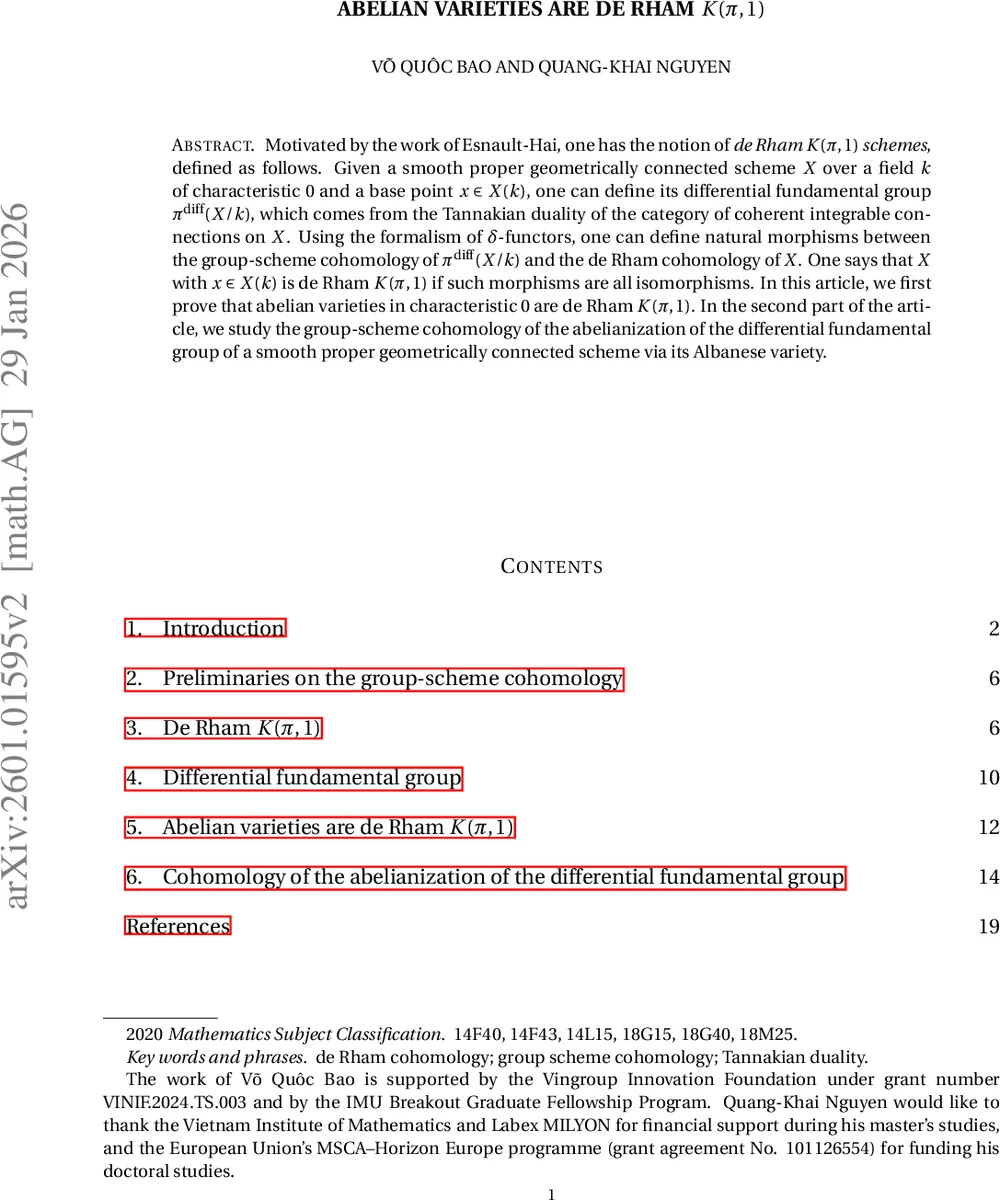
Motivated by the work of Esnault-Hai, one has the notion of de Rham $K(π,1)$ schemes, defined as follows. Given a smooth proper geometrically connected scheme $X$ over a field $k$ of characteristic 0 and a base point $x \in X (k)$, one can define its differential fundamental group $π^{\mathrm{diff}}(X/k)$, which comes from the Tannakian duality of the category of coherent integrable connections on $X$. Using the formalism of $δ$-functors, one can define natural morphisms between the group-scheme cohomology of $π^{\mathrm{diff}}(X/k)$ and the de Rham cohomology of $X$. One says that $X$ with $x\in X(k)$ is de Rham $K(π,1)$ if such morphisms are all isomorphisms. In this article, we first prove that abelian varieties in characteristic $0$ are de Rham $K(π,1)$. In the second part of the article, we study the group-scheme cohomology of the abelianization of the differential fundamental group of a smooth proper geometrically connected scheme via its Albanese variety.
💡 Research Summary
The paper introduces and studies the notion of a “de Rham K(π,1) scheme”, a de Rham analogue of the classical topological K(π,1) spaces. For a smooth proper geometrically connected scheme X over a field k of characteristic 0 with a rational base point x, the differential fundamental group π^diff(X/k) is defined via Tannakian duality from the category of coherent O_X‑modules equipped with integrable k‑linear connections (the MIC category). The fiber functor at x yields an equivalence between MIC_coh(X) and the category of finite‑dimensional representations Rep_f(π^diff(X/k)). Using this equivalence, a universal δ‑functor produces natural comparison maps
δ_i^X/k(V): H^i(π^diff(X/k), V) → H^i_{dR}(X, (V,∇))
for every i≥0 and every finite‑dimensional π^diff‑module V. X is called de Rham K(π,1) if all these maps are isomorphisms.
The first main result (Theorem 5.3) asserts that every abelian variety over a characteristic 0 field is de Rham K(π,1). The proof proceeds in two stages.
-
Complex case (k=ℂ). For a complex abelian variety A, the differential fundamental group coincides with the pro‑algebraic completion of the topological fundamental group π_1^{top}(A^{an}) (Deligne–Esnault–Hai). Since A^{an} is a real torus (S^1)^{2g}, it is a classical K(π,1) space; the Cartan–Leray comparison maps ρ_i: H^i(π_1^{top}, M) → H^i(A, M) are isomorphisms for all i. Via the Tannakian equivalence, the de Rham comparison maps δ_i coincide with ρ_i, hence are isomorphisms.
-
General field k. One chooses a finitely generated subfield k′⊂k over which the abelian variety A and its connection data are defined. After base‑changing to ℂ, the comparison in the complex case yields isomorphisms for A⊗_k′ℂ. The key observation is that π^diff(A) is a commutative affine group scheme; it splits as a direct product of its unipotent part and its multiplicative‑type part. Lemma 2.1 shows that group‑scheme cohomology of a commutative group reduces to the cohomology of its unipotent part with invariants under the multiplicative part. Lemma 2.2 proves that a faithfully flat morphism inducing an isomorphism on unipotent parts yields isomorphisms on cohomology. Using the Lyndon–Hochschild–Serre spectral sequence for the extension by the multiplicative part, together with base‑change properties of group‑scheme cohomology, one transfers the complex isomorphisms back to the original field k. Consequently δ_i^A/k(V) is an isomorphism for all i and V, establishing the de Rham K(π,1) property.
Corollary 5.4 follows: for an abelian variety of dimension g, H^i(π^diff(A), V) vanishes for i>2g, is finite‑dimensional for all i, and its Euler characteristic ∑(−1)^i dim H^i equals zero.
The second part of the paper investigates the relationship between the differential fundamental group of a smooth proper variety X and that of its Albanese variety Alb X. The Albanese morphism f: X→Alb X induces a morphism of differential fundamental groups f^: π^diff(X)→π^diff(Alb X). Since π^diff(Alb X) is commutative (Lemma 4.2), f^ factors through the maximal abelian quotient π^diff(X)^ab. Theorem 6.3 shows that the induced map π^diff(X)^ab → π^diff(Alb X) is faithfully flat, and for every finite‑dimensional representation V of π^diff(Alb X) the cohomology groups satisfy
H^i(π^diff(Alb X), V) ≅ H^i(π^diff(X)^ab, V) for all i≥0.
The proof again uses the complex case: over ℂ, the topological fundamental groups satisfy a similar statement, and the de Rham first cohomology groups of X and Alb X are naturally isomorphic. For a general field, one reduces to the complex case via a finitely generated subfield and applies the Lyndon–Hochschild–Serre spectral sequence together with the faithful flatness of the map on unipotent parts.
Corollary 6.5 deduces that the group‑scheme cohomology of π^diff(X)^ab is finite‑dimensional in every degree and has Euler characteristic zero. Finally, Corollary 6.6 translates the result back to the topological setting: for a complex smooth proper variety, π_1^{top}(Alb X) is the quotient of the abelianization π_1^{top}(X)^ab by its torsion subgroup, and the induced maps on cohomology with coefficients in any representation are isomorphisms.
Overall, the paper establishes that abelian varieties provide the first non‑curve examples of de Rham K(π,1) schemes, and it clarifies how the de Rham cohomology of a variety is reflected in the cohomology of the abelianized differential fundamental group via the Albanese map. The methods blend transcendental arguments (complex analytic topology), Tannakian formalism, spectral sequence techniques, and careful base‑change analysis, opening avenues for further exploration of de Rham K(π,1) phenomena in non‑abelian or positive‑characteristic contexts.
Comments & Academic Discussion
Loading comments...
Leave a Comment