Living Droplets with Mesoscale Swimmers
We study the activity of “living” droplets, which confine 1-6 mesoswimmers in 3D using a superhydrophobic substrate. The swimmers induce oscillations of the droplets at their inherent resonant frequencies, regardless of swimmer size and number. In contrast, the droplet oscillation amplitude is strongly affected by crowding, which we successfully model with a new scaling law and show that crowding reduces the speed of the swimmers. These fundamental living matter physics results reveal mechanisms for bio-inspired droplet actuation with implications for mesoscale robotics, fluidics, and sensing.
💡 Research Summary
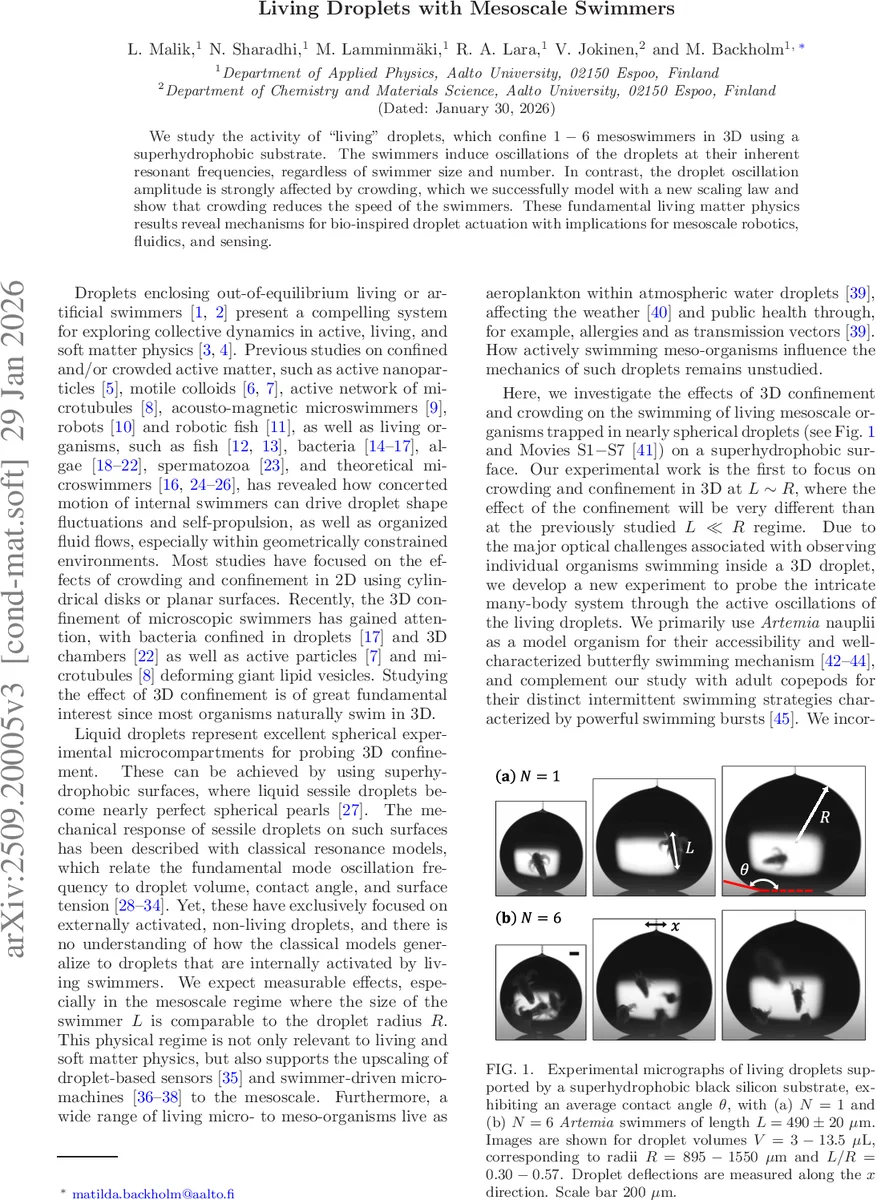
In this work the authors investigate “living droplets” that encapsulate a small number (1–6) of mesoscale swimmers inside nearly spherical sessile droplets formed on a super‑hydrophobic black‑silicon substrate. The droplets have volumes ranging from 2 µL to 20 µL (radii 0.6–1.75 mm) and exhibit a very high static contact angle of ~163°, ensuring minimal pinning and low kinetic friction. Two model swimmers are employed: Artemia nauplii (young brine‑shrimp larvae) of length L≈0.5 mm (24 h old) or L≈0.7 mm (48 h old) that swim continuously by flapping antennae, and adult Acartia tonsa copepods (L≈1.1 mm) that generate burst‑type strokes.
A thin glass micropipette (length 2.5–2.8 cm, spring constant ≈5 nN µm⁻¹ for Artemia, ≈2.4 nN µm⁻¹ for copepods) is inserted just beneath the droplet surface to record lateral deflection x(t) of the interface with a side‑view camera (40–100 fps, 5× magnification). The resulting time series shows clear oscillatory behavior. Fourier analysis reveals two characteristic frequencies: a high‑frequency peak f₁ that matches the fundamental resonance of the droplet, and a low‑frequency peak f₂ associated with collective “envelope” events when several swimmers impact the interface simultaneously.
The high‑frequency resonance f₁ scales with droplet volume as f₁ ∝ V⁻⁰·⁵, in excellent agreement with the classical Clanet‑Keller (CK) model for sessile droplets:
f₁ =
Comments & Academic Discussion
Loading comments...
Leave a Comment