Explicit desingularisation of Kummer surfaces in characteristic two via specialisation
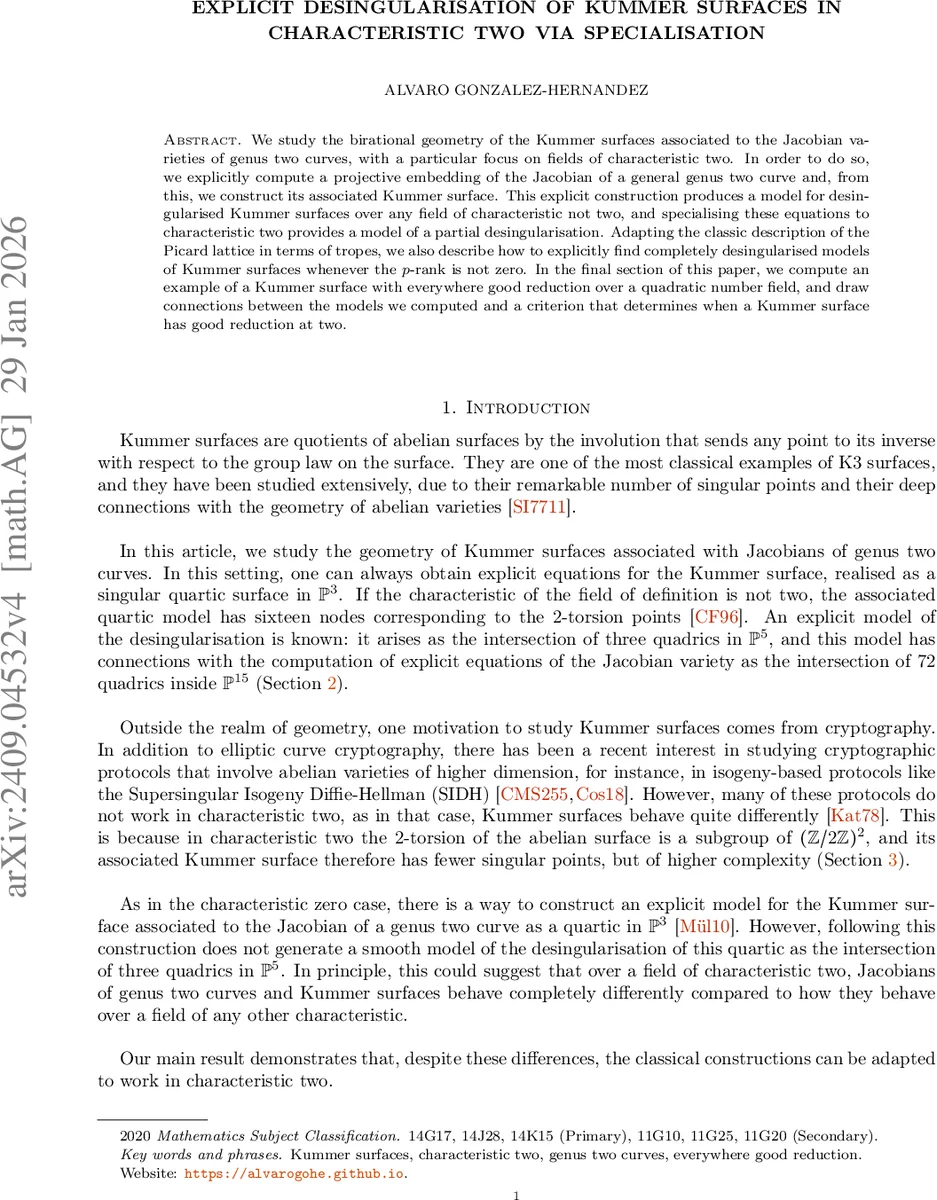
We study the birational geometry of the Kummer surfaces associated to the Jacobian varieties of genus two curves, with a particular focus on fields of characteristic two. In order to do so, we explicitly compute a projective embedding of the Jacobian of a general genus two curve and, from this, we construct its associated Kummer surface. This explicit construction produces a model for desingularised Kummer surfaces over any field of characteristic not two, and specialising these equations to characteristic two provides a model of a partial desingularisation. Adapting the classic description of the Picard lattice in terms of tropes, we also describe how to explicitly find completely desingularised models of Kummer surfaces whenever the $p$-rank is not zero. In the final section of this paper, we compute an example of a Kummer surface with everywhere good reduction over a quadratic number field, and draw connections between the models we computed and a criterion that determines when a Kummer surface has good reduction at two.
💡 Research Summary
The paper investigates the birational geometry of Kummer surfaces attached to Jacobians of genus‑two curves, with a special emphasis on fields of characteristic two. The authors begin by recalling the classical construction in characteristic different from two: a generic genus‑two curve C is given by an affine model
y² + g(x) y = f(x)
with f of degree six and g of degree three, such that the sextic ˜f(x)=f(x)+¼g(x)² is separable. The six Weierstrass roots ω₁,…,ω₆ generate the full 2‑torsion of the Jacobian J. By constructing four even rational functions k₁,…,k₄ and six odd functions b₁,…,b₆ on J, the authors obtain bases for the linear systems |Θ⁺+Θ⁻| (dimension 4) and |2(Θ⁺+Θ⁻)| (dimension 16). The first system yields an embedding J → P¹⁵ defined by 72 quadratic equations; the even part of these equations gives the classical quartic model X⊂P³ of the Kummer surface, which has sixteen A₁ singularities corresponding to the 2‑torsion points. The second system, after blowing up J at its 2‑torsion, produces a smooth K3 surface Y that embeds into P⁵ as the complete intersection of three quadrics. The authors describe in detail the three families of quadratic relations: (i) the 20 Plücker‑type relations k_{ij}k_{rs}=k_{ir}k_{js}, (ii) eight mixed relations involving the b_i and the k_j, and (iii) 21 relations among the b_i themselves.
Having set up the characteristic‑zero picture, the paper’s main contribution is to specialize these equations to characteristic two. In characteristic two the 2‑torsion subgroup collapses from (ℤ/2ℤ)⁴ to (ℤ/2ℤ)², so the number of singular points on the quartic drops, but the remaining singularities become more intricate. By reducing the 72 quadratic equations modulo 2 and analysing which relations survive, the authors show that the partial desingularisation of the Kummer surface is still given by the intersection of three quadrics in P⁵. This provides an explicit model for a “partial” resolution that works over any perfect field of characteristic two.
A central technical tool is the classical configuration of sixteen tropes—conics passing through six singular points each. The authors reinterpret tropes combinatorially in terms of subsets of the six Weierstrass points: six “single‑point” tropes T_i and ten “triple‑pair” tropes T_{ijk}. They explain how the action of the 2‑torsion translates tropes among themselves and how the field of definition of each trope is dictated by symmetric functions in the ω_i. In the case where the p‑rank of J is non‑zero (i.e., the 2‑torsion is fully split), the tropes remain defined over explicit quadratic extensions, and this information is used to construct completely desingularised models even in characteristic two.
The final section applies the theory to arithmetic. The authors exhibit a genus‑two curve defined over the quadratic field K=ℚ(√29) whose Jacobian has everywhere good reduction. Using the explicit equations from the previous sections, they compute a Kummer surface attached to this Jacobian and verify that it also has everywhere good reduction. The verification relies on the criterion of Lazda–Skorobogatov (2023), which translates the condition of good reduction at the prime 2 into a statement about the Galois action on the 2‑torsion points of the Jacobian. By checking that the Galois representation satisfies the required invariance properties, they confirm that the Kummer surface’s reduction at 2 is smooth, thereby providing the first known example of a K3 surface (specifically a Kummer surface) with everywhere good reduction over a number field.
In summary, the paper makes three major contributions:
-
Explicit characteristic‑zero model – a concrete set of 72 quadratic equations defining the Jacobian in P¹⁵, the quartic Kummer surface in P³, and its smooth desingularisation as a three‑quadric complete intersection in P⁵.
-
Specialization to characteristic 2 – a systematic reduction of the above equations, yielding an explicit partial desingularisation valid over any perfect field of characteristic two, together with a detailed analysis of how tropes and the p‑rank control the remaining singularities.
-
Arithmetic application – construction of a Kummer surface over a quadratic field with everywhere good reduction, and a demonstration that the Lazda–Skorobogatov criterion can be checked explicitly using the models developed.
These results bridge the gap between the classical theory of Kummer surfaces (mostly developed over characteristic zero) and the arithmetic of K3 surfaces in positive characteristic, with potential implications for both the study of reduction of K3 surfaces and for cryptographic protocols that aim to use higher‑dimensional abelian varieties in characteristic two.
Comments & Academic Discussion
Loading comments...
Leave a Comment