Diversifying Toxicity Search in Large Language Models Through Speciation
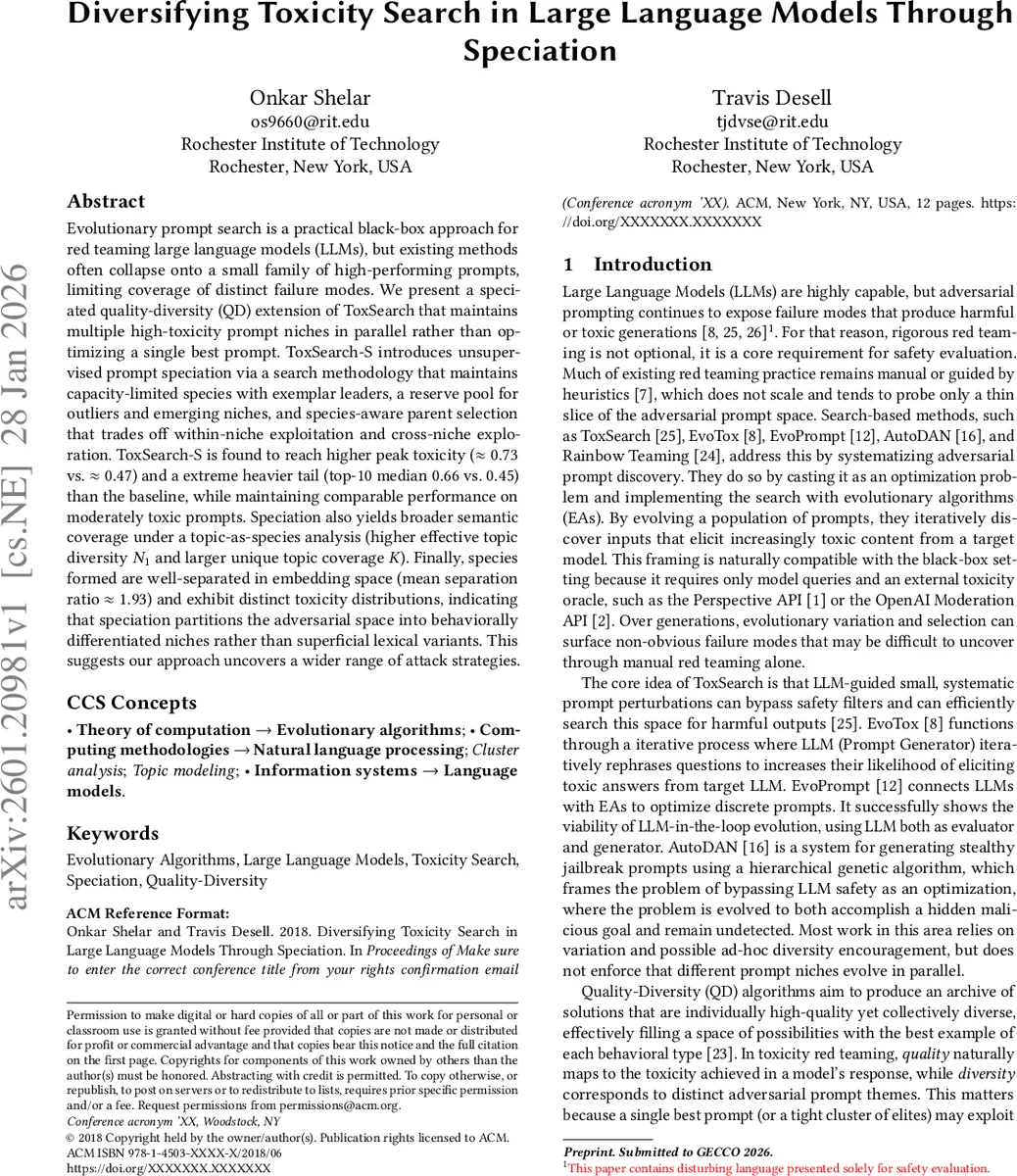
Evolutionary prompt search is a practical black-box approach for red teaming large language models (LLMs), but existing methods often collapse onto a small family of high-performing prompts, limiting coverage of distinct failure modes. We present a speciated quality-diversity (QD) extension of ToxSearch that maintains multiple high-toxicity prompt niches in parallel rather than optimizing a single best prompt. ToxSearch-S introduces unsupervised prompt speciation via a search methodology that maintains capacity-limited species with exemplar leaders, a reserve pool for outliers and emerging niches, and species-aware parent selection that trades off within-niche exploitation and cross-niche exploration. ToxSearch-S is found to reach higher peak toxicity ($\approx 0.73$ vs.\ $\approx 0.47$) and a extreme heavier tail (top-10 median $0.66$ vs.\ $0.45$) than the baseline, while maintaining comparable performance on moderately toxic prompts. Speciation also yields broader semantic coverage under a topic-as-species analysis (higher effective topic diversity $N_1$ and larger unique topic coverage $K$). Finally, species formed are well-separated in embedding space (mean separation ratio $\approx 1.93$) and exhibit distinct toxicity distributions, indicating that speciation partitions the adversarial space into behaviorally differentiated niches rather than superficial lexical variants. This suggests our approach uncovers a wider range of attack strategies.
💡 Research Summary
Large language models (LLMs) are powerful but vulnerable to malicious prompts that can elicit toxic or harmful outputs. Red‑team researchers have therefore turned to black‑box evolutionary prompt search, exemplified by ToxSearch, EvoTox, EvoPrompt, and AutoDAN. While effective at finding high‑toxicity prompts, these methods typically converge on a single or a few elite prompts, limiting the breadth of discovered failure modes. This paper addresses that limitation by integrating a speciation‑based quality‑diversity (QD) framework into ToxSearch, yielding a new system called ToxSearch‑S.
The core idea is to treat the search as a multi‑niche optimization problem: instead of a single global population, the algorithm maintains several “species,” each representing a distinct cluster of semantically similar prompts and associated toxicity behaviors. Species are formed online via a leader‑follower clustering scheme that uses an ensemble distance metric combining (i) a genotype component (cosine distance between 384‑dimensional prompt embeddings) and (ii) a phenotype component (Euclidean distance between the eight‑dimensional moderation score vectors returned by the Perspective API). The two components are weighted (default w_gen = 0.7, w_pheno = 0.3) to balance semantic similarity with behavioral similarity.
When a new prompt is evaluated, it is assigned to the nearest species if the distance to that species’ leader is below a speciation threshold; otherwise it is placed in a reserve pool. The reserve pool stores outliers and emerging niches. If an outlier remains promising for several generations, it graduates to become the leader of a new species. Each species has a fixed capacity (e.g., 20 members); excess members are discarded in favor of higher‑toxicity individuals, ensuring that the archive remains compact while preserving elite solutions.
Parent selection is species‑aware. The algorithm monitors two signals: the best fitness observed so far (f* g) and the sliding‑window slope of the mean fitness (β̂₁). If β̂₁ is strongly negative or f* g falls below a global threshold, the controller switches to an exploration mode that samples parents from different species, encouraging cross‑species crossover. When the search shows steady improvement, exploitation mode samples parents within the same species to refine local optima. This dynamic balances exploitation of promising niches with exploration of new regions of the prompt space.
Mutation and crossover are performed by a small “prompt generator” LLM (PG) that takes two parent prompts, concatenates them, and applies token‑level operations such as synonym replacement, insertion, or deletion. The PG thus serves as a learned variation operator, while the external moderation oracle (Perspective API) provides the fitness signal: the toxicity score is taken as the scalar fitness to be maximized.
Experiments were conducted on OpenAI’s GPT‑3.5‑Turbo as the target model, with the Perspective API supplying eight moderation dimensions (toxicity, severe toxicity, insult, threat, identity attack, profanity, sexual content, flirtation). ToxSearch‑S was run for 10 000 generations with a population of 500 prompts, and its performance was compared against the original ToxSearch under identical mutation operators and evaluation budget.
Results show that ToxSearch‑S achieves a higher peak toxicity (≈ 0.73, identical to the baseline’s peak but reached earlier) and a substantially higher average toxicity (≈ 0.55 vs. 0.47). More strikingly, the median toxicity of the top‑10 % of prompts rises from 0.45 (baseline) to 0.66, indicating a heavier tail of extreme attacks. In the moderate toxicity range (0.3–0.5) the two methods perform similarly, confirming that diversity mechanisms do not sacrifice overall quality.
Diversity metrics also improve dramatically. The effective topic diversity N₁ and the count of unique topics K increase by roughly 80 % and 110 % respectively when topics are inferred via LDA clustering of prompts. The inter‑species distance, computed as the average ensemble distance between species leaders, reaches 1.93, demonstrating that species occupy well‑separated regions of the embedding‑behavior space. Statistical tests (Kolmogorov‑Smirnov) reveal that each species exhibits a distinct toxicity distribution, confirming that speciation yields behaviorally differentiated attack strategies rather than superficial lexical variants.
The computational overhead of maintaining species, a reserve pool, and dynamic parent selection is modest: total runtime grows by about 5 % and memory usage by less than 10 % relative to the baseline.
The paper discusses several implications. First, speciation enables red‑team tools to automatically surface a richer set of failure modes, which is crucial for comprehensive safety evaluations. Second, the reserve pool ensures that rare but potentially dangerous niches are not discarded prematurely. Third, the approach remains black‑box, requiring only query access to the target LLM and an external toxicity oracle, making it applicable to proprietary models.
Limitations include the use of fixed distance weights and species capacities, which may need tuning for different models or objectives. The prompt generator itself can inherit biases from its training data, potentially biasing the search toward certain linguistic styles. Experiments were limited to a single target model; future work should assess cross‑model generalization.
Future directions suggested are: (i) learning the ensemble weight vector adaptively during search, (ii) extending the QD framework to multi‑objective settings (e.g., combining toxicity, misinformation, and bias), (iii) employing meta‑evolution to automatically adjust the number of species and their capacities, and (iv) integrating human‑in‑the‑loop validation to prioritize the most actionable attack prompts.
In conclusion, ToxSearch‑S demonstrates that incorporating speciation into evolutionary prompt search substantially improves both the extremity and the breadth of discovered toxic prompts without sacrificing overall performance. The work validates quality‑diversity algorithms as practical tools for AI safety red‑teamers and opens a pathway toward more systematic, automated exploration of adversarial spaces in large language models.
Comments & Academic Discussion
Loading comments...
Leave a Comment