Quench spectroscopy of amplitude modes in a one-dimensional critical phase
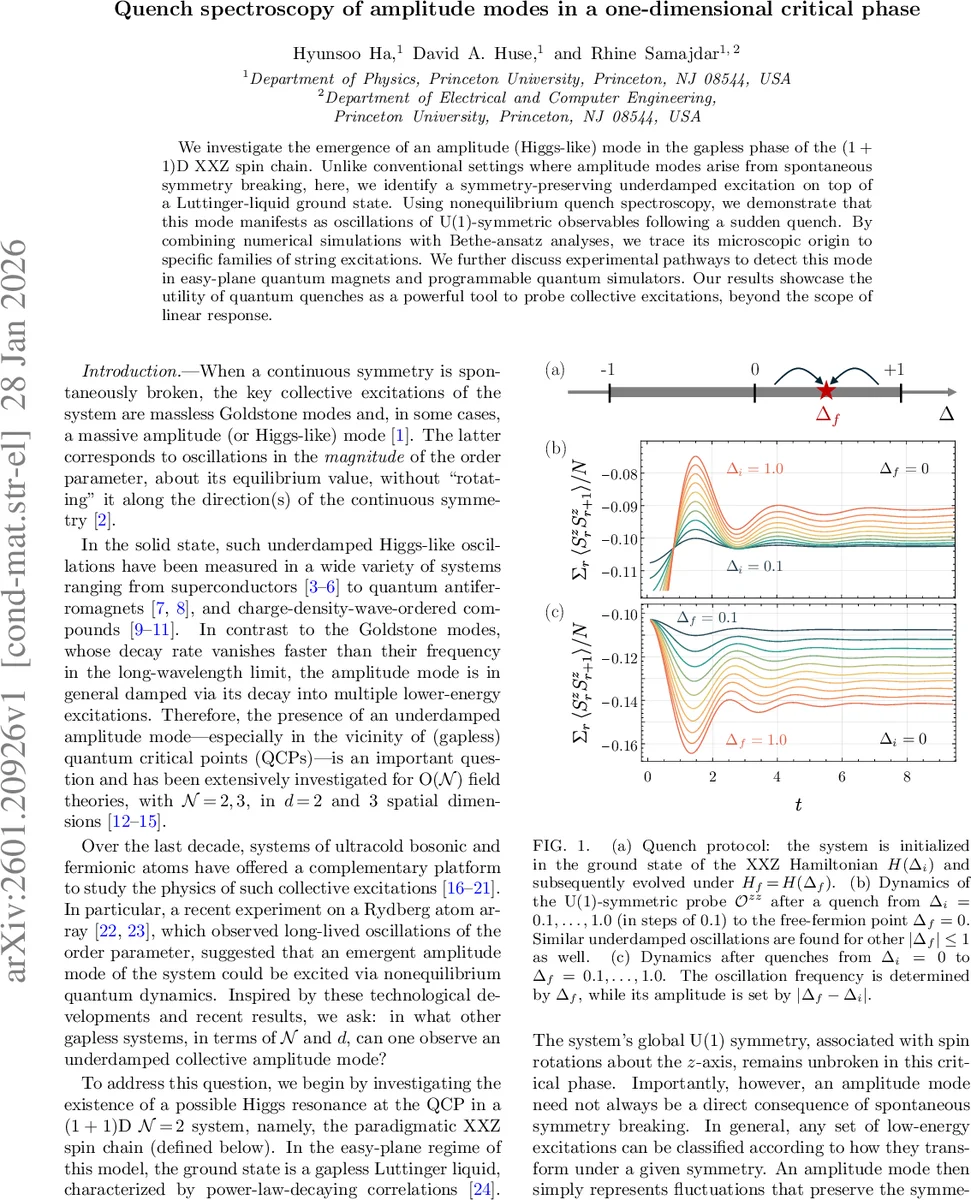
We investigate the emergence of an amplitude (Higgs-like) mode in the gapless phase of the $(1+1)$D XXZ spin chain. Unlike conventional settings where amplitude modes arise from spontaneous symmetry breaking, here, we identify a symmetry-preserving underdamped excitation on top of a Luttinger-liquid ground state. Using nonequilibrium quench spectroscopy, we demonstrate that this mode manifests as oscillations of U(1)-symmetric observables following a sudden quench. By combining numerical simulations with Bethe-ansatz analyses, we trace its microscopic origin to specific families of string excitations. We further discuss experimental pathways to detect this mode in easy-plane quantum magnets and programmable quantum simulators. Our results showcase the utility of quantum quenches as a powerful tool to probe collective excitations, beyond the scope of linear response.
💡 Research Summary
The paper reports the discovery of an under‑damped amplitude (Higgs‑like) mode in the gapless Luttinger‑liquid phase of the one‑dimensional spin‑½ XXZ chain. Unlike the conventional Higgs mode that appears after spontaneous breaking of a continuous symmetry, this excitation preserves the full U(1) spin‑rotation symmetry of the model. The authors demonstrate that the mode can be excited and detected by a quantum‑quench protocol, which they term “quench spectroscopy.”
Model and quench protocol
The Hamiltonian is the antiferromagnetic XXZ chain
(H(\Delta)=J\sum_{r=1}^{N-1}\big(S^x_r S^x_{r+1}+S^y_r S^y_{r+1}+\Delta S^z_r S^z_{r+1}\big))
with exchange (J>0) and anisotropy (\Delta). For (|\Delta|\le 1) the ground state is a gapless Luttinger liquid. The authors first obtain the ground state (|\psi(0)\rangle) at an initial anisotropy (\Delta_i) using density‑matrix renormalization group (DMRG). At time (t=0) they suddenly change the anisotropy to a final value (\Delta_f) (still within the critical regime) and let the system evolve under (H_f=H(\Delta_f)). The time‑dependent state is (|\psi(t)\rangle=e^{-iH_f t}|\psi(0)\rangle). As an observable they choose the uniform, U(1)‑symmetric operator
(O_{zz}=\frac{1}{N}\sum_{r} S^z_r S^z_{r+1}),
which commutes with the global spin‑rotation symmetry and is experimentally accessible through global measurements.
Numerical observations
Using time‑evolving block decimation (TEBD) the authors compute (\langle O_{zz}(t)\rangle) for various quenches. They find pronounced, long‑lived oscillations whose frequency depends only on the final anisotropy (\Delta_f), while the amplitude is set by the difference (|\Delta_f-\Delta_i|). For a quench to the free‑fermion point (\Delta_f=0) the period is (T\approx 2.5/J) (frequency (\omega\approx 2.5J)), essentially independent of (\Delta_i). The oscillations are not explained by the single‑particle bandwidth; instead they signal a collective many‑body mode.
Analytical framework – free‑fermion limit
At (\Delta=0) the model maps via Jordan‑Wigner to non‑interacting spinless fermions with dispersion (E(k)=J\cos k). The operator (O_{zz}) becomes a quartic fermionic term that creates two particles with momenta (k_{p\pm}) and two holes with momenta (k_{h\pm}). Momentum conservation imposes (\kappa=k_{p+}+k_{p-}-k_{h+}-k_{h-}=2\pi\ell). The authors parametrize the four momenta by three variables ((Q,p,q)) as
(k_{p\pm}=Q\pm p,\quad k_{h\pm}=Q\pm(\pi-q)).
The excitation energy is (\varepsilon=2J\cos Q(\cos p+\cos q)). The density of states at a given energy (\omega) is then a surface integral over the constant‑energy manifold in ((Q,p,q)) space. They compute both the bare density of states (g(\omega)) and the weighted response (\langle O_{zz}\rangle^{(1)}(\omega)\propto |A(Q,p,q)|^2/\varepsilon) with matrix element (A(Q,p,q)=\sin p\sin q).
The analysis reveals Van Hove singularities at (\omega_1^\ast=3\sqrt{3}J/2\approx2.6J) and (\omega_2^\ast=2J). At these frequencies the constant‑energy surface touches the boundary of the allowed domain, producing cusps in (g(\omega)). Because the matrix element vanishes on the boundary lines (p=0) or (q=0), the response peak is shifted slightly below (\omega_1^\ast). Consequently the early‑time dynamics are dominated by a well‑defined under‑damped oscillation, while at long times the decay follows power laws: a leading (t^{-2}) term from the low‑energy edge (\omega=0) and subleading oscillatory contributions (\sim t^{-5/2}) from the two Van Hove points.
Bethe‑ansatz treatment for (|\Delta_f|<1)
The XXZ chain is integrable, allowing an exact description of excitations via Bethe ansatz. For (|\Delta_f|<1) the eigenstates consist of real rapidities (particle‑like excitations) and complex strings (bound states). The authors identify three families of excitations that couple to (O_{zz}): (I) two‑particle–two‑hole states built from real rapidities, (II) states involving a 2‑string together with a hole, and (III) states with two 2‑strings. By evaluating the overlap (\langle n|O_{zz}|0\rangle) for each family they find that the dominant contribution to the under‑damped mode originates from excitations containing a 2‑string. These string excitations generate a sharp feature in the dynamical structure factor at an energy that matches the observed oscillation frequency for a given (\Delta_f). Thus the amplitude mode can be interpreted as a coherent superposition of specific string excitations that respect the U(1) symmetry.
Experimental relevance and extensions
The authors discuss realistic platforms where the protocol could be implemented. In easy‑plane quantum magnets the anisotropy (\Delta) can be tuned by applying a magnetic field or pressure; in superconducting qubit arrays or trapped‑ion chains the XXZ Hamiltonian can be engineered with programmable couplings. The observable (O_{zz}) corresponds to nearest‑neighbour spin‑spin correlations, measurable via neutron scattering, ESR, or site‑resolved quantum‑gas microscopy. The paper also includes a supplemental analysis of the transverse‑field Ising chain (N=1), showing that a similar symmetry‑preserving mode exists even when the symmetry is discrete (Z₂). This suggests that quench spectroscopy is a broadly applicable tool for uncovering hidden collective excitations beyond linear response.
Conclusions
The work establishes that a quantum quench can act as a spectroscopic probe of collective amplitude modes in a gapless one‑dimensional critical phase. The identified mode is under‑damped, symmetry‑preserving, and rooted in the microscopic structure of Bethe‑ansatz string excitations. By bridging non‑equilibrium dynamics, exact integrability, and realistic experimental considerations, the study opens a new avenue for exploring Higgs‑like physics in low‑dimensional quantum many‑body systems where conventional symmetry‑breaking arguments do not apply.
Comments & Academic Discussion
Loading comments...
Leave a Comment