A generative machine learning model for designing metal hydrides applied to hydrogen storage
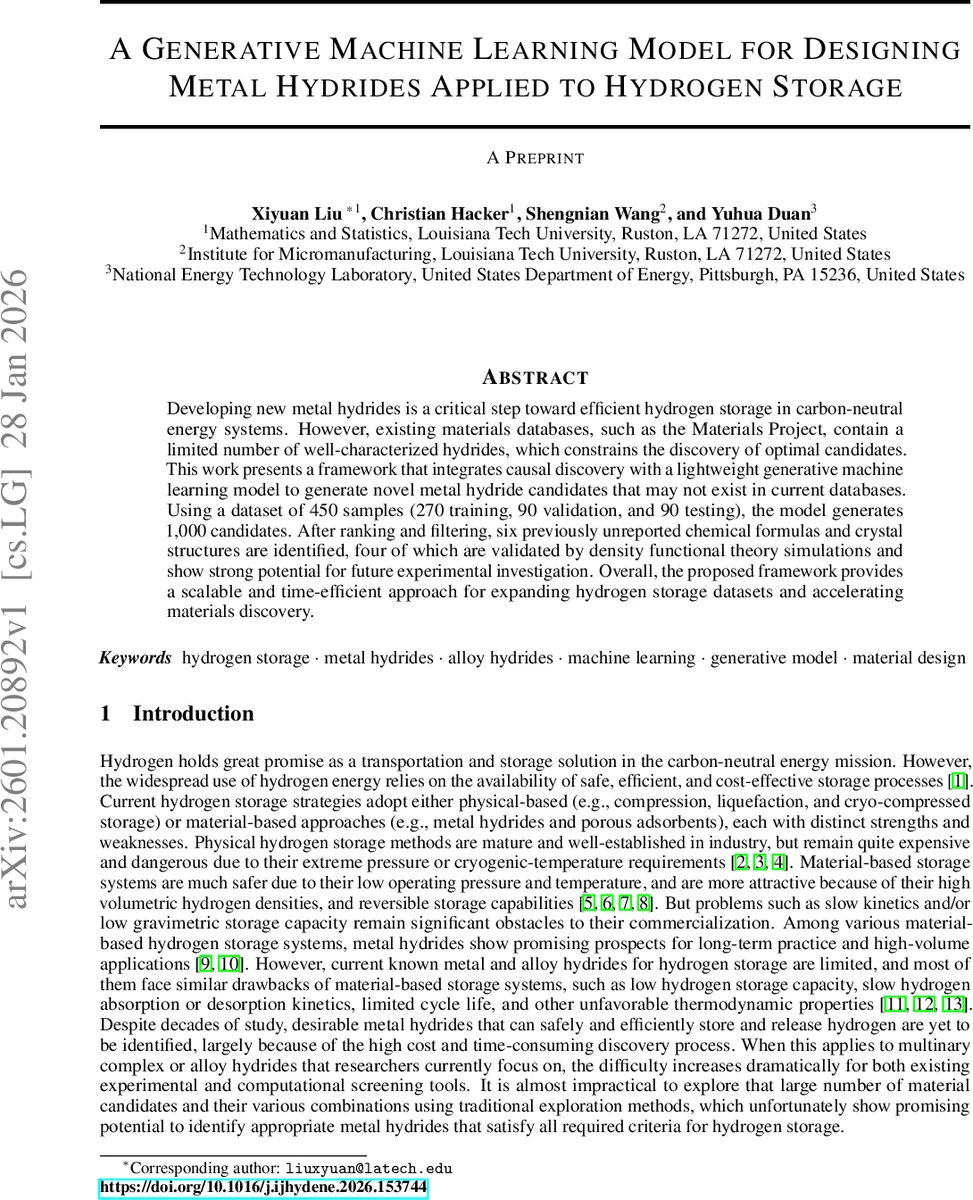
Developing new metal hydrides is a critical step toward efficient hydrogen storage in carbon-neutral energy systems. However, existing materials databases, such as the Materials Project, contain a limited number of well-characterized hydrides, which constrains the discovery of optimal candidates. This work presents a framework that integrates causal discovery with a lightweight generative machine learning model to generate novel metal hydride candidates that may not exist in current databases. Using a dataset of 450 samples (270 training, 90 validation, and 90 testing), the model generates 1,000 candidates. After ranking and filtering, six previously unreported chemical formulas and crystal structures are identified, four of which are validated by density functional theory simulations and show strong potential for future experimental investigation. Overall, the proposed framework provides a scalable and time-efficient approach for expanding hydrogen storage datasets and accelerating materials discovery.
💡 Research Summary
The paper addresses the pressing need for new metal hydrides capable of efficient hydrogen storage in a carbon‑neutral energy landscape. Existing materials databases, such as the Materials Project, contain only a few hundred well‑characterized hydrides, limiting the discovery of optimal candidates. To overcome this bottleneck, the authors develop an integrated framework that couples causal discovery with a lightweight generative machine‑learning model, enabling the creation of novel metal‑hydride compositions and crystal structures even when only a small amount of data is available.
First, the authors define a composite “Hydrogen Storage Score” (H‑Storage Score) that combines hydrogen weight fraction (W_H2) with a formation‑energy‑based weighting factor (E_factor). This metric simultaneously captures gravimetric capacity and thermodynamic suitability, favoring materials whose formation energies lie near zero (neither too stable nor too unstable). Using the Materials Project, they assemble a dataset of 450 hydrides (270 for training, 90 for validation, 90 for testing) and compute the H‑Storage Score for each entry.
Next, they apply the Fast Causal Inference (FCI) algorithm—a constraint‑based causal discovery method—to the dataset. FCI identifies the Markov blanket of the H‑Storage Score, i.e., the minimal set of features that directly influence the score while accounting for hidden confounders. This step reduces the original high‑dimensional feature space (dozens of compositional, structural, and electronic descriptors) to a handful of key variables (e.g., specific elemental ratios, lattice parameters, electronic band‑gap proxies). By focusing on causally relevant features rather than simple correlations, the authors mitigate the curse of dimensionality and avoid over‑fitting.
With the reduced feature set, they train a Variational Autoencoder (VAE). The VAE’s encoder maps each hydride’s descriptor vector into a low‑dimensional latent space; the decoder reconstructs the full descriptor, including a CIF‑style crystal‑structure representation, from latent vectors. Because the VAE is trained on only 270 samples, the causal‑guided feature selection is crucial: it limits the number of learnable parameters, allowing the model to converge quickly on a consumer‑grade GPU (NVIDIA RTX 3090) without requiring massive computational resources.
After training, the VAE is sampled to generate 1,000 candidate materials. Each generated candidate includes a proposed chemical formula, a CIF file describing its crystal lattice, and a predicted H‑Storage Score. A rule‑based filter then removes chemically implausible or economically infeasible compositions (e.g., rare or toxic elements, extreme stoichiometries) and enforces a minimum H‑Storage Score threshold. The remaining candidates are relaxed using a pretrained M3GNet graph‑based interatomic potential, which refines lattice parameters and yields updated material descriptors.
Four of the six top‑ranked, previously unreported alloy hydrides pass subsequent density‑functional‑theory (DFT) validation. DFT calculations confirm negative formation energies (≈ −0.15 to −0.25 eV per atom), hydrogen weight fractions between 2.5 wt% and 3.0 wt%, and the absence of imaginary phonon modes, indicating both thermodynamic and dynamical stability. These four materials therefore exhibit strong potential for experimental synthesis and further performance testing.
The study highlights several key innovations: (1) causal discovery‑driven feature selection that dramatically reduces data requirements; (2) a lightweight VAE capable of generating not only compositions but also explicit crystal‑structure files; (3) an end‑to‑end pipeline that runs on a single high‑end GPU, cutting computational cost by roughly an order of magnitude compared with brute‑force DFT screening. Limitations include reliance on observational data for causal graph construction (which may miss hidden variables), the need for post‑generation DFT verification to ensure chemical realism, and the current focus on thermodynamic metrics without explicit kinetic modeling.
Future directions proposed by the authors involve extending the scoring function to incorporate kinetic descriptors (e.g., hydrogen absorption/desorption rates), integrating Bayesian optimization or reinforcement learning for multi‑objective material design, and employing recurrent neural networks (LSTM) to model time‑dependent processes such as hydrogen diffusion.
In summary, the paper demonstrates that a carefully engineered combination of causal inference and generative deep learning can unlock the discovery of novel metal hydrides from modest datasets, offering a scalable, cost‑effective alternative to traditional high‑throughput computational screening and paving the way for accelerated materials discovery in hydrogen storage and beyond.
Comments & Academic Discussion
Loading comments...
Leave a Comment