Jurisdiction as Structural Barrier: How Privacy Policy Organization May Reduce Visibility of Substantive Disclosures
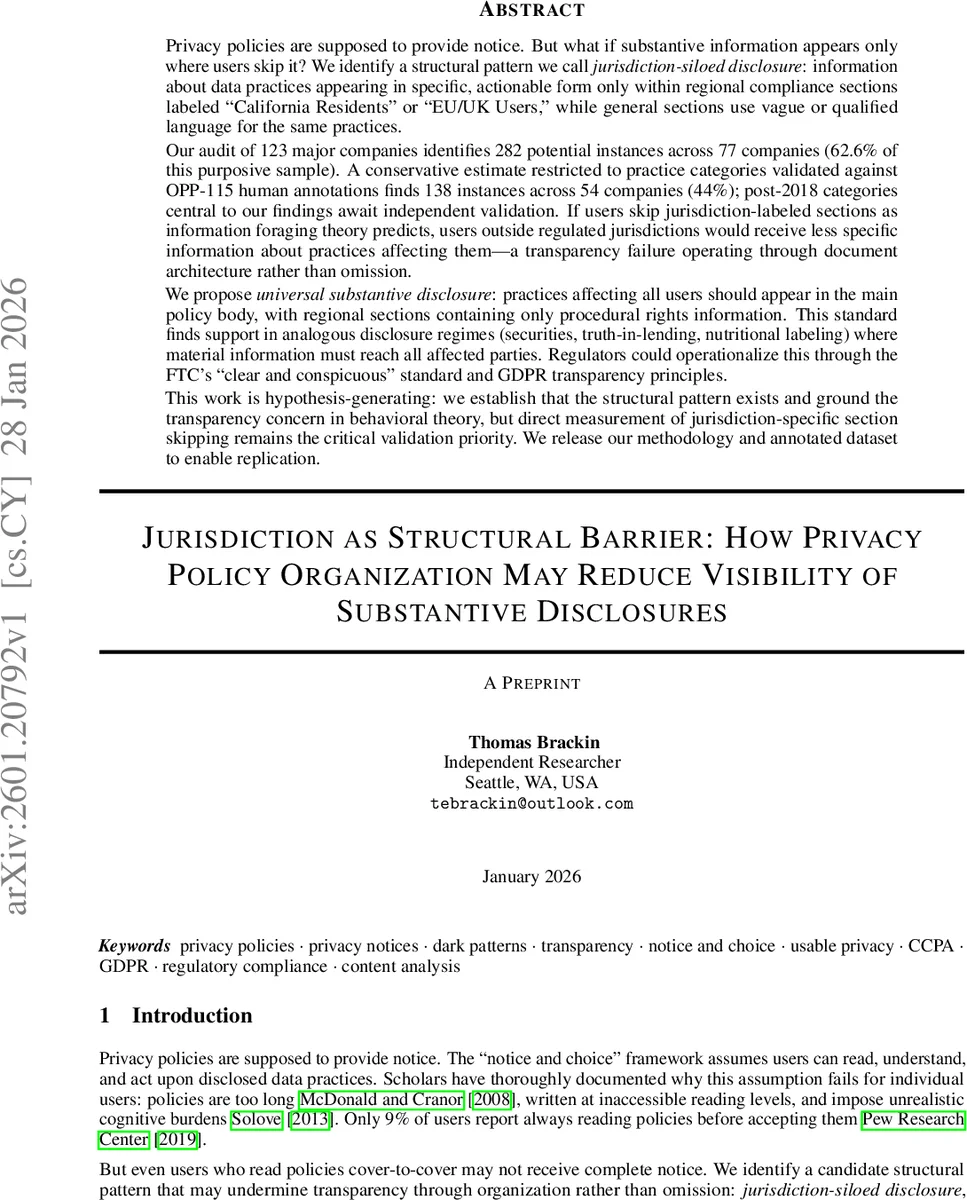
Privacy policies are supposed to provide notice. But what if substantive information appears only where users skip it? We identify a structural pattern we call jurisdiction-siloed disclosure: information about data practices appearing in specific, actionable form only within regional compliance sections labeled “California Residents” or “EU/UK Users,” while general sections use vague or qualified language for the same practices. Our audit of 123 major companies identifies 282 potential instances across 77 companies (62.6% of this purposive sample). A conservative estimate restricted to practice categories validated against OPP-115 human annotations finds 138 instances across 54 companies (44%); post-2018 categories central to our findings await independent validation. If users skip jurisdiction-labeled sections as information foraging theory predicts, users outside regulated jurisdictions would receive less specific information about practices affecting them–a transparency failure operating through document architecture rather than omission. We propose universal substantive disclosure: practices affecting all users should appear in the main policy body, with regional sections containing only procedural rights information. This standard finds support in analogous disclosure regimes (securities, truth-in-lending, nutritional labeling) where material information must reach all affected parties. Regulators could operationalize this through the FTC’s “clear and conspicuous” standard and GDPR transparency principles. This work is hypothesis-generating: we establish that the structural pattern exists and ground the transparency concern in behavioral theory, but direct measurement of jurisdiction-specific section skipping remains the critical validation priority. We release our methodology and annotated dataset to enable replication.
💡 Research Summary
The paper introduces and empirically investigates a previously under‑examined structural barrier to privacy‑policy transparency that the authors term “jurisdiction‑siloed disclosure.” In this pattern, companies place concrete, actionable statements about core data practices—such as data sales, biometric collection, or automated profiling—exclusively inside sections that are labeled for a specific legal jurisdiction (e.g., “California Residents,” “EU/UK Users”). The same practices are either omitted or described with vague, conditional language in the general, “all‑users” portion of the policy. Because the headings signal geographic relevance, users who are not residents of the named jurisdiction are likely to skip those sections entirely, a behavior predicted by information‑foraging theory and supported by prior eye‑tracking and navigation studies.
Methodologically, the authors assembled a purposive sample of 123 major‑company privacy policies. They defined a taxonomy of ten high‑impact practice categories and manually coded each policy for the presence of (1) a substantive, specific disclosure and (2) the location of that disclosure (general body vs. jurisdiction‑specific section). An initial scan identified 282 potential instances across 77 companies (62.6 % of the sample). To guard against false positives, the authors cross‑validated a subset against the OPP‑115 human‑annotation corpus; the conservative, validated count dropped to 138 instances across 54 companies (44 %). These numbers demonstrate that jurisdiction‑siloed disclosure is not an isolated quirk but a widespread design choice among large firms.
The theoretical grounding rests on information‑foraging theory (Pirolli & Card, 1999), which posits that users follow “information scent” cues—such as headings—to decide whether to continue exploring a document. When a heading like “Your California Privacy Rights” appears, non‑California users perceive a weak or negative scent and satisfy their information need by stopping, often after a few seconds of skimming. Empirical work by Obar & Oeldorf‑Hirsch (2020), Vu et al. (2007), and Steinfeld (2016) confirms that such heading‑driven skipping is common in privacy‑policy reading. The authors acknowledge that direct measurement of skipping behavior for jurisdiction‑specific sections is still missing, and they position this as a critical validation step for future work.
From a regulatory perspective, the paper highlights a gap in current privacy‑law drafting. Laws such as the California Consumer Privacy Act (CCPA), the EU General Data Protection Regulation (GDPR), and Illinois’ Biometric Information Privacy Act (BIPA) prescribe what information must be disclosed but not where within a policy it must appear. Consequently, firms can technically comply by placing required disclosures solely inside jurisdiction‑specific sections, while leaving the main body with only procedural instructions (opt‑out mechanisms, contact details, etc.). This satisfies the letter of the law but undermines the spirit of “clear and conspicuous” notice required by the FTC and the “easily accessible” principle embedded in GDPR’s transparency obligations.
To address the identified problem, the authors propose a normative design principle they call Universal Substantive Disclosure. Under this standard, any practice that affects all users—regardless of jurisdiction—must be disclosed in the universal, top‑level portion of the privacy policy. Jurisdiction‑specific sections would be reserved for procedural content, such as how to exercise a right, submit a request, or contact a supervisory authority. The authors draw analogies to other disclosure regimes (securities filings, truth‑in‑lending disclosures, nutritional labeling) where material facts must reach every affected party, arguing that privacy policies should follow a similar logic.
The paper concludes with a roadmap for future research. First, empirical studies—using eye‑tracking, click‑stream logs, or controlled user experiments—should directly measure the prevalence of jurisdiction‑section skipping. Second, automated tools that parse policy structure (not just content) need to be developed, extending existing corpora like OPP‑115 and PriVaSeer to detect siloed placement at scale. Third, comparative experiments should assess whether policies adhering to Universal Substantive Disclosure improve user comprehension, perceived fairness, and regulatory compliance outcomes. By releasing their annotation methodology and the full dataset, the authors invite the community to replicate, extend, and refine the analysis, thereby turning a hypothesis‑generating observation into a robust empirical foundation for policy redesign and regulatory guidance.
Comments & Academic Discussion
Loading comments...
Leave a Comment