Refinements of Erdős's irrationality criterion for certain sparse infinite series
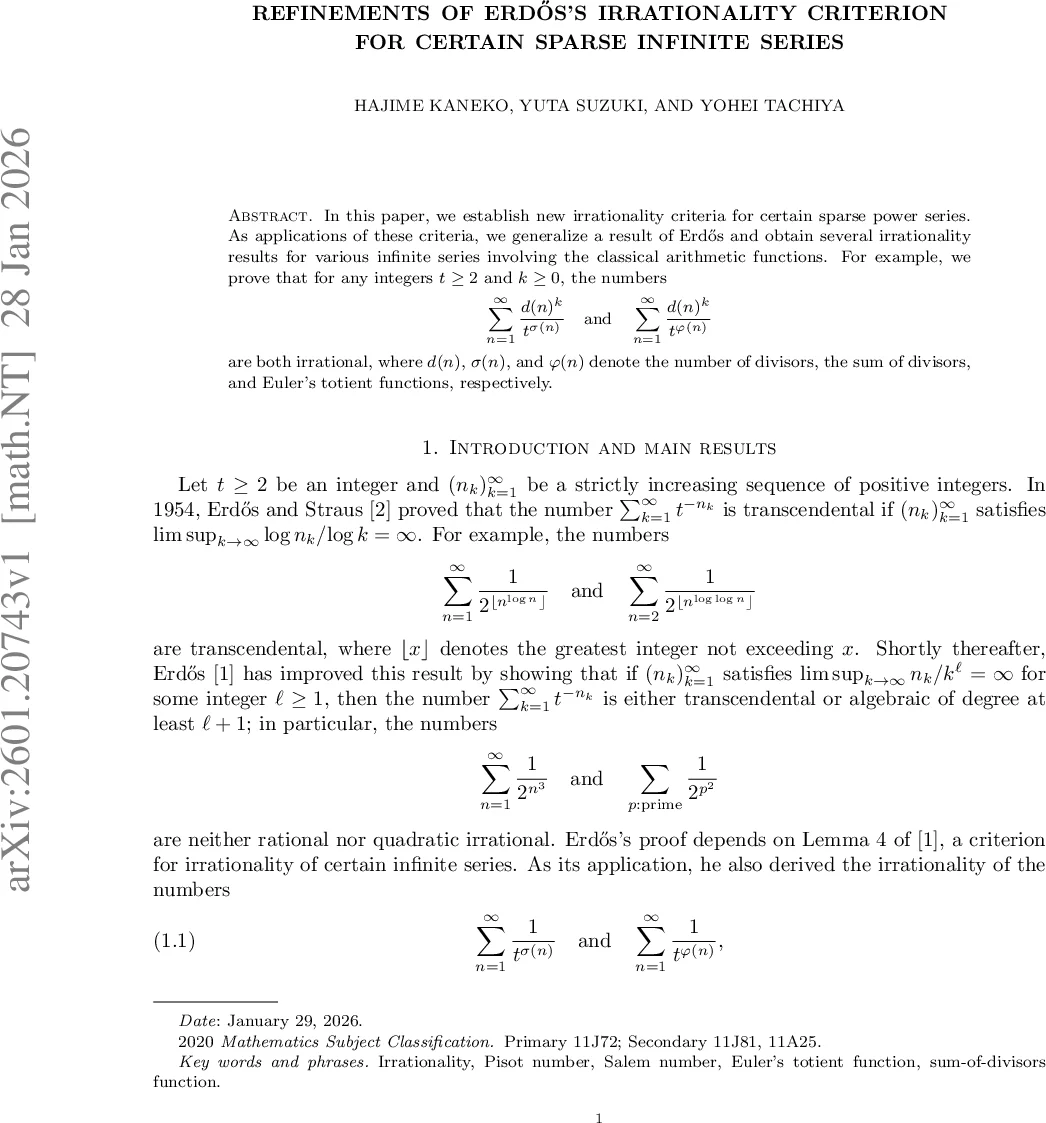
In this paper, we establish new irrationality criteria for certain sparse power series. As applications of these criteria, we generalize a result of Erdős and obtain several irrationality results for various infinite series involving the classical arithmetic functions. For example, we prove that for any integers $t\ge2$ and $k\geq0$, the numbers [ \sum_{n=1}^{\infty} \frac{d(n)^k}{t^{σ(n)}} \quad\text{and}\quad \sum_{n=1}^{\infty} \frac{d(n)^k}{t^{ϕ(n)}} ] are both irrational, where $d(n)$, $σ(n)$, and $ϕ(n)$ denote the number of divisors, the sum of divisors, and Euler’s totient functions, respectively.
💡 Research Summary
The paper revisits and substantially strengthens Erdős’s irrationality criterion for sparse infinite series. Erdős and Straus (1954) proved that series of the form (\sum_{k\ge1} t^{-n_k}) are transcendental when the index sequence ({n_k}) grows sufficiently fast, e.g. (\limsup_{k\to\infty}\frac{\log n_k}{\log k}=\infty). Later Erdős refined this result, showing that if (\limsup_{k\to\infty}\frac{n_k}{k^\ell}=\infty) for some integer (\ell\ge1), then the same series is either transcendental or algebraic of degree at least (\ell+1). The key tool behind these results is Lemma 4 of Erdős’s paper, a criterion for irrationality of series with non‑negative integer coefficients.
The authors of the present work introduce a new framework based on Pisot and Salem numbers—real algebraic integers (q>1) whose Galois conjugates lie inside the unit disc (Pisot) or on its boundary (Salem). By exploiting the fact that all embeddings (\sigma) of (\mathbb{Q}(q)) satisfy (|q^\sigma|\le1), they obtain precise control over the “tail” of a series, \
Comments & Academic Discussion
Loading comments...
Leave a Comment