FD-MAD: Frequency-Domain Residual Analysis for Face Morphing Attack Detection
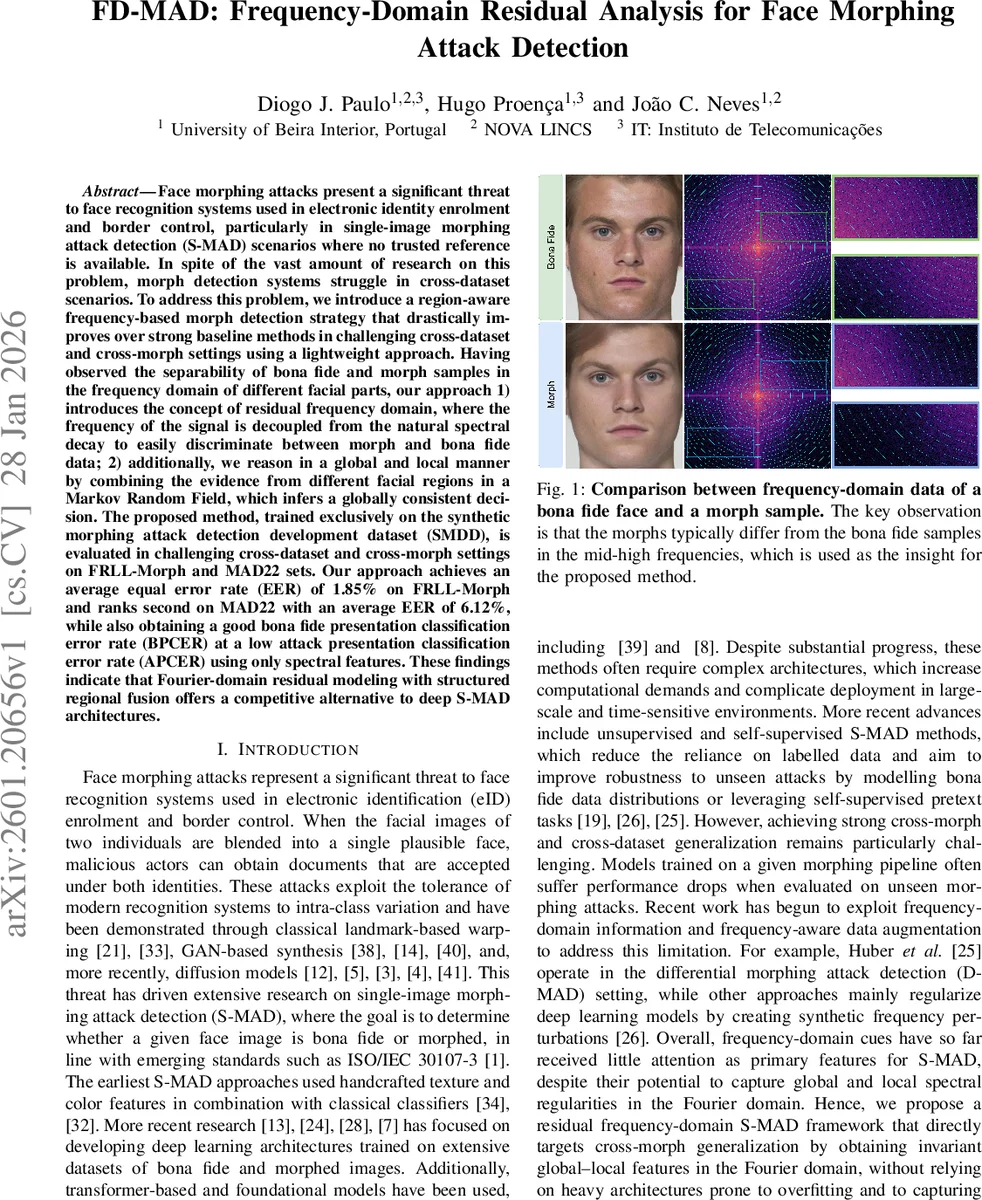
Face morphing attacks present a significant threat to face recognition systems used in electronic identity enrolment and border control, particularly in single-image morphing attack detection (S-MAD) scenarios where no trusted reference is available. In spite of the vast amount of research on this problem, morph detection systems struggle in cross-dataset scenarios. To address this problem, we introduce a region-aware frequency-based morph detection strategy that drastically improves over strong baseline methods in challenging cross-dataset and cross-morph settings using a lightweight approach. Having observed the separability of bona fide and morph samples in the frequency domain of different facial parts, our approach 1) introduces the concept of residual frequency domain, where the frequency of the signal is decoupled from the natural spectral decay to easily discriminate between morph and bona fide data; 2) additionally, we reason in a global and local manner by combining the evidence from different facial regions in a Markov Random Field, which infers a globally consistent decision. The proposed method, trained exclusively on the synthetic morphing attack detection development dataset (SMDD), is evaluated in challenging cross-dataset and cross-morph settings on FRLL-Morph and MAD22 sets. Our approach achieves an average equal error rate (EER) of 1.85% on FRLL-Morph and ranks second on MAD22 with an average EER of 6.12%, while also obtaining a good bona fide presentation classification error rate (BPCER) at a low attack presentation classification error rate (APCER) using only spectral features. These findings indicate that Fourier-domain residual modeling with structured regional fusion offers a competitive alternative to deep S-MAD architectures.
💡 Research Summary
The paper addresses the pressing problem of detecting face morphing attacks in single‑image scenarios (S‑MAD), where no trusted reference image is available. While deep learning approaches have achieved high accuracy on in‑distribution data, they often fail to generalize across different morphing pipelines (landmark‑based, GAN‑based, diffusion‑based) and datasets. The authors propose a lightweight, interpretable method that operates entirely in the Fourier domain and exploits the well‑known power‑law behavior of natural images (the magnitude spectrum roughly follows f⁻α).
The core idea is to compute a residual spectrum that removes the estimated f⁻α baseline from the log‑magnitude radial profile of an image. For each RGB channel, the 2‑D discrete Fourier transform is taken, the log‑magnitude spectrum is azimuthally averaged into K concentric frequency rings, and a linear fit in log‑log space provides the baseline parameters (intercept a and slope b). Subtracting this baseline yields a residual vector r(f) that highlights deviations caused by morphing artifacts, especially in the mid‑to‑high frequency bands where warping and blending introduce irregular energy patterns. The residuals from all three channels are concatenated, standardized, and reduced by PCA to form a compact global descriptor x_r, which is fed to a linear SVM (or logistic regression) to produce a global morph probability s_global.
To capture localized artifacts, the method extracts four semantic facial regions (left eye, right eye, nose, mouth) using a landmark detector. Each region undergoes the same Fourier‑residual pipeline, producing region‑specific descriptors that are classified by independent logistic regressors, yielding per‑region posterior probabilities p_r(z=1|x_r). These probabilities are transformed into unary potentials ψ_r(z)=−log p_r(z) for a pairwise Markov Random Field (MRF). The MRF connects neighboring regions (e.g., both eyes, eye‑nose, nose‑mouth) with pairwise potentials that penalize label disagreement, encouraging a globally consistent labeling while still allowing region‑specific evidence to dominate when necessary. Exact inference (e.g., graph‑cut) yields a consensus local decision s_local.
The final morph score is a weighted combination of s_global and s_local, providing a probabilistic, interpretable decision that leverages both global spectral trends and fine‑grained regional cues.
Experiments are conducted in a strict cross‑dataset, cross‑morph setting. The model is trained exclusively on the synthetic SMDD development set and evaluated on two challenging benchmarks: FRLL‑Morph (which includes a variety of landmark‑based and GAN‑based morphs) and MAD22 (which aggregates 22 different morphing techniques, including recent diffusion‑based methods). FD‑MAD achieves an average Equal Error Rate (EER) of 1.85 % on FRLL‑Morph, outperforming strong deep‑learning baselines, and an average EER of 6.12 % on MAD22, ranking second overall. Notably, the method maintains low Bona‑Fide Presentation Classification Error Rate (BPCER) while keeping Attack Presentation Classification Error Rate (APCER) well below 5 %, a balance crucial for operational deployment.
Ablation studies dissect the contributions of each component: (i) using only the global residual descriptor, (ii) using only the regional descriptors, (iii) fusing regional scores by simple averaging instead of MRF, and (iv) omitting the baseline removal step. Results show that (a) global and local residuals are complementary, (b) the MRF fusion significantly improves robustness to heterogeneous artifacts (especially for high‑quality GAN morphs), and (c) baseline removal is essential for exposing the subtle spectral deviations that differentiate morphs from bona‑fide images. t‑SNE visualizations of the residual feature space reveal well‑separated clusters for bona‑fide and morph samples, underscoring the interpretability of the approach.
In summary, the paper makes three major contributions: (1) introducing a Fourier‑domain residual representation that isolates morph‑induced spectral anomalies, (2) designing a structured regional fusion via a Markov Random Field to enforce coherent decisions across facial parts, and (3) demonstrating that a lightweight, non‑deep architecture can achieve state‑of‑the‑art performance in cross‑dataset and cross‑morph scenarios. The authors plan to release code and models, facilitating real‑time, large‑scale deployment in border control and identity verification systems.
Comments & Academic Discussion
Loading comments...
Leave a Comment