The RoPES project with HARPS and HARPS-N II. A third planet in the multi-planet system HD 176986
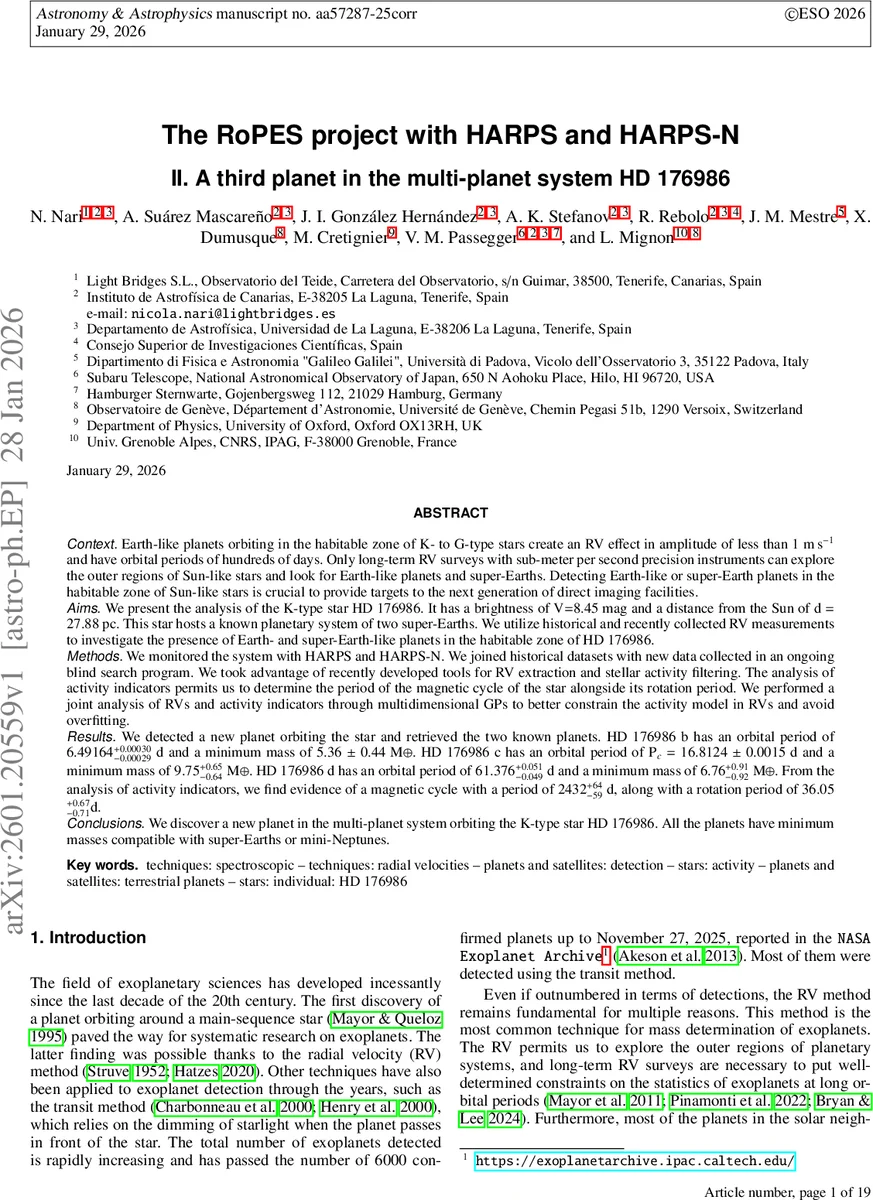
Earth-like planets orbiting in the habitable zone of K- to G-type stars create an RV effect in amplitude of less than 1 \si{\meter\per\second} and have orbital periods of hundreds of days. Only long-term RV surveys with sub-meter per second precision instruments can explore the outer regions of Sun-like stars and look for Earth-like planets and super-Earths. We present the analysis of the K-type star HD 176986. It has a brightness of V=8.45 mag and a distance from the Sun of d = 27.88 pc. This star hosts a known planetary system of two super-Earths. We joined historical datasets with new data collected in an ongoing blind search program. We took advantage of recently developed tools for RV extraction and stellar activity filtering. The analysis of activity indicators permits us to determine the period of the magnetic cycle of the star alongside its rotation period. We performed a joint analysis of RVs and activity indicators through multidimensional GPs to better constrain the activity model in RVs and avoid overfitting. We detected a new planet orbiting the star and retrieved the two known planets. HD 176986 b has an orbital period of 6.49164$^{+0.00030}{-0.00029}$ d and a minimum mass of 5.36 $\pm$ 0.44 M$\oplus$. HD 176986 c has an orbital period of P$c$ = 16.8124 $\pm$ 0.0015 d and a minimum mass of 9.75${-0.64}^{+0.65}$ M$\oplus$. HD 176986 d has an orbital period of 61.376$^{+0.051}{-0.049}$ d and a minimum mass of 6.76${-0.92}^{+0.91}$ M$\oplus$. From the analysis of activity indicators, we find evidence of a magnetic cycle with a period of 2432${-59}^{+64}$ d, along with a rotation period of 36.05 $_{-0.71}^{+0.67}$ d. We discover a new planet in the multi-planet system orbiting the K-type star HD 176986. All the planets have minimum masses compatible with super-Earths or mini-Neptunes.
💡 Research Summary
The paper presents a comprehensive radial‑velocity (RV) study of the nearby K2.5 V star HD 176986, a target of the RoPES (Rocky Planets in Equatorial Stars) long‑term survey. Using more than 750 high‑resolution spectra obtained with the HARPS spectrograph (both before and after its 2015 fiber upgrade) and the northern counterpart HARPS‑N, the authors assembled three distinct RV data sets (H03, H15, and HN). In addition to the standard cross‑correlation function (CCF) velocities, they processed the same spectra with the YARARA pipeline, which corrects a wide range of instrumental systematics (cosmic rays, telluric contamination, detector stitching, etc.) and extracts line‑by‑line (LBL) velocities. The YARARA‑corrected RVs show a clear reduction in root‑mean‑square scatter (from ~3.8 m s⁻¹ to ~3.4 m s⁻¹) and in the average internal uncertainties, demonstrating the power of spectral‑level cleaning for sub‑meter‑per‑second work.
The authors also gathered ancillary activity diagnostics: CCF‑derived metrics (FWHM, BIS), chromospheric indices (Ca II H&K S‑index, Hα, Na I D), and photometry from TESS (sector 80) and ASAS‑SN. Periodogram analysis of these indicators revealed a stellar rotation period of 36.05 ± 0.7 days and a long‑term magnetic cycle of 2432 ± 60 days (≈ 6.7 years). These activity signals overlap with the RV domain and must be modeled jointly to avoid false planetary detections.
To disentangle planetary signals from stellar activity, the authors employed a multidimensional Gaussian Process (GP) framework with a quasi‑periodic kernel, simultaneously fitting the RVs and all activity indices. Model comparison was performed using nested sampling (Dynesty), allowing the calculation of Bayesian evidences for competing models. The three‑planet model (including the two previously known planets b and c) was strongly favored over the two‑planet model (Δln Z ≈ +12), confirming the presence of a third periodicity at ~61.4 days.
The newly identified planet, HD 176986 d, has an orbital period of 61.376 ± 0.05 days, a semi‑amplitude K ≈ 1.9 m s⁻¹, and a minimum mass M sin i = 6.76 ± 0.9 M⊕. Its semi‑major axis is roughly 0.23–0.25 AU, placing it outside both the conservative (0.59–1.05 AU) and optimistic (0.45–1.10 AU) habitable zones defined for a 1 M⊕ planet around a star with L⋆ = 0.331 L⊙. Nevertheless, the system now hosts three super‑Earths (b: 5.36 ± 0.44 M⊕, P = 6.49 d; c: 9.75 ± 0.65 M⊕, P = 16.81 d; d: 6.76 ± 0.91 M⊕, P = 61.38 d) that are dynamically stable according to N‑body integrations.
Stellar parameters derived from Gaia DR3 and high‑resolution spectroscopy are: M⋆ = 0.789 ± 0.019 M⊙, R⋆ = 0.782 ± 0.035 R⊙, Teff = 4931 ± 77 K,
Comments & Academic Discussion
Loading comments...
Leave a Comment