A universal construction of $p$-typical Witt vectors of associative rings
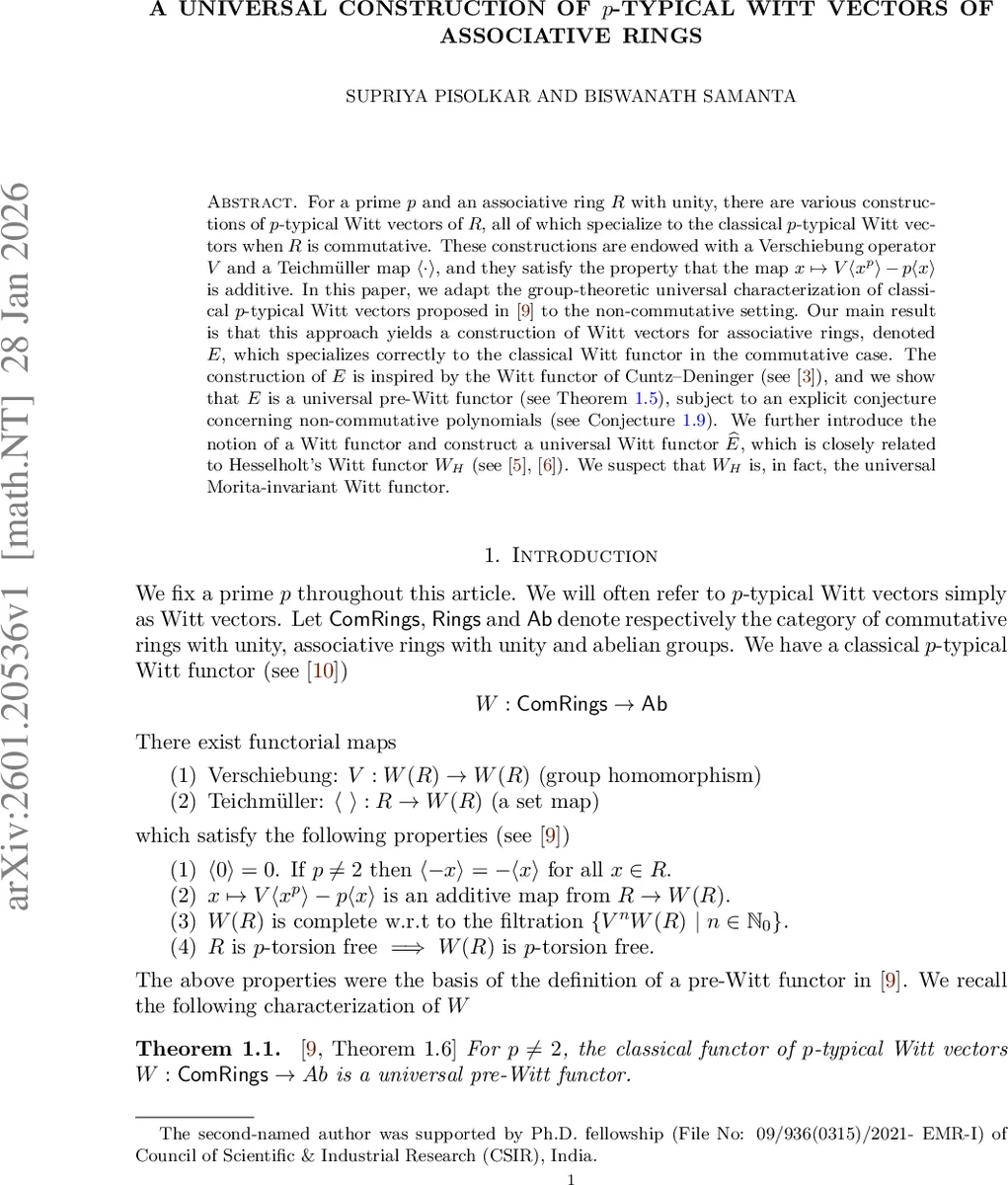
For a prime $p$ and an associative ring $R$ with unity, there are various constructions of $p$-typical Witt vectors of $R$, all of which specialize to the classical $p$-typical Witt vectors when $R$ is commutative. These constructions are endowed with a Verschiebung operator $V$ and a Teichmüller map $\langle \cdot \rangle$, and they satisfy the property that the map $x \mapsto V\langle x^p\rangle - p\langle x \rangle$ is additive. In this paper, we adapt the group-theoretic universal characterization of classical $p$-typical Witt vectors proposed in arXiv:2405.12680 to the non-commutative setting. Our main result is that this approach yields a construction of Witt vectors for associative rings, denoted $E$, which specializes correctly to the classical Witt functor in the commutative case. The construction of $E$ is inspired by the Witt functor of Cuntz–Deninger, and we show that $E$ is a universal pre-Witt functor, subject to an explicit conjecture concerning non-commutative polynomials. We further introduce the notion of a Witt functor and construct a universal Witt functor $\hat{E}$, which is closely related to Hesselholt’s Witt functor $W_H$. We suspect that $W_H$ is, in fact, the universal Morita-invariant Witt functor.
💡 Research Summary
The paper addresses the long‑standing problem of extending the classical p‑typical Witt vector functor, which is traditionally defined only for commutative rings, to the broader category of associative (possibly non‑commutative) rings while preserving the essential group‑theoretic structure. The authors adapt the universal group‑theoretic characterization of Witt vectors introduced in arXiv:2405.12680 and combine it with the construction of Cuntz–Deninger to produce a new functor E: Rings → Abelian groups.
Construction of E.
For a ring R, take a free presentation 0 → I → ℤ{R} → R → 0, where ℤ{R} is the free non‑commutative polynomial ring on the set R. Apply the Cuntz–Deninger functor X, which assigns to any ring a V‑complete abelian group equipped with a Verschiebung operator V and a Teichmüller map ⟨·⟩. Inside X(ℤ{R}) the authors define two V‑stable closed subgroups:
1. X_I, generated by differences Vⁿ⟨a⟩ − Vⁿ⟨b⟩ for a − b ∈ I;
2. Σ_I, consisting of elements obtained by pulling back via a morphism φ: S → R from a p‑torsion‑free source S (and its commutator‑quotient \bar S).
The subgroup f X_I is the closure of the union of X_I and Σ_I. The Witt‑type group for R is then defined as
E(R) = X(ℤ{R}) / f X_I.
Because V and ⟨·⟩ are defined on X, they descend to E, and the crucial identity
x ↦ V⟨x^p⟩ − p⟨x⟩
remains additive, satisfying the defining axiom of a pre‑Witt functor.
Verification of the pre‑Witt axioms.
The authors prove that E is functorial, V‑complete, and that the map above is additive. They also show that if both R and its commutator‑quotient \bar R are p‑torsion‑free, then f X_I coincides with the p‑saturation X_sat I, which guarantees that E(R) is p‑torsion‑free. Lemma 2.6 establishes independence from the choice of free presentation, while Lemma 2.7 shows that for a free non‑commutative polynomial algebra A, E(A) ≅ X(A).
Compatibility with the classical Witt functor.
When R is commutative, the free non‑commutative ring ℤ{R} maps onto the usual polynomial ring ℤ
Comments & Academic Discussion
Loading comments...
Leave a Comment