A Unified Symmetry Classification of Many-Body Localized Phases
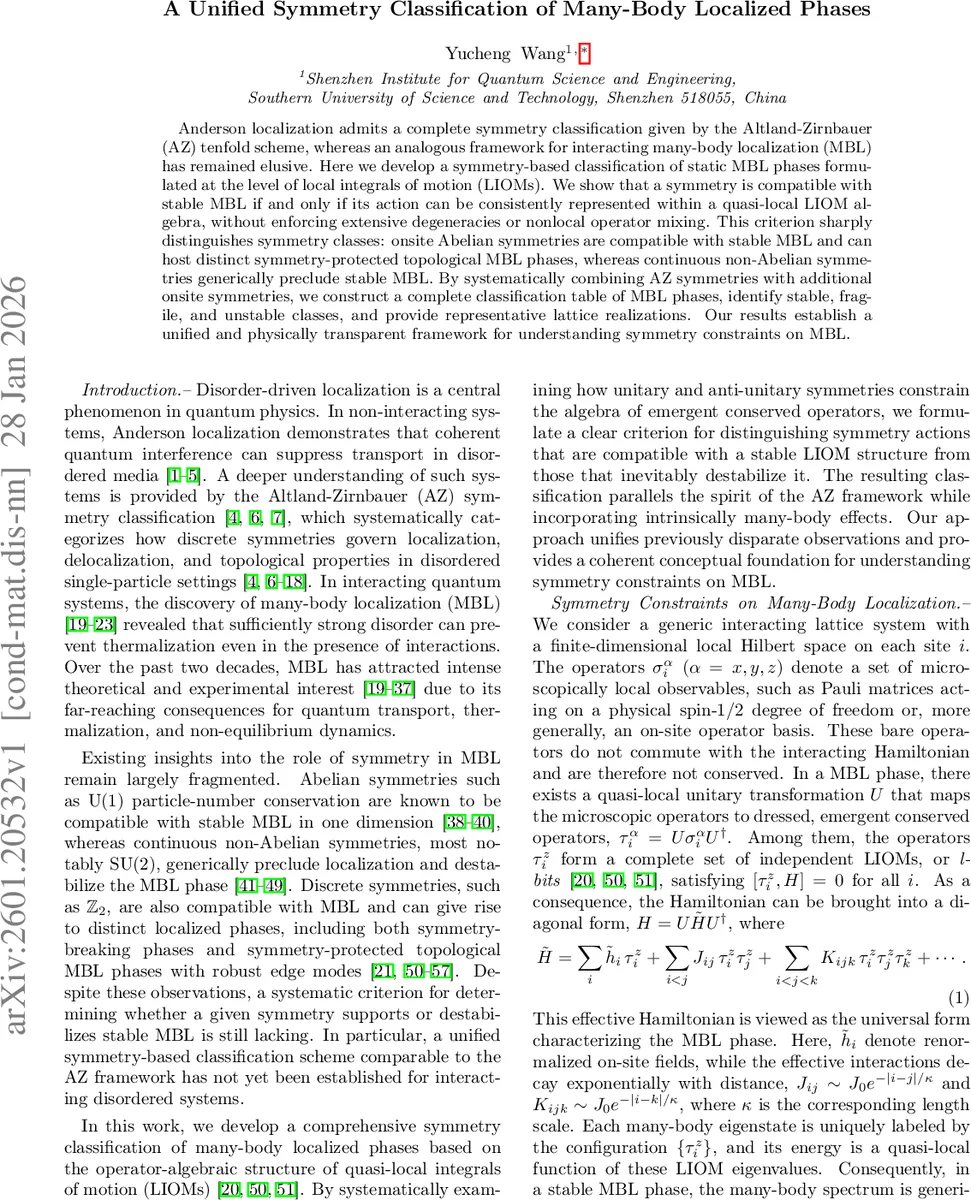
Anderson localization admits a complete symmetry classification given by the Altland-Zirnbauer (AZ) tenfold scheme, whereas an analogous framework for interacting many-body localization (MBL) has remained elusive. Here we develop a symmetry-based classification of static MBL phases formulated at the level of local integrals of motion (LIOMs). We show that a symmetry is compatible with stable MBL if and only if its action can be consistently represented within a quasi-local LIOM algebra, without enforcing extensive degeneracies or nonlocal operator mixing. This criterion sharply distinguishes symmetry classes: onsite Abelian symmetries are compatible with stable MBL and can host distinct symmetry-protected topological MBL phases, whereas continuous non-Abelian symmetries generically preclude stable MBL. By systematically combining AZ symmetries with additional onsite symmetries, we construct a complete classification table of MBL phases, identify stable, fragile, and unstable classes, and provide representative lattice realizations. Our results establish a unified and physically transparent framework for understanding symmetry constraints on MBL.
💡 Research Summary
The authors present a comprehensive symmetry classification for many‑body localized (MBL) phases, filling a long‑standing gap in the theory of interacting disordered systems. Building on the well‑established Altland‑Zirnbauer (AZ) tenfold way for non‑interacting Anderson localization, they develop an operator‑algebraic framework that works directly with the quasi‑local integrals of motion (LIOMs) that define an MBL phase.
The central result is a precise compatibility criterion: a global symmetry group G can coexist with a stable MBL phase if and only if there exists a quasi‑local unitary transformation that simultaneously diagonalizes the Hamiltonian in a complete set of LIOMs {τᶻ_i} and implements each group element g∈G as a quasi‑local map τᶻ_i → f_i({τᶻ_j}) whose support remains exponentially localized near site i, without forcing an extensive number of exact degeneracies in the many‑body spectrum. This condition captures two physical requirements: (i) the symmetry must preserve the quasi‑local structure of the LIOM algebra, and (ii) it must not generate a proliferation of resonant states that would trigger an avalanche instability.
Applying this criterion, the paper distinguishes three broad symmetry families:
-
On‑site Abelian symmetries (U(1), Z_n, etc.). These can be represented by assigning definite charges or sign flips to individual LIOMs. The action imposes only selection rules, leaving the spectrum non‑degenerate up to finite, controllable splittings. Consequently, such symmetries are fully compatible with stable MBL and can support distinct symmetry‑protected topological (SPT‑MBL) phases, including edge modes that persist at infinite temperature.
-
Anti‑unitary time‑reversal symmetry. When T² = +1 (class AI) the LIOMs can be chosen real, and MBL remains stable. For T² = −1 (class AII) Kramers doublets appear, leading to an extensive pattern of pairwise degeneracies. In one dimension these degeneracies are local and MBL can survive, but in higher dimensions they tend to form resonant networks, rendering the phase “fragile” (stable only in 1D).
-
Continuous non‑Abelian symmetries (SU(2), SU(N), etc.). The symmetry forces each site to host a multiplet of LIOMs that transform non‑trivially under the group. This creates an exponential (∼2ᴺ) local degeneracy, dramatically enhancing the many‑body density of states and enabling avalanche processes that destroy localization in any spatial dimension. Hence such symmetries are deemed incompatible with stable MBL.
The authors then systematically combine the AZ classes (characterized by the presence or absence of time‑reversal T, particle‑hole C, and chiral S symmetries) with additional on‑site symmetries, constructing a full classification table (Table I). Each entry lists: (i) the AZ indices (T², C², S), (ii) any extra on‑site symmetry, (iii) the induced action on the LIOM algebra (scalar, real, Kramers‑paired, BdG‑type, projective, etc.), and (iv) the resulting localization outcome in one dimension (Stable MBL, Fragile MBL, SPT‑MBL, or Unstable). Notably, several AZ classes that are distinct for non‑interacting particles (e.g., BDI, DIII, CI, CII) collapse into a single entry once interactions and LIOMs are considered, because the extra constraints they impose are already captured by the LIOM algebra.
Concrete lattice realizations are provided for each class:
- Class A (no symmetry) – disordered XXZ spin chain, exhibiting robust scalar LIOMs and stable MBL.
- Class AI – real‑valued spin chains with random couplings, where time‑reversal acts as complex conjugation.
- Class AII – spin‑½ chains with physical time‑reversal (T² = −1), leading to Kramers‑paired LIOMs and fragile MBL.
- Class AI II (chiral) – disordered interacting Dirac/SSH chains, supporting paired LIOMs and stable chiral MBL.
- Classes D and C – Bogoliubov‑de Gennes (BdG) systems such as random Kitaev chains (class D) and random s‑wave superconductors (class C), both admitting BdG‑type LIOMs and stable MBL in 1D.
- A + U(1) – spinless fermion chains with conserved particle number, where LIOMs carry definite U(1) charge.
- AI + Z₂, A + Z₂ × Z₂, AI + Z₂ ⋊ T – various Z₂‑protected models, including the cluster model that hosts projective LIOMs and SPT‑MBL edge modes.
The paper emphasizes that even identical global symmetries can lead to distinct MBL classes depending on how they are realized at the LIOM level (e.g., the XXZ chain vs. the spinless fermion chain both have U(1) symmetry but belong to different entries).
In the discussion, the authors highlight several implications: the classification provides a predictive tool for designing experiments (e.g., cold‑atom or superconducting‑qubit platforms) that aim to realize protected MBL phases; it clarifies why certain symmetries (continuous non‑Abelian) are fundamentally incompatible with localization, reinforcing earlier numerical and analytical results; and it opens avenues for exploring “fragile” MBL in higher dimensions, where additional mechanisms (e.g., many‑body resonances) may need to be suppressed.
Overall, the work extends the celebrated AZ tenfold way to interacting, highly excited many‑body systems by focusing on the algebraic structure of emergent conserved operators. It offers a unified, physically transparent framework that reconciles symmetry, topology, and localization, and sets the stage for systematic exploration of symmetry‑constrained MBL phases in both theory and experiment.
Comments & Academic Discussion
Loading comments...
Leave a Comment