Alteraxial Phonons in Collinear Magnets
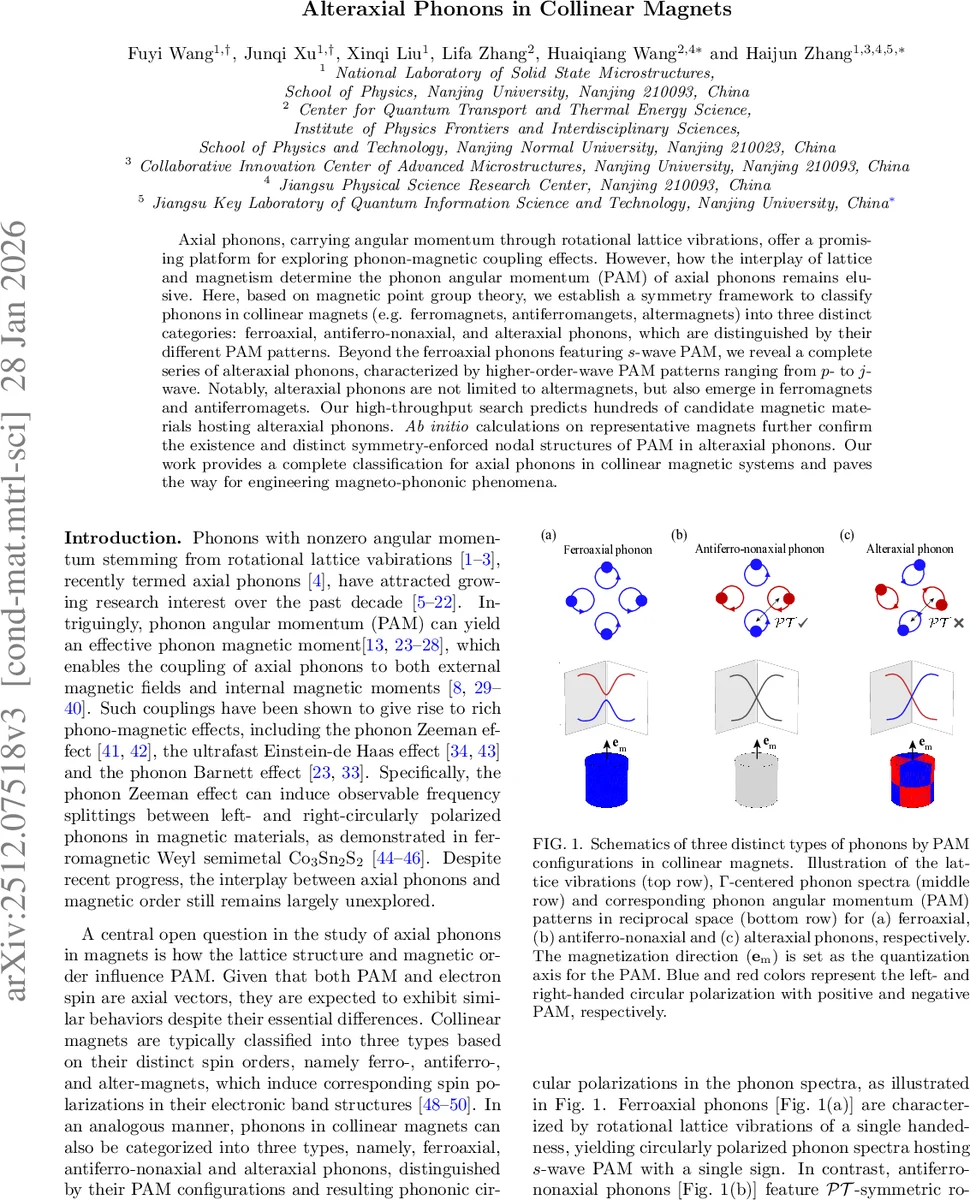
Axial phonons, carrying angular momentum through rotational lattice vibrations, offer a promising platform for exploring phonon-magnetic coupling effects. However, how the interplay of lattice and magnetism determine the phonon angular momentum (PAM) of axial phonons remains elusive. Here, based on magnetic point group theory, we establish a symmetry framework to classify phonons in collinear magnets (e.g. ferromagnets, antiferromangets, altermagnets) into three distinct categories: ferroaxial, antiferro-nonaxial, and alteraxial phonons, which are distinguished by their different PAM patterns. Beyond the ferroaxial phonons featuring $s$-wave PAM, we reveal a complete series of alteraxial phonons, characterized by higher-order-wave PAM patterns ranging from $p$- to $j$-wave. Notably, alteraxial phonons are not limited to altermagnets, but also emerge in ferromagnets and antiferromagets. Our high-throughput search predicts hundreds of candidate magnetic materials hosting alteraxial phonons. Ab initio calculations on representative magnets further confirm the existence and distinct symmetry-enforced nodal structures of PAM in alteraxial phonons. Our work provides a complete classification for axial phonons in collinear magnetic systems and paves the way for engineering magneto-phononic phenomena.
💡 Research Summary
This paper establishes a comprehensive symmetry‑based classification of axial phonons—lattice vibrations that carry angular momentum (phonon angular momentum, PAM)—in collinear magnetic materials. Using magnetic point‑group (MPG) theory, the authors show that the interplay between crystal symmetry and magnetic order determines whether a phonon mode possesses non‑zero PAM and, if so, what spatial pattern that PAM adopts. They identify three distinct phonon families in collinear magnets (ferromagnets, antiferromagnets, and altermagnets): (i) ferroaxial phonons, which exhibit an s‑wave (uniform sign) PAM; (ii) antiferro‑nonaxial phonons, which are forced to have zero PAM everywhere because combined parity‑time (PT) symmetry is preserved; and (iii) alteraxial phonons, a newly defined class that displays higher‑order wave‑like PAM patterns ranging from p‑ to j‑wave.
The key insight is that the presence or absence of PT symmetry, together with the specific MPG, dictates the parity (even or odd) of the PAM wave function. When PT is broken, PAM can be non‑zero. If the MPG contains an operation for which the product η(T)χ(R)=−1 (where η(T) is the time‑reversal character and χ(R) the handedness‑preserving character of the spatial operation), symmetry enforces a set of nodal surfaces in the Brillouin zone where PAM vanishes. The number of such surfaces—an integer from 1 to 7, termed the “MPG integer”—directly maps to the angular momentum wave order: one surface corresponds to p‑wave, two to d‑wave, up to seven for j‑wave. Conversely, if no operation yields η(T)χ(R)=−1, PAM retains a single sign throughout the Brillouin zone, giving rise to the ferroaxial s‑wave case.
To demonstrate the practical relevance of this framework, the authors performed high‑throughput screening of 1,029 collinear magnetic compounds extracted from the MAGNDATA and Materials Project databases. Each material’s crystal and magnetic structures were used to assign an MPG, which then uniquely determines its phonon class. The statistical outcome shows that 60.2 % of the compounds host antiferro‑nonaxial phonons (PT‑symmetric), while the remaining 39.8 % host axial phonons: 26.3 % are centrosymmetric even‑wave (ferroaxial), 9.0 % are non‑centrosymmetric odd‑wave, and 4.5 % are non‑centrosymmetric even‑wave. In total, 237 materials are identified as candidates for alteraxial phonons, encompassing both odd‑ and even‑wave patterns.
Three representative materials are examined with first‑principles density‑functional perturbation theory (DFPT) supplemented by a perturbative spin‑phonon coupling that explicitly breaks time‑reversal symmetry. (1) CrSb (MPG 6′/m′mm′) is a centrosymmetric even‑wave altermagnet. Without the T‑breaking term, its phonon spectrum respects PT and shows zero PAM (antiferro‑nonaxial). Introducing the spin‑phonon perturbation yields a g‑wave PAM pattern with four symmetry‑enforced nodal surfaces crossing Γ (three vertical surfaces linked by C₃z and one horizontal surface enforced by C₂z T). (2) Cr₂SbAs (MPG 6′m′2) lacks inversion symmetry, leading to a non‑centrosymmetric odd‑wave (f‑wave) PAM pattern with three vertical nodal surfaces; the f‑wave character persists after adding the T‑breaking term. (3) MnSe (MPG 6′mm′) exhibits a non‑centrosymmetric even‑wave (g‑wave) PAM pattern with two nodal surfaces. In all cases, the calculated phonon dispersions and PAM distributions around the Γ point clearly illustrate the predicted higher‑order waveforms and the symmetry‑protected nodal structures.
The paper’s contributions are fourfold: (i) a complete MPG‑based taxonomy of axial phonons in collinear magnets, (ii) the theoretical prediction that alteraxial phonons can realize p‑ to j‑wave angular momentum textures, (iii) a large‑scale materials search identifying hundreds of realistic candidates, and (iv) first‑principles verification of the existence and symmetry‑enforced nodal topology of alteraxial phonons. By revealing how lattice vibrations can acquire complex angular momentum textures dictated by magnetic symmetry, this work opens new avenues for exploiting phonon‑magnetic coupling phenomena such as phonon Zeeman splitting, ultrafast Einstein‑de Haas torque, and phonon Barnett effects, with potential impact on spintronic, magnonic, and quantum information technologies.
Comments & Academic Discussion
Loading comments...
Leave a Comment