Large-time Behavior for a Cutoff Level-Set Mean Curvature G-equation with Source term
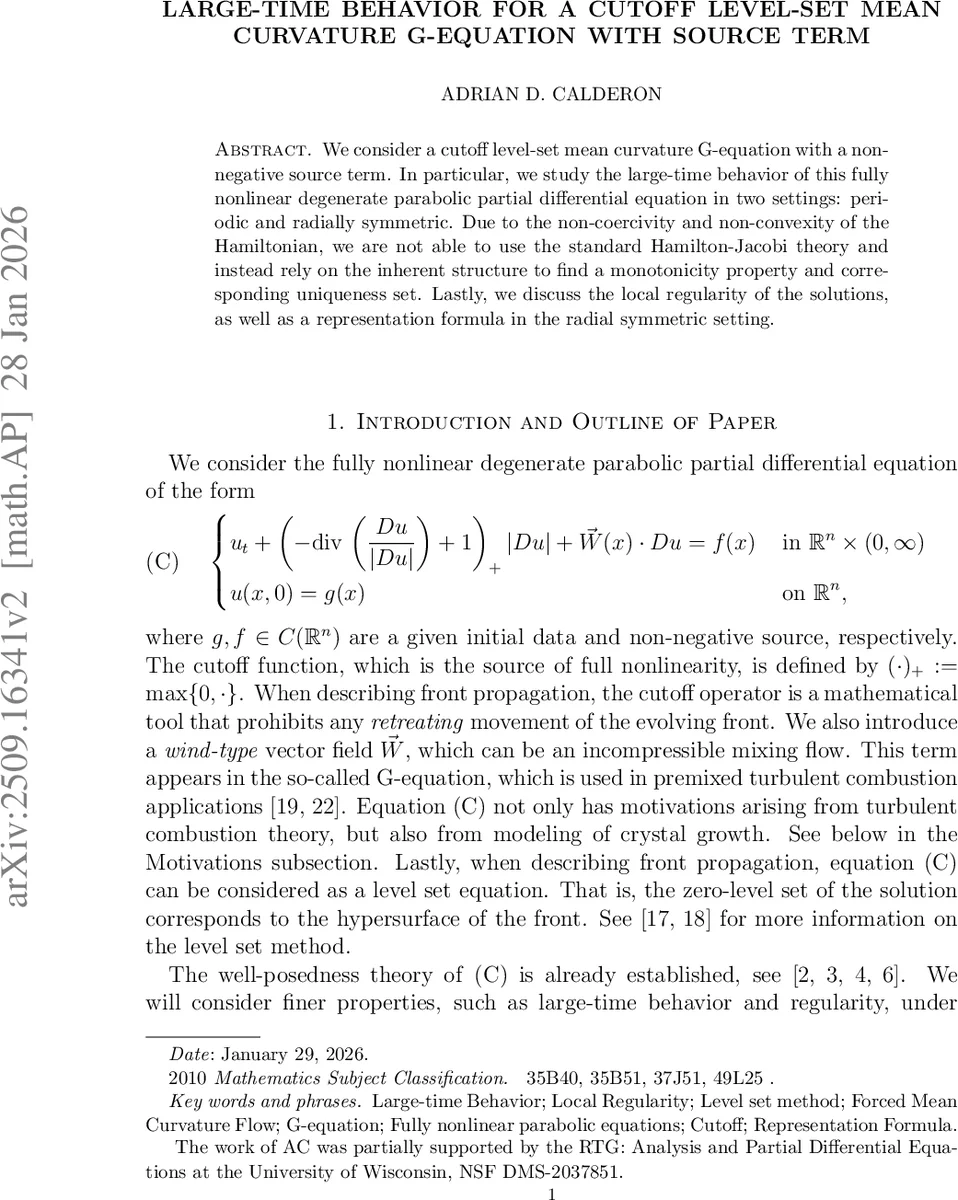
We consider a cutoff level-set mean curvature G-equation with a non-negative source term. In particular, we study the large-time behavior of this fully nonlinear degenerate parabolic partial differential equation in two settings: periodic and radially symmetric. Due to the non-coercivity and non-convexity of the Hamiltonian, we are not able to use the standard Hamilton-Jacobi theory and instead rely on the inherent structure to find a monotonicity property and corresponding uniqueness set. Lastly, we discuss the local regularity of the solutions, as well as a representation formula in the radial symmetric setting.
💡 Research Summary
The paper investigates the long‑time asymptotics of a fully nonlinear degenerate parabolic PDE that models a cutoff level‑set mean‑curvature flow with a non‑negative source term. The equation, written in the form
u_t + (−div(Du/|Du|)·D²u) + (|Du|)⁺ + W(x)·Du = f(x) in ℝⁿ×(0,∞),
with initial data u(x,0)=g(x), incorporates three essential ingredients: (i) a curvature‑driven diffusion term (the mean‑curvature operator), (ii) a cutoff nonlinearity (·)⁺ = max{0,·} that prevents “re‑burning’’ of already burnt regions, and (iii) an advective wind field W(x) that models turbulent flow. The source f(x)≥0 represents fuel supply (in combustion) or material deposition (in crystal growth).
Because the Hamiltonian associated with this PDE is neither coercive nor convex, the classical Hamilton‑Jacobi theory—particularly the ergodic cell problem and large‑time convergence results—cannot be applied directly. The authors therefore develop a new analytical framework based on two structural observations:
-
Monotonicity of the cutoff term: wherever the source vanishes (f=0) the equation reduces to u_t = –W·Du ≤ 0, so the solution is non‑increasing in time on that set. This set, denoted A, is called the Aubry set. Under the standing assumptions (P1)–(P3) for the periodic case (f,g∈C(Tⁿ), W∈Lip(Tⁿ), A⊂{W=0} and A∩{W=0}=∅), A is both a monotonicity region and a uniqueness set for the stationary problem.
-
Comparison principle on the Aubry set: Lemma 2.1 shows that if a viscosity subsolution v and a supersolution w of the stationary equation agree on A (v≤w on A), then v≤w everywhere on the torus. The proof uses a λ‑scaling argument (considering λw with λ>1), the Crandall‑Ishii Lemma (Theorem of Sums), and a careful analysis of the matrix inequality involving the anisotropic diffusion matrix a_{ij}(p)=δ_{ij}−p_ip_j/|p|². By sending λ→1⁺ a contradiction is obtained unless the inequality holds globally.
With this comparison principle in hand, the authors consider the half‑relaxed limits u⁺(x)=limsup*{t→∞}u(x,t) and u⁻(x)=liminf*{t→∞}u(x,t). Proposition 2.2 establishes that u⁺ and u⁻ are respectively a sub‑ and supersolution of the stationary ergodic problem (E). Lemma 2.1 then forces u⁺=u⁻, yielding a unique continuous limit v(x) on Tⁿ. Consequently, Theorem 1.1 proves uniform convergence u(x,t)→v(x) as t→∞ for the periodic setting.
The second part of the paper treats the radially symmetric case. Here the data depend only on the radius r=|x|: f(x)=F(r), g(x)=G(r) with F∈C¹(
Comments & Academic Discussion
Loading comments...
Leave a Comment