An $H^1$ multiplier theorem on anisotropic spaces
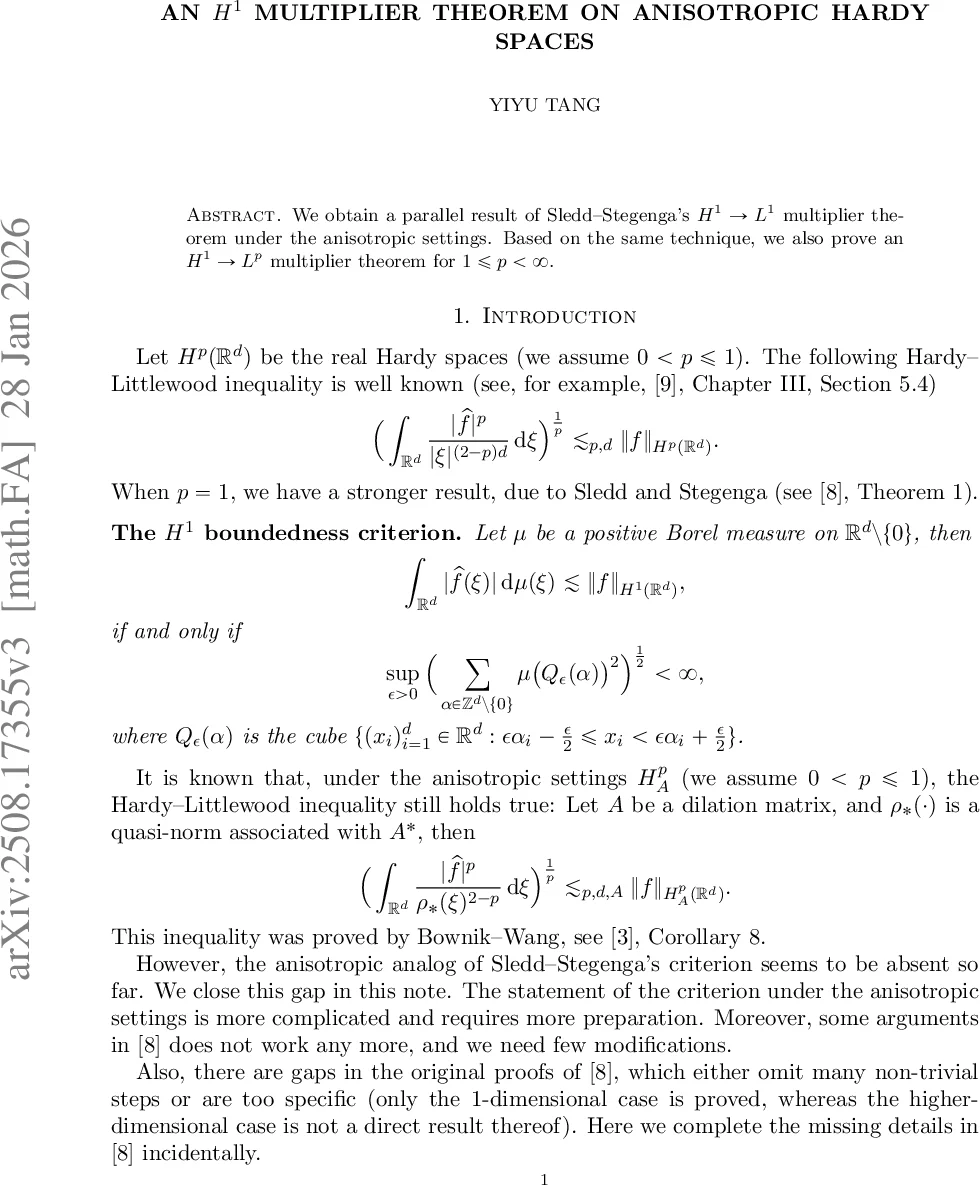
A parallel result of (the classical) Sledd–Stegenga’s $H^1\rightarrow L^1$ multiplier theorem was obtained on the $H^1$ space under the anisotropic settings. Based on the same technique, an $H^1\rightarrow L^p$ multiplier theorem is also proved for $1\leq p<\infty$.
💡 Research Summary
The paper establishes a complete analogue of the classical Sledd–Stegenga H¹→L¹ multiplier theorem in the setting of anisotropic Hardy spaces H¹_A, where A is a dilation matrix whose eigenvalues all have modulus greater than one. The authors first recall the necessary background on anisotropic dilations, the associated homogeneous quasi‑norm ρ_A, and the construction of ellipsoidal “balls” Δ_k = A^kΔ that replace Euclidean balls in this context. Using these geometric objects they define the anisotropic Hardy space H¹_A via a smooth maximal function and give its atomic decomposition: an H¹_A‑atom is supported in a translate of some Δ_k, bounded by |Δ_k|^{-1} and has zero mean.
The main result (Theorem 4.1) provides a necessary and sufficient condition on a positive Borel measure μ on ℝ^d for the inequality
∫{ℝ^d} |ĥf(ξ)| dμ(ξ) ≲ ‖f‖{H¹_A}
to hold for all f∈H¹_A. The condition is expressed as a lattice‑sum bound:
sup_{k∈ℤ} ∑_{α∈ℤ^d} μ(A^Δ_k ∩ R^_α)^{1/2} < ∞,
where A^* is the transpose of A, Δ^* the dual ellipsoid, R^* the smallest axis‑aligned rectangle containing Δ^, and R^_α denotes the translate of R^* by the integer vector α. This condition captures how μ distributes mass relative to the anisotropic geometry induced by A.
The proof of sufficiency proceeds by testing the inequality on H¹_A‑atoms. A key Fourier‑transform estimate for atoms, due to Bownik–Wang, shows that |â(ξ)| is bounded by a constant times b_k · ρ_{A^*}(ξ)^{-1} when ξ lies outside a dilated ellipsoid of scale b^k. The μ‑integral is split into two regions: the “near” region A^Δ_k∩(N_k R^) and its complement. For the near region, Proposition 4.2 supplies a finite covering by O(N_k) translates of rectangles, allowing the use of Cauchy–Schwarz together with the lattice‑sum condition (4.2). For the far region, the decay of the atom’s Fourier transform is exploited, and a higher‑dimensional version of the Sledd–Stegenga inequality (Proposition 4.4) is applied to control supremum norms over rectangles. This proposition, proved in detail for d=2 and sketched for higher dimensions, fills a gap in the original Sledd–Stegenga work. Combining these estimates yields the desired bound for each atom, and the atomic decomposition then gives the full inequality.
The necessity of the lattice‑sum condition is shown using Bochner–Riesz multipliers m_λ(ξ) = (1−|ξ|²)_+^λ with λ>0. The explicit inverse Fourier transform involves a Bessel function and satisfies a pointwise decay estimate. If (4.2) fails, one can construct a sequence of dilated ellipsoids on which the Bochner–Riesz multiplier violates the H¹_A→L¹_A bound, contradicting the assumed inequality. Hence (4.2) is also necessary.
With the same machinery, the authors extend the result to H¹_A→L^p multipliers for any 1≤p<∞. The same lattice‑sum condition appears, now multiplied by a p‑dependent constant, yielding
∫{ℝ^d} |ĥf(ξ)|^p dμ(ξ) ≲ ‖f‖{H¹_A}^p.
The paper also addresses several shortcomings of the original Sledd–Stegenga paper: it supplies the missing higher‑dimensional proof of the key inequality, clarifies steps that were omitted, and corrects minor gaps. Moreover, the authors discuss the duality between H¹_A and anisotropic BMO, showing that the measure condition can be interpreted in terms of BMO norms.
Overall, the work completes the anisotropic multiplier theory by providing a clean geometric criterion for measures that render the Fourier transform bounded from H¹_A into L^p spaces, thereby deepening the connection between anisotropic harmonic analysis, Hardy space theory, and multiplier problems.
Comments & Academic Discussion
Loading comments...
Leave a Comment