Effects of quantum geometry on the decoherence induced by black holes
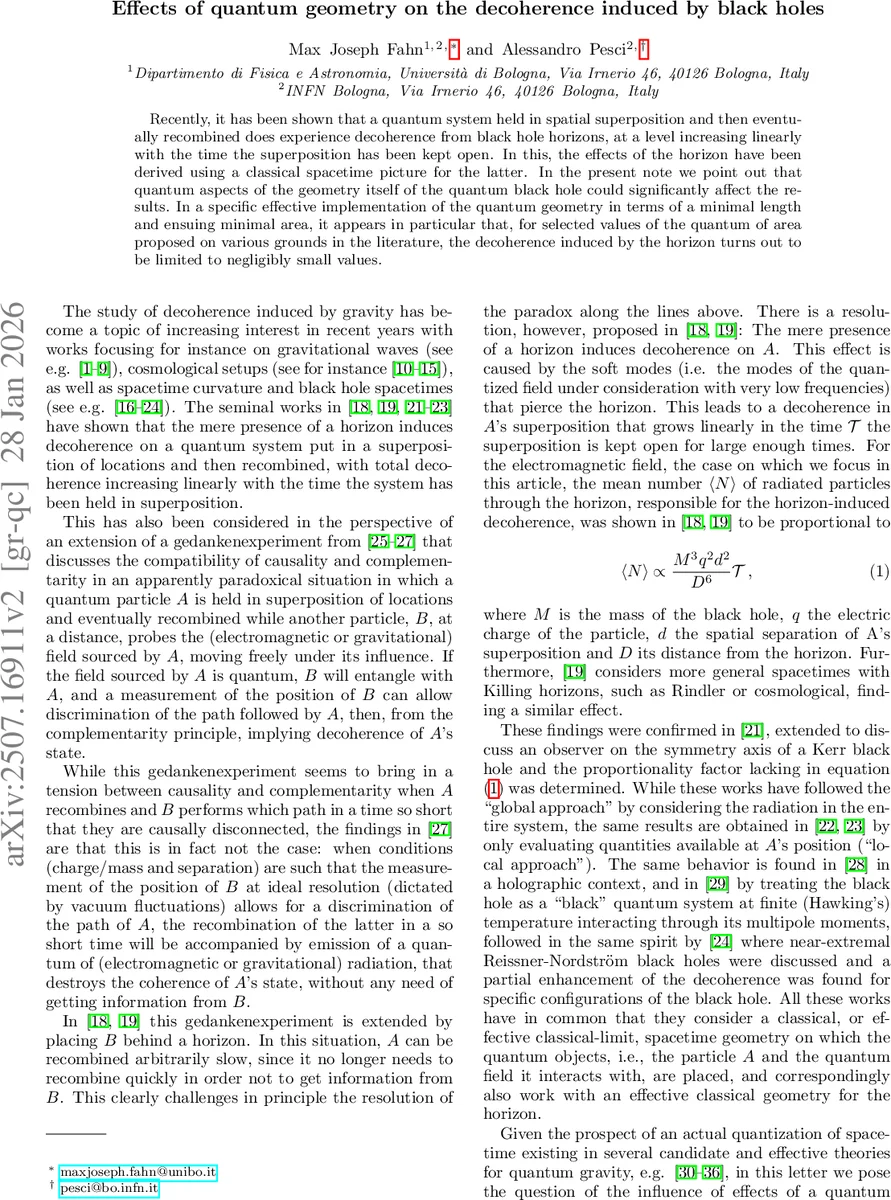
Recently, it has been shown that a quantum system held in spatial superposition and then eventually recombined does experience decoherence from black hole horizons, at a level increasing linearly with the time the superposition has been kept open. In this, the effects of the horizon have been derived using a classical spacetime picture for the latter. In the present note we point out that quantum aspects of the geometry itself of the quantum black hole could significantly affect the results. In a specific effective implementation of the quantum geometry in terms of a minimal length and ensuing minimal area, it appears in particular that, for selected values of the quantum of area proposed on various grounds in the literature, the decoherence induced by the horizon turns out to be limited to negligibly small values.
💡 Research Summary
The paper revisits the recent claim that a quantum system placed in a spatial superposition and later recombined suffers decoherence due to the presence of a black‑hole horizon, with the decoherence functional growing linearly with the time the superposition is kept open. All previous works (e.g., Refs.
Comments & Academic Discussion
Loading comments...
Leave a Comment