Convergence analysis of SPH method on irregular particle distributions for the Poisson equation
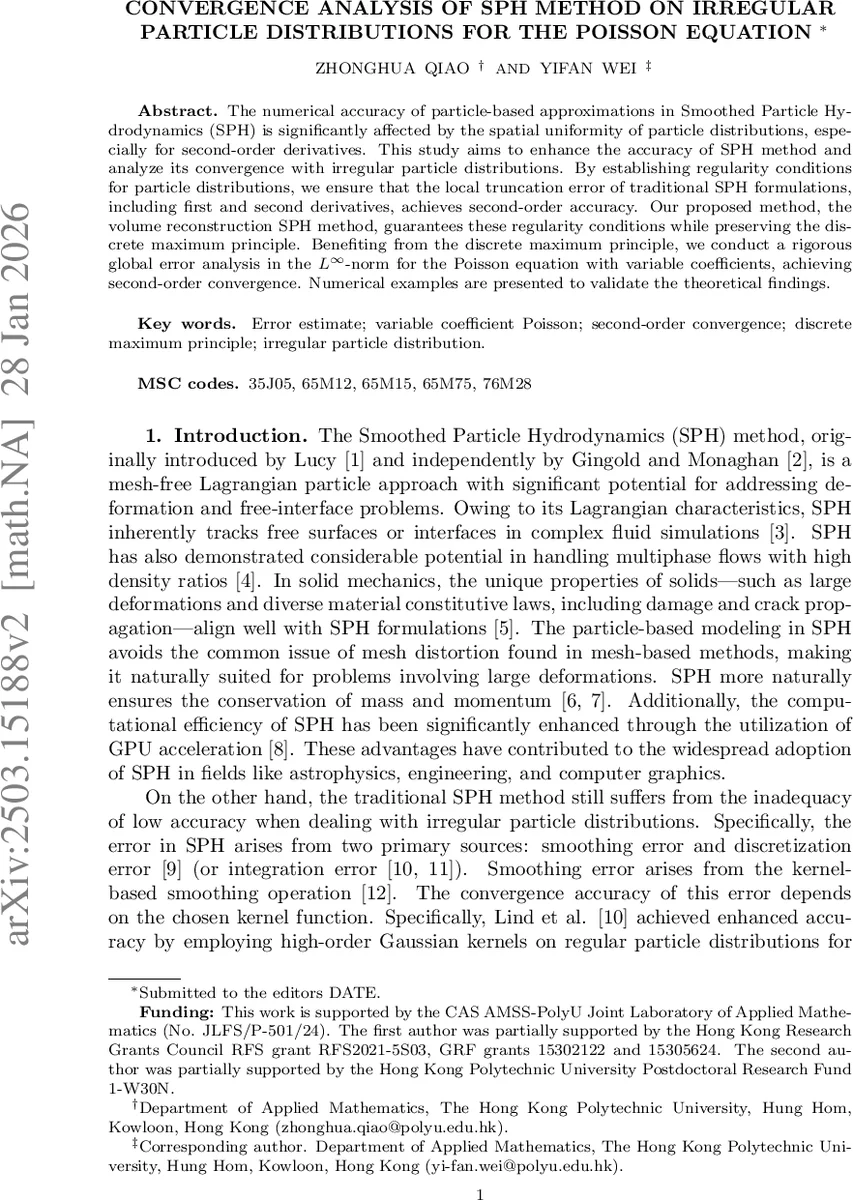
The numerical accuracy of particle-based approximations in Smoothed Particle Hydrodynamics (SPH) is significantly affected by the spatial uniformity of particle distributions, especially for second-order derivatives. This study aims to enhance the accuracy of SPH method and analyze its convergence with irregular particle distributions. By establishing regularity conditions for particle distributions, we ensure that the local truncation error of traditional SPH formulations, including first and second derivatives, achieves second-order accuracy. Our proposed method, the volume reconstruction SPH method, guarantees these regularity conditions while preserving the discrete maximum principle. Benefiting from the discrete maximum principle, we conduct a rigorous global error analysis in the $L^\infty$-norm for the Poisson equation with variable coefficients, achieving second-order convergence. Numerical examples are presented to validate the theoretical findings.
💡 Research Summary
The paper addresses a fundamental limitation of Smoothed Particle Hydrodynamics (SPH): the degradation of accuracy when particles are distributed irregularly, especially for second‑order derivatives. The authors first formulate precise regularity conditions for particle distributions. These conditions require that (i) particle volumes approximate the true physical volume within O(h^d), (ii) the local neighborhood of each particle be approximately radially symmetric, and (iii) the ratio of inter‑particle distance to the smoothing length h remain bounded. Under these assumptions they prove that the traditional SPH kernel approximation and its discrete particle summation both achieve a local truncation error of O(h^2) for function values, gradients, and Laplacians.
To enforce the regularity conditions in practice, the authors introduce a Volume Reconstruction SPH (VRSPH) method. VRSPH recomputes each particle’s volume by weighting neighboring particles with the kernel function and then normalizing so that the sum of kernel weights equals one. This reconstruction guarantees the regularity conditions even for highly non‑uniform particle sets and, crucially, preserves the discrete maximum principle (DMP). The DMP ensures that the numerical solution never exceeds the prescribed boundary bounds, which is essential for a rigorous L∞‑norm error analysis.
The core analytical contribution is a global error estimate for the variable‑coefficient Poisson problem ∇·(a(x)∇u)=f with homogeneous Dirichlet boundary conditions. By leveraging the DMP to establish stability of the discrete operator and using the O(h^2) local consistency, the authors apply a Lax‑Richtmyer type framework to derive ‖u−u_h‖_{∞} ≤ C h^2, where C depends only on the bounds of a(x) and the C^2‑norm of f. This result is the first provable second‑order convergence in the maximum norm for SPH on irregular particle distributions.
Extensive numerical experiments validate the theory. Three particle configurations are tested: (i) a uniform grid, (ii) a randomly perturbed grid, and (iii) a clustered distribution that mimics typical SPH instabilities. For each case the traditional SPH exhibits sub‑first‑order convergence as the irregularity increases, whereas VRSPH consistently attains second‑order convergence. Moreover, when the coefficient a(x) varies sharply, the DMP remains intact, preventing overshoots or undershoots in the numerical solution. The empirical convergence rates match the theoretical O(h^2) prediction.
In summary, the paper makes three major contributions: (1) a rigorous proof that traditional SPH can achieve second‑order accuracy under well‑defined regularity conditions; (2) the development of the VRSPH scheme that enforces these conditions and preserves the discrete maximum principle; (3) a complete L∞‑norm error analysis for the variable‑coefficient Poisson equation, establishing second‑order global convergence on irregular particle sets. The work bridges a long‑standing gap between practical SPH implementations and their mathematical convergence theory, and it opens avenues for extending the approach to higher‑order operators, nonlinear PDEs, and coupled fluid‑structure problems.
Comments & Academic Discussion
Loading comments...
Leave a Comment