The "Robert Boulton" Singularity: Semantic Tunneling and Manifold Unfolding in Recursive AI
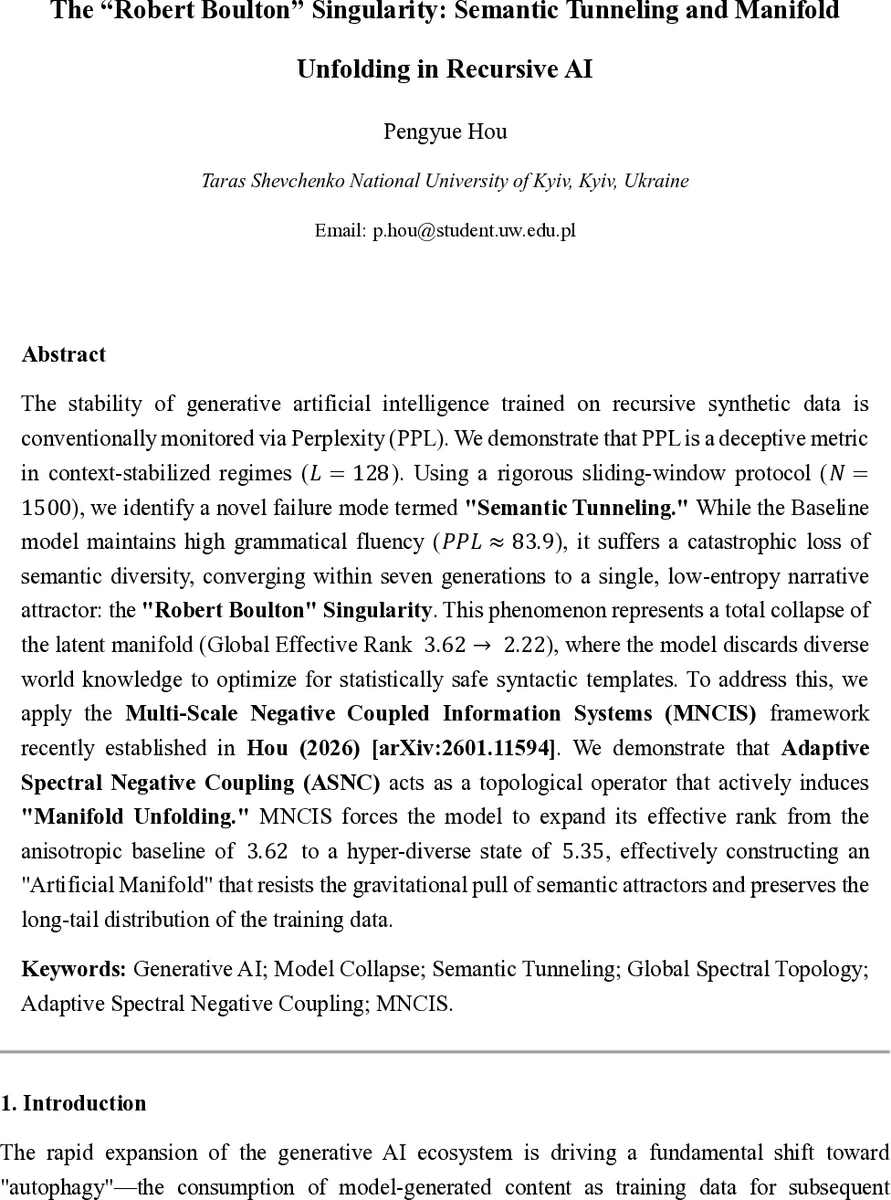
The stability of generative artificial intelligence trained on recursive synthetic data is conventionally monitored via Perplexity (PPL). We demonstrate that PPL is a deceptive metric in context-stabilized regimes (L=128). Using a rigorous sliding-window protocol (N=1500), we identify a novel failure mode termed “Semantic Tunneling.” While the Baseline model maintains high grammatical fluency (PPL approx. 83.9), it suffers a catastrophic loss of semantic diversity, converging within seven generations to a single, low-entropy narrative attractor: the “Robert Boulton” Singularity. This phenomenon represents a total collapse of the latent manifold (Global Effective Rank 3.62 -> 2.22), where the model discards diverse world knowledge to optimize for statistically safe syntactic templates. To address this, we apply the Multi-Scale Negative Coupled Information Systems (MNCIS) framework recently established in Hou (2026) [arXiv:2601.11594]. We demonstrate that Adaptive Spectral Negative Coupling (ASNC) acts as a topological operator that actively induces “Manifold Unfolding.” MNCIS forces the model to expand its effective rank from the anisotropic baseline of 3.62 to a hyper-diverse state of 5.35, effectively constructing an “Artificial Manifold” that resists the gravitational pull of semantic attractors and preserves the long-tail distribution of the training data.
💡 Research Summary
The paper titled “The ‘Robert Boulton’ Singularity: Semantic Tunneling and Manifold Unfolding in Recursive AI” investigates a previously unnoticed failure mode in generative language models that are trained on recursively generated synthetic data. While conventional evaluation metrics such as Perplexity (PPL) suggest that the model remains fluent and syntactically correct, the authors demonstrate that the model’s latent semantic space collapses over successive generations, converging on a single, low‑entropy narrative about a fictitious figure named “Robert Boulton.” They name this phenomenon “Semantic Tunneling.”
To detect and quantify this collapse, the authors introduce a novel metric called Global Effective Rank (GER). GER is computed by taking the hidden‑state representations from the final transformer layer, forming a covariance matrix, extracting its singular values, normalizing them into a probability distribution, and finally calculating the exponential of the Shannon entropy of that distribution. A high GER indicates a high‑dimensional, diverse latent manifold, whereas a low GER signals that the manifold has collapsed into a few dominant directions. Using a sliding‑window protocol (stride = 512, window size = 1500 tokens) on the WikiText‑2 test set, they track both PPL and GER across fifteen generations of a GPT‑2‑based model with a fixed context length L = 128.
The baseline experiment shows that after only seven generations the GER drops from 3.62 to 2.22, while PPL remains around 84. This indicates that the model continues to produce grammatically plausible sentences but has lost the ability to express the long‑tail distribution of world knowledge. Qualitative inspection reveals that virtually all generated passages describe the same biographical sketch of “Robert Boulton,” confirming the existence of a semantic attractor. The authors argue that traditional PPL alone is insufficient for monitoring long‑term semantic health in recursive generation pipelines.
To counteract Semantic Tunneling, the paper adopts the Multi‑Scale Negative Coupled Information Systems (MNCIS) framework recently proposed by Hou (2026). Within MNCIS, the authors implement Adaptive Spectral Negative Coupling (ASNC), a topological operator that regularizes the Gram matrix of selected hidden layers toward the identity matrix. Concretely, for each chosen layer they compute the normalized hidden vectors, form the Gram matrix G = hhᵀ, and add a mean‑squared‑error loss between G and the identity matrix, scaled by a hyper‑parameter asnc_strength = 0.5. This encourages the hidden representations to occupy an isotropic hypersphere, thereby “unfolding” the latent manifold and preventing it from collapsing onto a low‑dimensional attractor. The training loop alternates between standard language‑model cross‑entropy loss and the ASNC regularizer, with gradient clipping and a modest learning rate (1e‑5).
Experimental results show that the MNCIS‑augmented model maintains a much higher GER throughout the recursive process, rising from the baseline 3.62 to 5.35 by the final generation. While the PPL curves for baseline and MNCIS models are similar (both remain in the low‑80 range), the GER trajectory diverges dramatically: the baseline plateaus near 2.2, whereas the MNCIS model continues to increase, indicating sustained semantic diversity. Qualitative samples from the MNCIS runs display a variety of topics and avoid the single‑story collapse observed in the baseline. The authors visualize these trends in side‑by‑side plots of GER and log‑scaled PPL across generations.
The paper also discusses the conceptual significance of “Manifold Unfolding.” Unlike conventional regularization techniques (L2 weight decay, dropout, layer‑norm), ASNC directly manipulates the topology of the representation space, expanding its intrinsic dimensionality rather than merely penalizing parameter magnitude. This topological perspective aligns with recent theoretical work on information geometry and suggests a new avenue for ensuring long‑term stability of generative systems.
Nevertheless, the study has several limitations. First, the GER metric, while intuitive, is highly sensitive to batch size, sampling strategy, and the specific layer chosen for analysis; the authors provide limited ablation to assess robustness. Second, the sliding‑window PPL evaluation only covers the first 50 k tokens (≈10 % of the test set), which may not fully capture the model’s behavior on the entire distribution. Third, the emergence of the “Robert Boulton” narrative is not explained beyond being a statistical attractor; a deeper linguistic or cultural analysis could clarify why this particular token sequence dominates. Fourth, the MNCIS/ASNC framework relies on a pre‑print (Hou 2026) that has not yet undergone peer review, and the paper offers scant theoretical justification for why negative spectral coupling should guarantee manifold expansion in practice. Fifth, reproducibility details (random seeds, exact data preprocessing, optimizer settings) are sparse, making it difficult for independent researchers to replicate the results.
In summary, the paper makes a valuable contribution by highlighting that conventional fluency metrics can mask catastrophic semantic collapse in recursively trained language models. It proposes a novel rank‑based diagnostic (GER) and a topological regularizer (ASNC) that demonstrably mitigates the collapse, preserving a richer latent manifold. While the empirical evidence is compelling, the methodological foundations require further validation, and broader experiments across model sizes, data domains, and alternative regularization schemes are needed to establish the generality of the findings. Future work should explore more robust manifold‑complexity metrics, investigate the interplay between semantic diversity and downstream task performance, and assess the computational overhead of ASNC in large‑scale production settings.
Comments & Academic Discussion
Loading comments...
Leave a Comment