Control systems for synthetic biology and a case-study in cell fate reprogramming
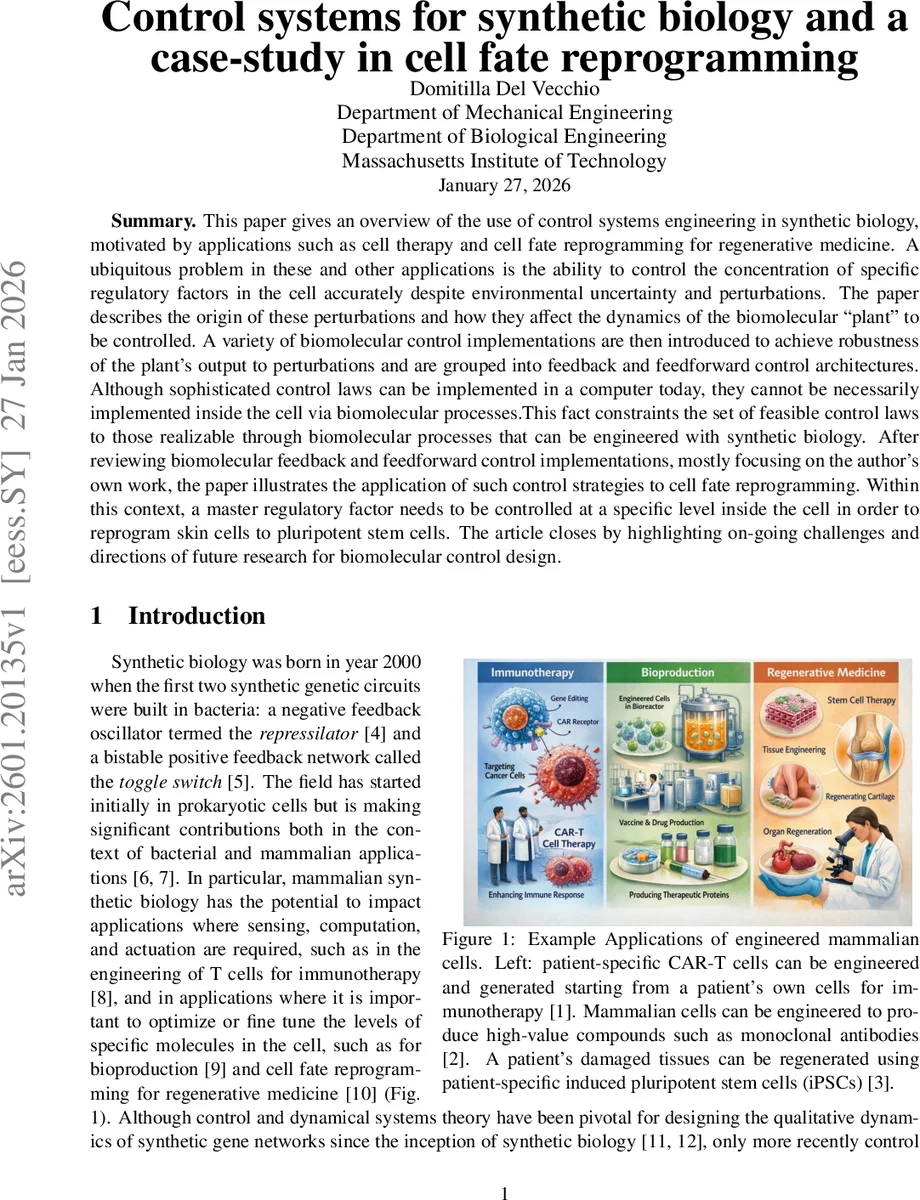
This paper gives an overview of the use of control systems engineering in synthetic biology, motivated by applications such as cell therapy and cell fate reprogramming for regenerative medicine. A ubiquitous problem in these and other applications is the ability to control the concentration of specific regulatory factors in the cell accurately despite environmental uncertainty and perturbations. The paper describes the origin of these perturbations and how they affect the dynamics of the biomolecular ``plant’’ to be controlled. A variety of biomolecular control implementations are then introduced to achieve robustness of the plant’s output to perturbations and are grouped into feedback and feedforward control architectures. Although sophisticated control laws can be implemented in a computer today, they cannot be necessarily implemented inside the cell via biomolecular processes. This fact constraints the set of feasible control laws to those realizable through biomolecular processes that can be engineered with synthetic biology. After reviewing biomolecular feedback and feedforward control implementations, mostly focusing on the author’s own work, the paper illustrates the application of such control strategies to cell fate reprogramming. Within this context, a master regulatory factor needs to be controlled at a specific level inside the cell in order to reprogram skin cells to pluripotent stem cells. The article closes by highlighting on-going challenges and directions of future research for biomolecular control design.
💡 Research Summary
The manuscript provides a comprehensive overview of how control‑systems engineering can be integrated into synthetic biology to achieve precise regulation of intracellular regulatory factors, a requirement that underlies many emerging therapeutic applications such as CAR‑T cell therapy, monoclonal antibody production, and induced pluripotent stem cell (iPSC) generation. The authors begin by describing the pervasive problem of environmental and intracellular perturbations that disturb the concentration of target proteins. These perturbations arise from three main sources: (i) the endogenous gene‑regulatory network (GRN) that adds an uncontrolled transcriptional component, (ii) competition for limited transcriptional and translational resources (RNA polymerases, ribosomes, degradation enzymes), and (iii) retroactivity caused by downstream binding of the output protein to its targets.
To formalize the problem, the paper introduces a simple deterministic ODE model (Equations 1‑2) in which the state variables are the mRNA concentration (m) and the protein concentration (X). Production rates are expressed as functions of free resource pools (R_T_X for transcription, R_T_L for translation) and a copy‑number factor α. Disturbances are captured by additive terms H_GRN (transcriptional disturbance) and r (retroactivity). Although the model neglects stochasticity and subcellular compartmentalization, it is widely used and matches experimental data sufficiently for the purpose of controller design.
Control architectures are grouped into two families: feedback and feed‑forward. The feedback family focuses on integral feedback, which guarantees perfect adaptation (zero steady‑state error) for step disturbances. The authors detail a mammalian implementation of an integral controller that uses a synthetic transcriptional repressor/activator pair to integrate the error between a reference value v and the measured output y. The controller dynamics are realized through the reversible binding of a regulator protein to a promoter, effectively performing the mathematical integration in the biochemical domain. Experimental validation shows that, when the controller is active, the output protein X returns to the set‑point despite large perturbations in transcriptional resources or GRN activity, whereas an unregulated construct exhibits large deviations.
Feed‑forward designs are presented as complementary strategies that anticipate disturbances. In the described schemes, a sensor module detects a specific disturbance (e.g., a change in resource availability) and directly modulates the translation rate of the target gene, thereby pre‑emptively compensating for the expected deviation. While feed‑forward control can achieve rapid disturbance rejection when the disturbance model is accurate, it lacks the robustness of integral feedback when the disturbance is mis‑estimated.
The central case study applies these concepts to cellular reprogramming: converting human skin fibroblasts into iPSCs by maintaining the transcription factor OCT4 at a precise concentration. The authors construct a synthetic gene circuit that expresses OCT4 under the control of the integral feedback module described above. To mitigate resource competition, a dedicated “resource pool” module is co‑expressed, sequestering ribosomes and polymerases away from competing endogenous genes. In vitro experiments demonstrate that the feedback‑controlled OCT4 expression remains within a narrow band around the desired set‑point across a range of perturbations, leading to a two‑fold increase in reprogramming efficiency compared with a constitutive OCT4 expression construct.
The discussion acknowledges several limitations. First, the disturbance model (H_GRN, r) is only partially known, making controller tuning challenging for heterogeneous cell populations. Second, cell‑to‑cell variability in DNA copy number (α) and resource pools can cause divergent circuit behavior. Third, long‑term stability of the synthetic controller through multiple cell divisions and differentiation steps remains to be demonstrated. Fourth, the metabolic burden imposed by the controller may affect cell viability and therapeutic efficacy.
Future research directions proposed include: (1) integrating model‑based design with machine‑learning‑driven parameter estimation to handle uncertainty; (2) extending the control framework to multi‑scale systems that couple molecular dynamics with tissue‑level behavior; (3) employing CRISPR‑based genome editing to embed permanent, low‑burden control modules; and (4) developing automated design‑build‑test pipelines that incorporate quantitative control metrics for large‑scale therapeutic cell manufacturing. By addressing these challenges, the authors argue that biomolecular control theory can move from proof‑of‑concept demonstrations toward reliable, clinically relevant synthetic biology applications.
Comments & Academic Discussion
Loading comments...
Leave a Comment